TUPE measures letter template

£14.99

UK-specific • Editable • Instant download • 12 months' updates

A TUPE measures letter provides a clear and structured way for an employer to explain proposed measures that may affect employees as part of a TUPE transfer. It helps set out what is expected to change, why the changes are being considered and how employees or their representatives can contribute to the consultation process.

Use this template to:
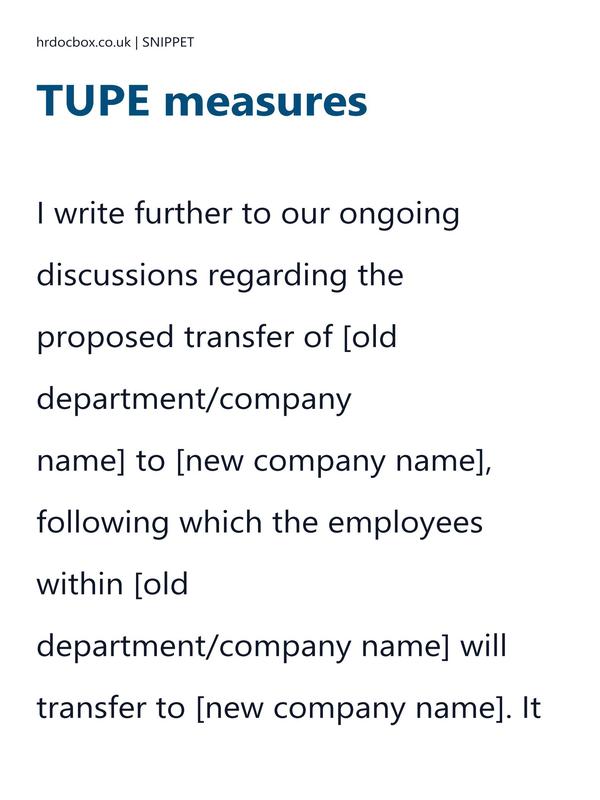
  • Explain proposed measures associated with a TUPE transfer.
  • Set out how employees may be affected by the proposed changes.
  • Explain the reasons for the proposed measures.
  • Provide information about working arrangements, location, reporting lines or other changes.
  • Support consultation with employee representatives or affected employees.
  • Invite questions, suggestions and alternative proposals.
  • Create a clear written record of the information provided during the TUPE process.
TUPE measures letter template
2026 Reviewed

What's included in this template?

This template brings together the key information, sections and considerations you need to create a clear, comprehensive and professional HR document. Preview the document below.

  • TUPE transfer and employee details
  • Summary of the proposed measures
  • Reasons for the proposed changes
  • Potential impact on employees
  • Working arrangements and organisational changes
  • Consultation arrangements
  • Employee representative details
  • Questions, feedback and alternative proposals
  • Next steps and contact information
Specifications
Access 12 months (includes updates)
Length 2 pages • 330 words
Jurisdiction England, Wales and Scotland
Based on UK employment law, ACAS guidance
Last review 23/08/2026
Next review 23/02/2027
Delivery Instant download
Formats .doc · .txt · email

Download .doc

Copy [to paste]

Email
Template

[Sender name]

[Sender address]

[date]

[Recipient name]

[Recipient address]


Dear [Recipient first name],

Proposed TUPE transfer - measures

Private and Confidential

As you are aware, [Company Name] is proposing to transfer [business / service / undertaking] to [New Employer] under the Transfer of Undertakings (Protection of Employment) Regulations 2006 (TUPE).

The proposed transfer is expected to take place on [Transfer Date].

As part of the transfer process, we are providing information about any measures that [New Employer / the business] envisages taking which may affect employees transferring as part of the TUPE process.

Proposed measures

Proposed measure: Potential impact on employees: Reason for measure:
PREVIEW ENDS HERE

This is the end of the preview

You've seen just 30% of how the TUPE measures letter template is structured. Get the complete editable template instantly and customise it for your organisation.

£14.99

Need the complete TUPE process?

Explore the TUPE templates toolkit

What is a TUPE measures letter?

TUPE measures letter template preview

A TUPE measures letter is used to explain changes that an employer expects may affect employees in connection with a TUPE transfer. Measures can include changes to working patterns, location, reporting structures, payroll arrangements, pensions, working practices or other aspects of the employees' working environment.

The letter gives employees or their representatives a clear written explanation of the proposed measures, the reasons behind them and how the consultation process will operate. It is therefore an important communication document within the wider TUPE process.

What is it used for?

The letter is primarily used to provide clear information about proposed measures and support meaningful consultation. It can help employees understand what the incoming or outgoing employer is proposing and provide a useful basis for questions, concerns and alternative suggestions.

It should not be treated as a way of simply announcing changes that have already been decided. Where consultation is required, the employer should genuinely consider representations made by employees or their representatives.

Who needs a TUPE measures letter?

The template is designed for employers, HR professionals and managers involved in a TUPE transfer where measures are expected to affect employees. It can be adapted for communication with recognised trade union representatives, elected employee representatives or employees where direct consultation is permitted.

What counts as a TUPE measure?

A measure is broadly a change that is likely to affect employees transferring under TUPE. Examples can include changes to working hours, workplace location, job duties, reporting structures, payroll dates, working practices or organisational arrangements.

The appropriate content will depend on the particular transfer. The template therefore provides a framework for identifying the specific measures rather than assuming that every TUPE transfer will involve the same changes.

Example

A facilities management contract is transferring from one service provider to another. The employees who work on the contract will transfer to the incoming provider under TUPE.

The incoming employer intends to introduce a different payroll date, change the reporting structure and introduce a new electronic scheduling system. It also expects employees to attend a different site for some administrative activities, although their normal operational location will remain unchanged.

HR works with the incoming employer to identify each proposed measure and consider how it may affect transferring employees. The information is provided to the outgoing employer so that it can be communicated to the affected employees and their representatives as part of the TUPE process.

The measures letter explains each proposed change, why it is being considered and how employees can raise questions or suggest alternatives. During consultation, employee representatives raise concerns about the proposed payroll date because of the impact on employees with existing direct debits.

The incoming employer considers the concern and decides to retain the existing payroll date for the first three months after the transfer while the new payroll arrangements are reviewed. The outcome is communicated to representatives and the affected employees.

The letter has therefore supported a genuine consultation process rather than simply documenting changes that had already been imposed.

The wider HR process

Related HR resources and workflow

Explore the HR resources that may be relevant before and / or after using the TUPE measures letter, helping you understand the wider process, maintain appropriate documentation and follow a consistent approach.

Previous
Letters
Request for information about TUPE measures letter

If TUPE is proposed, send this model letter to the incoming employer to request information about whether they intend to take any measures in relation to any of the transferring employees.

This
TUPE measures letter
Next
Letters
TUPE request to check personal information letter

If TUPE is confirmed, send this model letter to any affected employee to request that they check their personal information before you send it to the incoming employer.

Premium content

To continue reading, purchase this item or a parent toolkit, library or our full library.

Implementation guidance

Use these best practice actions, recommended timescales and process stages to understand when and how the TUPE measures letter should be used, helping ensure each step is handled consistently and appropriately documented.

Step Description Responsibility Timing (Days from Issue)
1 Identify TUPE Measures: Establish the measures the incoming or outgoing employer envisages taking that may affect transferring employees, including changes to working arrangements, location, reporting structures or other employment practices. HR / Management Day -30 to Day -21
2 Prepare the Information: Confirm the reasons for each proposed measure, the potential impact on employees and the information that needs to be provided to employee representatives or affected employees. HR / Management Day -21 to Day -14
3 Prepare and Issue the Measures Letter: Complete the TUPE Measures Letter with the transfer details, proposed measures, reasons and consultation arrangements, and provide it to the appropriate representatives or employees. HR / Employer Day -14 to Day 0
4 Consult on the Measures: Hold consultation meetings, answer questions and consider concerns, suggestions and alternative proposals raised by employees or their representatives. HR / Management / Representatives Day 1 onwards
5 Confirm the Outcome: Review the consultation feedback, confirm any changes to the proposed measures and communicate the final position before the TUPE transfer takes place. HR / Management Before Transfer Date
Premium content

To continue reading, purchase this item or a parent toolkit, library or our full library.

Common mistakes

Understand the common mistakes to avoid when using this HR template, helping you reduce risk, prevent unnecessary costs and ensure the process is handled correctly.

  • Confusing the duty to inform employees about the transfer with the separate requirement to consult about measures.
  • Listing proposed measures without explaining their likely impact or the reasons behind them.
  • Presenting proposed measures as final decisions before consultation has taken place.
  • Failing to involve the correct trade union or employee representatives, or to check whether direct consultation is permitted.
  • Providing the information too late to allow meaningful consultation before the transfer.
  • Failing to properly consider or respond to suggestions raised by employees or their representatives.
Premium content

To continue reading, purchase this item or a parent toolkit, library or our full library.

HR considerations

UK employment law and best practice

This template is designed to support the process, but the document should be used alongside the relevant HR procedure and applied to the circumstances of the individual case.

The Transfer of Undertakings (Protection of Employment) Regulations 2006 (TUPE) place specific obligations on employers to inform and, where required, consult affected employees or their representatives about a transfer and measures that may affect them. Acas describes informing and consulting as a legal obligation and emphasises that consultation should be genuine and meaningful. :contentReference[oaicite:1]{index=1}

What must employees be told?

The information provided should cover the fact that the transfer is taking place, when it is expected to happen and why. It should also include any measures that the new employer envisages taking which may affect transferring employees, together with the legal, economic and social implications of the transfer. :contentReference[oaicite:2]{index=2}

Examples of measures can include changes to working hours, workplace location, pay dates, working patterns, pension arrangements, reporting structures or possible redundancies. The measures letter provides a practical way of setting out this information clearly rather than leaving employees to interpret the implications themselves. :contentReference[oaicite:3]{index=3}

Who should be informed and consulted?

Where there is a recognised trade union, the appropriate union representatives should be involved. Where there is no recognised union, affected employees should normally be represented by appropriate employee representatives, subject to the rules that allow direct consultation in certain smaller organisations or transfers. :contentReference[oaicite:4]{index=4}

The changes introduced from 1 July 2024 allow employers to consult employees directly where the employer has fewer than 50 employees or fewer than 10 employees are transferring, subject to the conditions in TUPE. Employers should therefore check which consultation route applies rather than automatically assuming that representatives must be elected. :contentReference[oaicite:5]{index=5}

What does meaningful consultation involve?

Acas states that consultation must be genuine and meaningful. Employers should listen to representatives and affected employees, seriously consider their responses and suggestions and try to reach agreement where possible. An employer does not have to accept every suggestion, but it should be able to demonstrate that proposals were properly considered. :contentReference[oaicite:6]{index=6}

This is why a measures letter should describe proposals rather than presenting every measure as an irreversible decision. Where a suggestion is rejected, good practice is to explain the reasoning rather than simply stating that the proposal will not be adopted.

When should consultation take place?

There is no fixed statutory consultation period for TUPE. Acas states that employers must allow enough time to inform and fully consult before the transfer and recommends starting the process as early as possible. The appropriate period will depend on the size and complexity of the transfer and the nature of the proposed changes. :contentReference[oaicite:7]{index=7}

Responsibilities of the incoming and outgoing employer

Both the old and new employers have responsibilities under TUPE. The new employer must provide information about measures it envisages taking to the old employer, which must then pass the relevant information to representatives of affected employees. :contentReference[oaicite:8]{index=8}

In practice, both employers should coordinate their communications carefully so that employees receive accurate and consistent information. Acas also recommends that employers agree what will be communicated before meetings to avoid misunderstandings. :contentReference[oaicite:9]{index=9}

Who counts as an affected employee?

The consultation requirements can extend beyond employees who are transferring. Acas identifies affected employees as including transferring employees, employees remaining with the old employer whose work is affected by colleagues transferring out and employees already working for the new employer whose work is affected by incoming employees. :contentReference[oaicite:10]{index=10}

Employers should therefore consider the wider organisational impact rather than limiting their assessment to the employees whose contracts are moving between employers.

Consequences of failing to inform and consult

Failure to comply with TUPE information and consultation obligations can result in employment tribunal claims. Acas states that compensation can be up to 13 weeks' uncapped gross pay for each affected employee, depending on the circumstances. The old and new employers can also face liability. :contentReference[oaicite:11]{index=11}

A well-prepared measures letter cannot, by itself, satisfy the full TUPE consultation obligation. It should form part of a wider process that includes appropriate representatives, timely information, genuine consultation and proper consideration of responses.

Good TUPE practice

Good practice is to communicate early, use clear language, make information accessible and provide routes for employees to ask questions and raise concerns. Acas also recommends ensuring affected employees can access information, including employees who are absent or who may need reasonable adjustments to access the information. :contentReference[oaicite:12]{index=12}

The measures letter therefore works best as one part of a structured TUPE communication process, supported by consultation records, meeting notes and clear evidence of how employee and representative feedback has been considered.

You may also need these resources

FAQs

What is a TUPE measures letter?

A written document explaining proposed measures that may affect employees transferring under TUPE. Acas distinguishes these measures from the general information employees must receive about the transfer itself. :contentReference[oaicite:13]{index=13}

What counts as a measure under TUPE?

Measures can include changes likely to affect employees, such as working patterns, location, pay dates, reporting structures, pensions, working practices or redundancies. :contentReference[oaicite:14]{index=14}

Does a TUPE measures letter replace consultation?

No. The letter supports the information stage, but consultation must be genuine and meaningful, with employee or representative views properly considered. :contentReference[oaicite:15]{index=15}

How early should TUPE consultation begin?

There is no fixed statutory period, but Acas says employers should start as early as possible and allow enough time to fully inform and consult before the transfer. :contentReference[oaicite:16]{index=16}

Why use an HRDocBox TUPE measures letter?

It provides a structured starting point informed by TUPE, ACAS guidance and practical HR experience, helping employers communicate proposed measures clearly while keeping the wider consultation process in view.

Why use HRDocBox rather than asking AI to write one?

AI can produce a plausible TUPE letter, but the difficult part is understanding what needs to be communicated and how it fits into the legal process. HRDocBox combines deep HR knowledge, practical application and years of experience with UK employment-law and best-practice considerations.

How this content is developed and reviewed

The TUPE measures letter template is developed using a practical HR methodology that considers current UK employment legislation, ACAS guidance, CIPD good practice and the real-world HR process it supports. Templates are regularly reviewed and updated, with additional reviews triggered by significant changes to legislation, guidance or established HR practice, helping ensure each document remains practical, relevant and suitable for UK employers.

About the author

Darryl Horn, Chartered HR Director

Darryl is a Chartered HR professional with over 25 years' experience in senior HR and employee relations roles.

He has extensive practical experience of managing tupe processes and founded hrdocbox to provide businesses with practical, professionally developed HR resources grounded in UK employment law and best practice.

HRDocBox has been creating practical UK HR documents since 2009.

Executive recommendation

"Darryl provides support and advice with excellent judgement, and has a strong understanding of people, policies and UK employment legislation."

"He is someone I trust; consistent, dependable, and committed to doing things properly."

RB
Ruth Brock Chief Executive Officer The Hygiene Bank
Get started today

HR confidence starts here

Whether you employ 5 people or 50, hrdocbox gives you the structure, documents and expertise needed to manage employees professionally and legally.

Download your FREE UK employment contract template

Professionally written and fully compliant with UK employment law

Download FREE contract
Free UK employment contract template