Capability meeting script template

Quick preview
£9.99
5.0
Customer reviews 1 review
UK-specific Editable Instant download 12 months' updates

This Capability Meeting Script provides a structured framework for managers to conduct a formal capability meeting where concerns have been identified about an employee’s performance. It guides the discussion through the performance concerns, evidence, support provided, employee response, improvement expectations and next steps.

Use this script to:
  • Prepare and structure a formal capability meeting
  • Explain performance concerns clearly and objectively
  • Give the employee a proper opportunity to respond
  • Explore any barriers, support needs or reasonable adjustments
  • Agree improvement objectives, support and timescales
  • Create a clear record of the meeting and agreed next steps
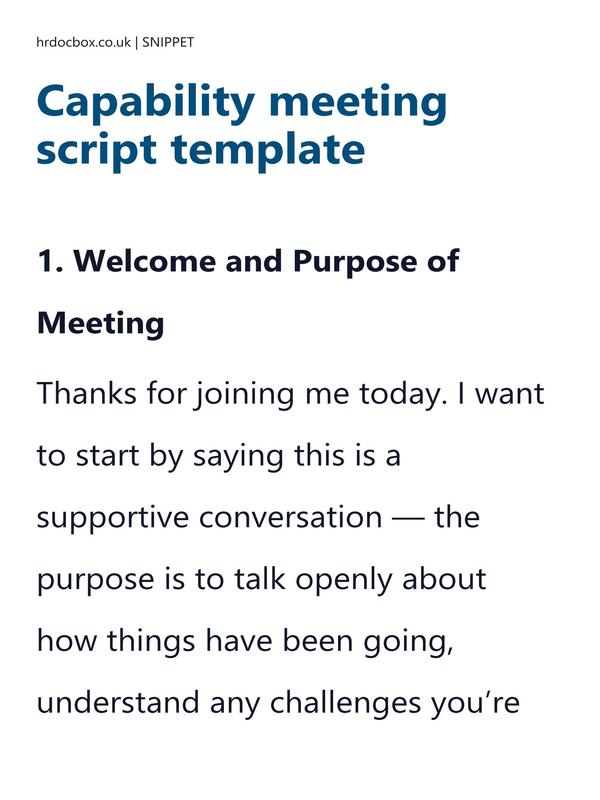
Capability meeting script template
2026 Reviewed
Get the complete resource

Don't just buy one template — get the complete Disciplinary templates toolkit

If you are managing a disciplinary process, the toolkit brings together practical HR templates covering investigations, hearings, warnings, appeals and outcomes.

50 templates • £24.99 • 12 months' access & updates
View the complete toolkit

What's included in this template?

This template brings together the key information, sections and considerations you need to create a clear, comprehensive and professional HR document. Preview the document below.

  • Employee and meeting details
  • Opening and explanation of the capability process
  • Performance concerns and supporting evidence
  • Questions about barriers, support and adjustments
  • Improvement objectives, support and review timescales
  • Meeting notes, actions and next steps
Template

Download .doc

Copy [to paste]

Email

Meeting details

Employee name  
Job title  
Department / team  
Line manager  
Meeting date  
Meeting time  
Meeting location / method  
Meeting chaired by  
HR representative, if applicable  
Employee companion, if applicable  

1. Purpose of the meeting

Manager introduction

Thank you for attending this meeting.

The purpose of today's meeting is to discuss concerns regarding your performance in your role and to give you an opportunity to respond to those

PREVIEW ENDS HERE

This is the end of the preview

You've seen 10% of how the Capability meeting script template is structured. Get the complete editable template instantly and customise it for your organisation.

£9.99
Specifications
Access 12 months, with updates
Length 3 pages • 1,211 words
Jurisdiction England, Wales, Scotland
Based on UK law, ACAS guidance
Last update 23/09/2026
Update reason Clarity and usability update.
Next review 23/03/2027
Delivery & Format Instant digital delivery, .doc · .txt · email

What is a capability meeting script?

Capability meeting script template preview

This document provides managers with a practical structure for holding a formal capability meeting. It is designed to keep the discussion focused on the employee’s ability to meet the required standard while giving them a genuine opportunity to explain their position and identify any support that may help them improve.

Explaining the performance concern

The script helps the manager explain the required standard, the areas where performance is falling short and the evidence supporting the concerns. This encourages a discussion based on specific examples rather than general statements about an employee’s performance.

Understanding the employee’s perspective

The employee is given an opportunity to respond to each concern, explain any difficulties and provide information that may not have been known to the manager. This can help identify whether the issue is genuinely one of capability or whether another factor needs to be addressed.

Considering support and adjustments

The meeting provides prompts to explore training, coaching, resources, workload, management support and any health or disability-related issues. Where appropriate, reasonable adjustments should be considered before decisions about an employee’s capability are made.

Agreeing improvement expectations

Where improvement is required, the document helps the manager establish clear and measurable expectations, appropriate support and realistic review dates. These can form part of a performance improvement plan where appropriate.

Recording the outcome

The document provides space to record the employee’s responses, actions, responsibilities and next steps. A written record helps both parties understand what was discussed and what is expected before the next review.

Example

A Production Manager has concerns about an employee’s performance in relation to production accuracy, completion of allocated work and adherence to the required working process. The concerns have previously been discussed informally and the employee has received additional coaching.

The manager invites the employee to a formal capability meeting, explains the areas of concern and provides examples of where the required standard has not been achieved. The manager then asks the employee to respond to each concern rather than immediately assuming that the performance issue is simply a lack of effort.

The employee explains that they are struggling with one part of the production process because they have not received sufficient training on a recently introduced machine. The manager recognises that this is relevant and agrees additional training and supervised practice before the employee is expected to meet the full production standard.

The manager and employee agree three measurable improvement objectives, together with weekly review meetings over the following six weeks. The manager records the agreed support, the standards required and the date of the next formal review.

The completed meeting record is retained with the employee’s capability documentation and a copy of the agreed objectives is provided to the employee.

Implementation guidance

Use these best practice actions, recommended timescales and process stages to understand when and how the Capability meeting script should be used, helping ensure each step is handled consistently and appropriately documented.

Step Description Responsibility Timing
1 Prepare the performance evidence, required standards, previous discussions, support provided and any relevant documentation before the meeting. Manager / HR At least 2–5 working days before meeting
2 Hold the capability meeting, explain the concerns and give the employee a reasonable opportunity to respond and provide information. Manager / Employee On scheduled meeting date
3 Explore the reasons for the performance difficulties and consider whether training, resources, workload, health issues or reasonable adjustments are relevant. Manager / Employee / HR During meeting
4 Agree clear improvement objectives, support, responsibilities and review dates, or explain the next formal stage where sufficient improvement has not been achieved. Manager / Employee During meeting / within 2 working days
5 Provide a written record of the discussion and monitor progress against the agreed objectives and timescales. Manager / HR Within 2–5 working days / ongoing
Premium content

To continue reading, purchase this item or a parent toolkit, library or our full library.

Common mistakes

Understand the common mistakes to avoid when using this HR template, helping you reduce risk, prevent unnecessary costs and ensure the process is handled correctly.

  • Using vague statements such as “your performance is not good enough” without specific evidence
  • Doing most of the talking and failing to give the employee a genuine opportunity to respond
  • Assuming the problem is capability without exploring possible underlying causes
  • Failing to consider training, resources or reasonable adjustments
  • Setting unrealistic or unmeasurable improvement objectives
  • Failing to provide the employee with a written record of what was agreed
Premium content

To continue reading, purchase this item or a parent toolkit, library or our full library.

HR considerations

UK employment law and best practice

This template is designed to support the process, but the document should be used alongside the relevant HR procedure and applied to the circumstances of the individual case.

Capability and performance

Capability concerns relate to an employee’s ability to perform their job to the required standard. Employers should first seek to understand the reasons for poor performance and consider appropriate support, including training, coaching and adequate resources.

https://www.acas.org.uk/performance-management/problems-with-an-employees-performance

Fair procedure

Where capability concerns are dealt with formally, employers should follow a fair procedure. The employee should understand the concerns, have an opportunity to respond and be given a reasonable opportunity to improve before dismissal is considered.

https://www.acas.org.uk/performance-management/dismissals-for-capability-or-conduct

Formal meeting and evidence

Where a formal meeting could result in a warning or other formal action, the employee should be given sufficient information about the performance concerns and reasonable time to prepare. Relevant evidence should be provided where appropriate.

https://www.acas.org.uk/acas-code-of-practice-on-disciplinary-and-grievance-procedures/html

Right to be accompanied

Where the capability meeting could result in a formal warning or other disciplinary action, the employee has a statutory right to be accompanied by a fellow worker, an appropriate trade union representative or an official employed by a trade union, provided they make a reasonable request. Employers should also check their own capability procedure, which may provide broader rights.

https://www.acas.org.uk/acas-code-of-practice-on-disciplinary-and-grievance-procedures/html

Performance improvement plans

A performance improvement plan can be used to set specific objectives, a reasonable timeframe and the support or training required. Employees should understand what improvement is expected and how progress will be assessed.

https://www.acas.org.uk/performance-management/problems-with-an-employees-performance

Disability and reasonable adjustments

Where performance difficulties may be connected to a disability, employers should consider whether reasonable adjustments are required. Adjustments may include changes to working arrangements, additional time, equipment, training or other measures that remove or reduce a disadvantage experienced by the employee.

https://www.acas.org.uk/supporting-disabled-people/capability-and-performance-when-someone-is-disabled

https://www.gov.uk/reasonable-adjustments-for-disabled-workers

Keeping records

Employers should keep written records of performance discussions, agreed objectives and support provided. The employee should normally be given a copy of the record so that both parties have a clear understanding of what was discussed and agreed.

https://www.acas.org.uk/performance-management

Dismissal as a last resort

If performance does not improve despite appropriate support and a reasonable opportunity to improve, dismissal may ultimately be considered. Employers should have evidence of the performance concerns and the steps taken to support improvement, and should consider whether there are reasonable alternatives before dismissal.

https://www.acas.org.uk/performance-management/dismissals-for-capability-or-conduct

You may also need these resources

FAQs

Is a capability meeting the same as a disciplinary meeting?

Not necessarily. Capability concerns relate to an employee’s ability to perform their role, while disciplinary matters normally concern conduct. A formal capability procedure may nevertheless follow similar principles of fairness, including giving the employee an opportunity to respond and providing a right of appeal where formal action is taken.

Can an employee bring someone to a capability meeting?

Where the meeting could result in a formal warning or other disciplinary action, there is a statutory right to be accompanied following a reasonable request. The organisation’s own capability procedure may also provide a right to accompaniment at other capability meetings.

What should a manager ask during a capability meeting?

The manager should explain the specific concerns, ask the employee for their response, explore possible reasons for the performance difficulties, consider what support may be required and establish whether there are any health, disability or other relevant factors that need to be considered.

Should a performance improvement plan be agreed at the meeting?

Where improvement is required, the meeting can be used to agree or refine a performance improvement plan. Objectives should be specific and measurable, with realistic timescales and clear information about the support available.

Should the manager make a decision during the meeting?

Not necessarily. Where the meeting is part of a formal process, it may be appropriate to adjourn so that the manager can consider the evidence and the employee’s response before deciding on the appropriate outcome.

Why use HRDocBox rather than AI?

HRDocBox templates provide a structured starting point based on UK HR practice and employment requirements. This script helps managers cover the important elements of a capability discussion consistently while still allowing the conversation to respond to the individual circumstances.

Customer reviews

What people are saying

Back to product

Useful when time was tight when time was tight

Mei Chen • 17 Sep 2026

It helped give managers confidence when they had not dealt with the situation before. It gave us a consistent approach without making every conversation sound identical.

How this content is developed and reviewed

The Capability meeting script template is developed using a practical HR methodology that considers current UK employment legislation, ACAS guidance, CIPD good practice and the real-world HR process it supports. Templates and supporting information are regularly reviewed and updated, with additional reviews triggered by significant changes to legislation, guidance or established HR practice, helping ensure each document remains practical, relevant and suitable for UK employers.

About the author

Darryl Horn, Chartered HR Director

Darryl is a Chartered HR professional with over 25 years' experience in senior HR and employee relations roles.

He has extensive practical experience of managing disciplinary HR processes and founded hrdocbox to provide businesses with practical, professionally developed HR resources grounded in UK employment law and best practice.

HRDocBox has been creating practical UK HR documents since 2009.

Executive recommendation

"Darryl provides support and advice with excellent judgement, and has a strong understanding of people, policies and UK employment legislation."

"He is someone I trust; consistent, dependable, and committed to doing things properly."

RB
Ruth Brock Chief Executive Officer The Hygiene Bank
Get started today

HR confidence starts here

Whether you employ 5 people or 50, hrdocbox gives you the structure, documents and expertise needed to manage employees professionally and legally.

Download your FREE UK employment contract template

Professionally written and fully compliant with UK employment law
Download FREE contract
Free UK employment contract template