Mediation meeting script template

£9.99
UK-specific Editable Instant download 12 months' updates

This Mediation Meeting Script provides a structured framework for managing a workplace mediation meeting between employees who are experiencing a conflict or disagreement. It helps the mediator establish expectations, hear each person's perspective, identify areas of agreement and work towards practical steps for improving the working relationship.

Use this script to:

  • Open a mediation meeting and establish clear ground rules
  • Give each person an opportunity to explain their perspective
  • Identify the issues and areas of disagreement
  • Support constructive discussion and agree practical next steps
Mediation meeting script template
2026 Reviewed

What's included in this template?

This template brings together the key information, sections and considerations you need to create a clear, comprehensive and professional HR document. Preview the document below.

  • Opening and explaining the purpose of mediation
  • Ground rules and expectations for the discussion
  • Questions for exploring each person's perspective
  • Prompts for identifying issues and areas of agreement
  • Framework for agreeing practical actions
  • Closing the meeting and confirming next steps

Your complete Grievance resource

Templates. Knowledge. Guidance. Everything you need, all in one place.

Explore the Grievance templates toolkit
Template

Download .doc

Copy [to paste]

Email

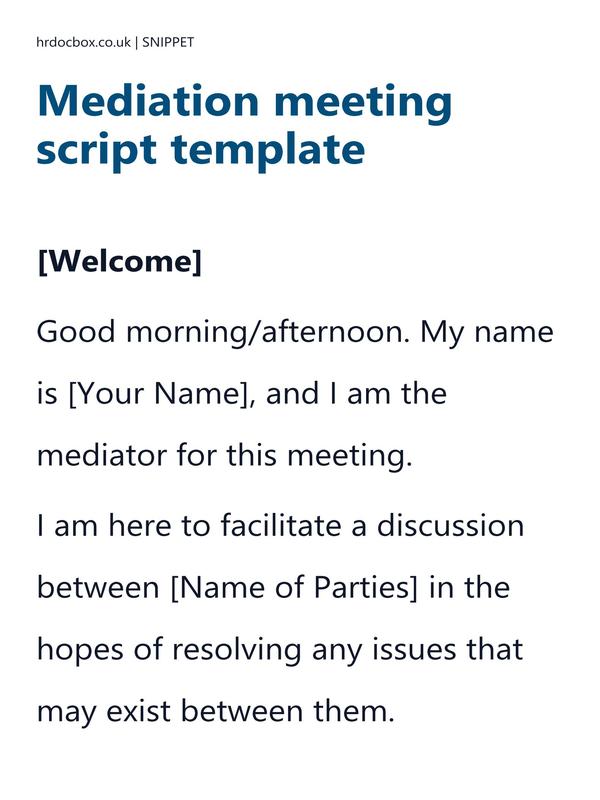
1   Opening the meeting

1.1   Thank you both for attending today. The purpose of this meeting is to provide an opportunity for you to discuss the difficulties you have been experiencing in your working relationship and to see whether we can agree some practical ways forward.

1.2   My role today is to facilitate the discussion. I am not here to decide who is right or wrong, and I will give each of you a fair opportunity to explain your perspective.

1.3   I would like us to focus on understanding what has happened, the impact it has had and what might help improve the working relationship going forward.

2   Ground rules

2.1   Before we begin, I would like us to agree some basic ground rules. Please allow each other to speak without interruption, listen to what the other person is saying and avoid personal criticism or inappropriate language.

2.2   I may intervene if I feel that the discussion is becoming unproductive or if one person is not being given a fair opportunity to speak.

2.3   We should also respect the confidential nature of the discussion, subject to any circumstances where information may need to be shared for an appropriate legal, safeguarding or other organisational reason.

2.4   Are you both comfortable proceeding on that basis?

3   Employee 1's perspective

[Employee 1], I would like to give you an opportunity to explain how you

PREVIEW ENDS HERE

This is the end of the preview

You've seen 40% of how the Mediation meeting script template is structured. Get the complete editable template instantly and customise it for your organisation.
£9.99
Specifications
Access 12 months, with updates
Length 2 pages • 564 words
Jurisdiction England, Wales, Scotland
Based on UK law, ACAS guidance
Last review 16/09/2026
Next review 16/03/2027
Delivery Instant digital delivery
Formats .doc · .txt · email

What is a mediation meeting script?

Mediation meeting script template preview

This Mediation Meeting Script provides a practical framework for facilitating a structured conversation where employees are experiencing workplace conflict or difficulties in their working relationship. It helps the mediator remain neutral while giving each person an opportunity to be heard.

Opening the mediation

The mediator can explain the purpose of the meeting, their role and the intended outcome. Establishing clear expectations at the beginning helps create a respectful environment in which the participants can discuss the issues openly.

Establishing ground rules

The meeting can begin with agreed ground rules covering respectful communication, listening without interruption, confidentiality and allowing each participant a fair opportunity to contribute. The mediator can intervene where discussion becomes unproductive or confrontational.

Understanding each person's perspective

Each participant should have an opportunity to explain what has happened from their perspective and describe the impact the situation has had on them. The mediator can use open questions to clarify points without taking sides or deciding who is right.

Exploring the issues

The mediator can help identify the underlying issues, distinguish facts from perceptions and explore where the participants' views differ. The focus should be on understanding the problem and its impact rather than allocating blame.

Agreeing practical steps

Where the participants are able to reach agreement, the mediator can help them identify realistic actions to improve the working relationship. This may include changes to communication, agreed boundaries, practical working arrangements or commitments from both individuals.

Example

Two employees have experienced ongoing disagreements about communication and the division of work within their team. Their manager believes that a facilitated discussion may help them address the issues before the relationship deteriorates further.

Before the meeting, the mediator speaks to each employee separately to explain the purpose of mediation and confirm that both understand the process. The mediator makes clear that their role is to facilitate the discussion rather than decide who is right or wrong.

During the meeting, each employee explains their perspective without interruption. The mediator asks questions to clarify what has happened and helps them identify that some of the conflict has resulted from different expectations about communication and responsibility for particular tasks.

The employees agree to raise concerns directly with each other rather than through colleagues, clarify responsibilities at the start of shared projects and have a short weekly check-in for the next month. The mediator records the agreed actions and arranges a follow-up discussion to review how the arrangements are working.

The wider HR process

Related HR resources and workflow

Explore the HR resources that may be relevant before and / or after using the Mediation meeting script, helping you understand the wider process, maintain appropriate documentation and follow a consistent approach.

Previous
Letters
Mediation meeting invitation letter

Our Mediation Meeting Invitation Letter Template facilitates conflict resolution by inviting parties to engage in a structured dialogue process.

This
Mediation meeting script
Next
Letters
Mediation meeting outcome letter

Our Outcome of Mediation Meeting Letter Template streamlines documenting mediation outcomes, preventing disputes, and ensuring clear understanding for both parties.

Premium content

To continue reading, purchase this item or a parent toolkit, library or our full library.

Implementation guidance

Use these best practice actions, recommended timescales and process stages to understand when and how the Mediation meeting script should be used, helping ensure each step is handled consistently and appropriately documented.

Step Description Responsibility Timing
1 Prepare the participants, explain the purpose of mediation and confirm that everyone understands the mediator's role and the arrangements for the meeting. Mediator / HR 2–5 working days before meeting
2 Open the meeting, establish the ground rules and give each participant a fair opportunity to explain their perspective without interruption. Mediator / Participants At start of meeting
3 Explore the issues, clarify areas of disagreement and help participants consider the impact of the situation and what needs to change. Mediator / Participants During meeting
4 Work with the participants to identify practical actions or changes that could improve the working relationship and confirm what each person is prepared to do. Mediator / Participants Before meeting ends
5 Confirm the agreed actions, explain any follow-up arrangements and review whether the agreed changes are working in practice. Mediator / HR Within 2–4 weeks
Premium content

To continue reading, purchase this item or a parent toolkit, library or our full library.

Common mistakes

Understand the common mistakes to avoid when using this HR template, helping you reduce risk, prevent unnecessary costs and ensure the process is handled correctly.

  • Taking sides – the mediator should remain neutral and avoid deciding who is right or wrong.
  • Allowing interruptions – establish clear ground rules so that each participant has a fair opportunity to speak.
  • Focusing on blame – encourage participants to explore what has happened, its impact and what needs to change.
  • Trying to resolve everything immediately – some issues may require further discussion, separate support or another appropriate process.
  • Agreeing vague outcomes – record practical actions and make clear what each participant has agreed to do.
  • Failing to follow up – check whether the agreed changes are working and address continuing difficulties appropriately.
Premium content

To continue reading, purchase this item or a parent toolkit, library or our full library.

HR considerations

UK employment law and best practice

This template is designed to support the process, but the document should be used alongside the relevant HR procedure and applied to the circumstances of the individual case.

Acas guidance on mediation

Acas recognises mediation as a way of helping people resolve workplace disagreements, usually with the assistance of an impartial person who helps participants reach their own agreement. Mediation can be used at different stages of a workplace dispute, depending on the circumstances. https://www.acas.org.uk/mediation

Voluntary participation

Mediation will generally work best where the participants are willing to engage with the process. Employers should explain the purpose and nature of mediation clearly and should avoid presenting it as a substitute for a formal process where a formal investigation or other procedure is required.

Impartiality and confidentiality

The mediator should approach the discussion impartially and should explain the extent to which information shared during mediation will be treated as confidential. Participants should understand any limits to confidentiality before the meeting begins.

Formal grievances and disciplinary matters

Mediation does not necessarily replace an employer's grievance or disciplinary procedures. Where an employee has raised a formal complaint or there are allegations that require investigation, the employer should consider whether mediation is appropriate alongside, or instead of, the relevant formal process.

Equality and reasonable adjustments

Employers should consider whether any participant requires reasonable adjustments to take part effectively in mediation. Where conflict involves discrimination, harassment or another protected characteristic, the employer should consider its responsibilities under the Equality Act 2010 and ensure that the mediation approach is appropriate to the circumstances. https://www.legislation.gov.uk/ukpga/2010/15/contents

Keeping appropriate records

Employers should retain an appropriate record of the mediation arrangements and any agreed actions, while respecting the confidentiality of the process. Records should be handled in accordance with the organisation's data protection and information-handling arrangements. https://www.gov.uk/data-protection

You may also need these resources

FAQs

What is a workplace mediation meeting?

A workplace mediation meeting is a facilitated conversation designed to help people resolve a disagreement or improve a difficult working relationship. An impartial mediator helps participants discuss the issues and, where possible, reach their own agreement.

Who should lead a mediation meeting?

Mediation should normally be facilitated by someone who can act impartially and has the appropriate skills and experience. This may be an internal manager or HR professional, although an external mediator may be appropriate where neutrality or independence is particularly important.

What should happen if the employees disagree during mediation?

The mediator should allow each person to explain their perspective, clarify the points of disagreement and encourage constructive discussion. The purpose is not necessarily to establish that one person's account is correct but to explore whether the participants can agree practical ways forward.

Is workplace mediation confidential?

Mediation is generally intended to provide a confidential environment for discussion, but the mediator should explain the scope and any limits of confidentiality at the outset. Confidentiality should not prevent appropriate action where there is a legal, safeguarding or other serious reason to disclose information.

Can mediation be used instead of a grievance procedure?

Sometimes, depending on the circumstances and the nature of the issue. Mediation may be unsuitable where serious allegations require formal investigation, so the employer should consider the facts and relevant procedures before deciding how the matter should be handled.

Why use HRDocBox rather than AI?

AI can produce a generic mediation script, but HRDocBox provides structured, UK-focused HR documentation designed around practical workplace processes. This script gives managers and HR a consistent framework for facilitating a constructive discussion while allowing the approach to be adapted to the circumstances.

How this content is developed and reviewed

The Mediation meeting script template is developed using a practical HR methodology that considers current UK employment legislation, ACAS guidance, CIPD good practice and the real-world HR process it supports. Templates and supporting information are regularly reviewed and updated, with additional reviews triggered by significant changes to legislation, guidance or established HR practice, helping ensure each document remains practical, relevant and suitable for UK employers.

About the author

Darryl Horn, Chartered HR Director

Darryl is a Chartered HR professional with over 25 years' experience in senior HR and employee relations roles.

He has extensive practical experience of managing grievance HR processes and founded hrdocbox to provide businesses with practical, professionally developed HR resources grounded in UK employment law and best practice.

HRDocBox has been creating practical UK HR documents since 2009.

Executive recommendation

"Darryl provides support and advice with excellent judgement, and has a strong understanding of people, policies and UK employment legislation."

"He is someone I trust; consistent, dependable, and committed to doing things properly."

RB
Ruth Brock Chief Executive Officer The Hygiene Bank
Get started today

HR confidence starts here

Whether you employ 5 people or 50, hrdocbox gives you the structure, documents and expertise needed to manage employees professionally and legally.

Download your FREE UK employment contract template

Professionally written and fully compliant with UK employment law
Download FREE contract
Free UK employment contract template