Libraries
780+ HR templates
Everything your business needs to stay compliant
Policies, contracts, letters, guidance and HR support tools for UK employers.
View full libraryPolicies, contracts, letters, guidance and HR support tools for UK employers.
View full libraryThis Disciplinary Policy provides a clear and consistent framework for managing concerns about employee conduct, behaviour, attendance or other breaches of workplace standards. It explains how disciplinary matters should be investigated, considered fairly and, where appropriate, addressed through formal action.
Use this policy to:

If you are establishing clear workplace standards, these conduct policy templates give you a practical set of policies covering expected behaviour, employee responsibilities and managing concerns.
This template brings together the key information, sections and considerations you need to create a clear, comprehensive and professional HR document. Preview the document below.
1 Overview
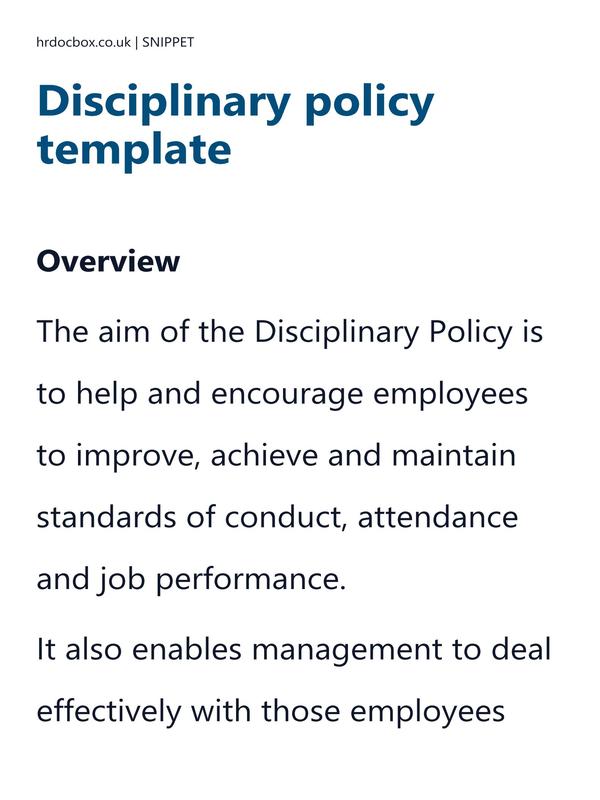
1.1 The aim of the Disciplinary Policy is to help and encourage employees to improve, achieve and maintain standards of conduct, attendance and job performance.
1.2 It also enables management to deal effectively with those employees who do not comply with the Company standards of conduct, attendance and performance in the workplace.
1.3 Equally, the policy and procedure are designed in a manner which is non-discriminatory and which is fair, consistent and effective. It must also be applied in a timely manner and without undue delay.
2 Scope
2.1 This policy is applicable to all employees of [company name].
3 General principles
3.1 All Managers have a responsibility for ensuring that employees are made aware of the Disciplinary Policy. All employees are to be informed of the standards of conduct and work performance expected of them and Managers should ensure that these standards are fully understood by those who work to them. Action taken under this policy must reflect fully the process detailed in the Procedural Appendix attached to this policy.
3.2 Matters relating to or arising under the Disciplinary Policy must be treated as confidential at all times. Failure to do so may itself constitute grounds for initiating disciplinary action.
3.3 Procedure
3.3.1 At each stage of this procedure, the employee has a right to be accompanied by an accredited Trade Union representative or work colleague. The employee will also be informed in writing of:
The nature of the complaint or allegation against them; and
The stage at which the matter is being considered.
3.3.2 The employee will also be reminded that they will be given a full opportunity to state their case and if action is taken, what improvement is required. They will also be reminded of their right of appeal.
3.3.3 Managers whose responsibilities require them to participate in or hold disciplinary meetings will be given appropriate training to enable them to undertake their role effectively and dispassionately.
Employees should make every effort to attend meetings or interviews relating to the application of the Disciplinary Procedure. If an individual is unable to attend, they will need to give notice and the reasons why they are unable to attend. The meeting will then be re-scheduled to a mutually convenient time. Unless the reasons are exceptional,
You've seen 10% of how the Disciplinary policy template is structured. Get the complete editable template instantly and customise it for your organisation.
This Disciplinary Policy provides employers with a structured framework for dealing with concerns about employee conduct, behaviour, attendance or other workplace issues. It is designed to support a fair, consistent and proportionate approach while giving employees a reasonable opportunity to understand and respond to concerns.
Disciplinary issues can range from relatively minor breaches of workplace rules through to serious misconduct. Managers should consider whether an issue can be dealt with informally before starting a formal process, where appropriate, while recognising that serious matters may require formal action from the outset.
Where formal disciplinary action is being considered, the relevant facts should normally be investigated before a disciplinary hearing takes place. The investigation should establish what happened, gather relevant evidence and identify any information that may support or contradict the concern. The person making the disciplinary decision should consider the evidence objectively rather than reaching a conclusion before the hearing.
Where there is a case to answer, the employee should be given sufficient information and reasonable time to prepare for the disciplinary hearing. The employee should have an opportunity to respond to the allegations, ask questions, present relevant evidence and raise any relevant mitigating circumstances. Employees have a statutory right to be accompanied at disciplinary hearings where the right applies.
Where misconduct or another disciplinary concern is established, the outcome should be appropriate to the circumstances and consistent with the organisation's procedure. Depending on the circumstances, this may include no formal action, a written warning, a final written warning or dismissal. The policy can also explain how warnings will operate and how long they will normally remain active.
Some conduct may be sufficiently serious to justify dismissal without notice following a fair disciplinary process. Examples of potential gross misconduct should be identified within the organisation's disciplinary rules and should reflect the nature of the organisation and the work undertaken.
Employees should be given an opportunity to appeal against formal disciplinary action. An appeal should be handled impartially and, wherever possible, by someone who was not previously involved in the decision. The outcome should be confirmed in writing and the organisation should retain appropriate confidential records of the process.
Use these best practice actions, recommended timescales and process stages to understand when and how the Disciplinary policy should be used, helping ensure each step is handled consistently and appropriately documented.
Understand the common mistakes to avoid when using this HR template, helping you reduce risk, prevent unnecessary costs and ensure the process is handled correctly.
A disciplinary procedure may be appropriate where there are concerns about an employee's conduct, behaviour, attendance or other breach of workplace rules. Depending on the circumstances, a manager may first address a minor issue informally, while serious matters may require a formal process.
A proportionate investigation should normally be carried out before formal disciplinary action is taken. The extent of the investigation will depend on the circumstances and seriousness of the matter, but relevant evidence should be considered before a decision is made.
The employee should receive sufficient information and reasonable time to prepare. The Acas Code does not prescribe one universal notice period, so the organisation should apply its own policy consistently and allow enough time for the employee to understand the allegations and prepare their response.
Yes, where the statutory right to be accompanied applies. The companion can generally be a fellow worker, a trade union representative or an official employed by a trade union. The right also applies to disciplinary appeal hearings. :contentReference[oaicite:7]{index=7}
Potentially. Gross misconduct is conduct that is sufficiently serious that it may justify dismissal without notice, but a fair disciplinary process should still be followed before a dismissal decision is made. Examples should be set out in the employer's disciplinary rules. :contentReference[oaicite:8]{index=8}
AI can generate generic disciplinary advice, but HRDocBox provides structured, UK-focused HR documentation designed around practical workplace processes and the Acas approach. This policy provides a consistent framework for investigating concerns, holding fair hearings, applying proportionate outcomes and managing appeals.
How this content is developed and reviewed
The Disciplinary policy template is developed using a practical HR methodology that considers current UK employment legislation, ACAS guidance, CIPD good practice and the real-world HR process it supports. Templates and supporting information are regularly reviewed and updated, with additional reviews triggered by significant changes to legislation, guidance or established HR practice, helping ensure each document remains practical, relevant and suitable for UK employers.
Darryl Horn, Chartered HR Director
Darryl is a Chartered HR professional with over 25 years' experience in senior HR and employee relations roles.
He has extensive practical experience of managing conduct HR processes and founded hrdocbox to provide businesses with practical, professionally developed HR resources grounded in UK employment law and best practice.
HRDocBox has been creating practical UK HR documents since 2009.
"Darryl provides support and advice with excellent judgement, and has a strong understanding of people, policies and UK employment legislation."
"He is someone I trust; consistent, dependable, and committed to doing things properly."




















Whether you employ 5 people or 50, hrdocbox gives you the structure, documents and expertise needed to manage employees professionally and legally.
Professionally written and fully compliant with UK employment law
Access a free contract template instantly - or save 10% on any document today.
Use this code at checkout for 10% off anything!
Includes instant download, updates, and full access to your HR templates.