Mental health and wellbeing policy template

£12.99
Editable template
Instant download
UK-specific & legally compliant
12 months updates included
2026 Reviewed

This Mental Health and Wellbeing Policy helps UK employers promote a supportive workplace, prevent and manage work-related stress, and provide appropriate support to employees experiencing mental health difficulties. It sets out responsibilities, reporting arrangements, available support and the approach to reasonable adjustments.

Use this policy to:
  • Promote positive mental health and wellbeing across the organisation.
  • Set out the responsibilities of managers, employees and the employer.
  • Identify, assess and reduce work-related stress risks.
  • Encourage employees to raise concerns and seek support without fear of stigma.
  • Explain how reasonable adjustments and workplace support will be considered.
  • Establish arrangements for wellbeing conversations, confidentiality and policy review.
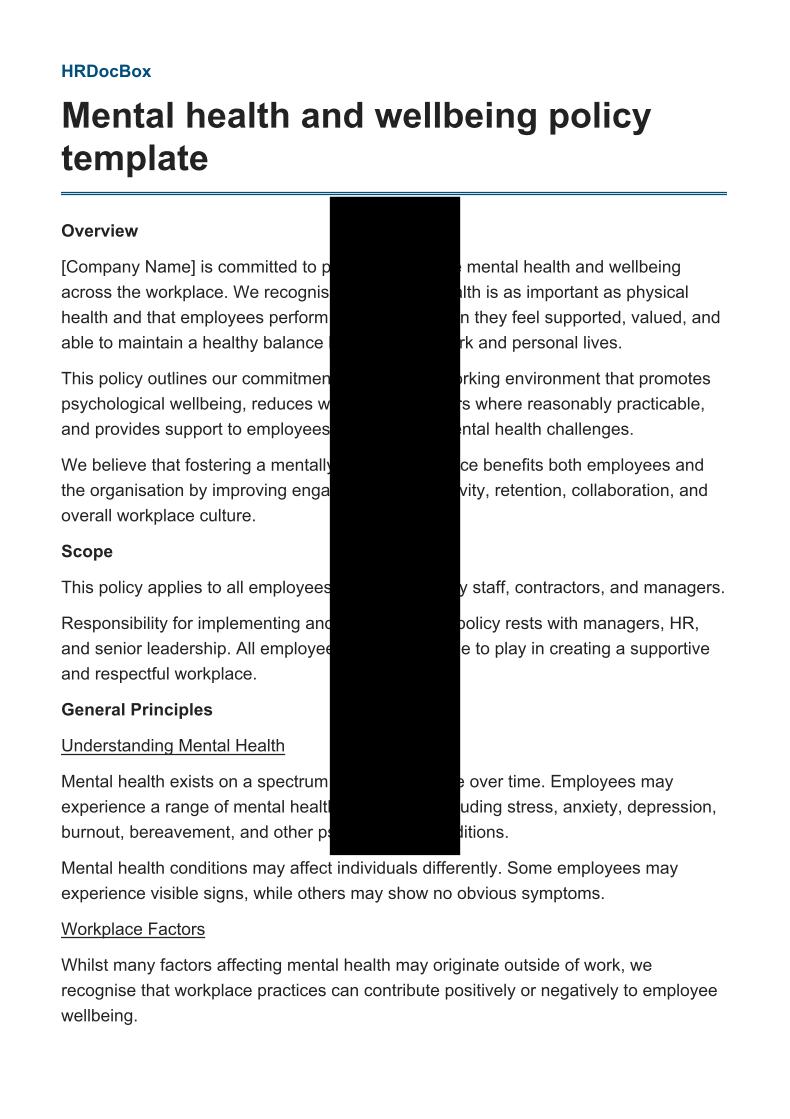
Mental health and wellbeing policy template preview

What you get with your purchase - much more than just a template!

Best practice example See what good looks like
Wider HR process Understand the bigger picture
Implementation guide Practical steps to follow
Common mistakes Know what to avoid
Get the complete resource

Don't just buy one policy — get the complete Wellbeing policies set

If you are strengthening your approach to employee wellbeing, these wellbeing policy templates give you a practical set of policies covering wellbeing needs, assessment, support, communication and review.

9 templates • £29.99 • 12 months' access & updates
View the policies

What's in this template?

  • Policy purpose, scope and commitment to positive mental health.
  • Responsibilities for managers, employees and senior leadership.
  • Work-related stress prevention, risk assessments and workload management.
  • Wellbeing conversations, early intervention and access to support.
  • Reasonable adjustments and support during absence or return to work.
  • Confidentiality, sensitive information and protection from discrimination.
  • Monitoring, review and continuous improvement arrangements.
Template

Download .doc

Copy [to paste]

Email

Mental health and wellbeing policy

1   Overview

1.1   [Company Name] is committed to promoting positive mental health and wellbeing across the workplace. We recognise that mental health is as important as physical health and that employees perform at their best when they feel supported, valued, and able to maintain a healthy balance between their work and personal lives.

1.2   This policy outlines our commitment to creating a working environment that promotes psychological wellbeing, reduces workplace stressors where reasonably practicable, and provides support to employees experiencing mental health challenges.

1.3   We believe that fostering a mentally healthy workplace benefits both employees and the organisation by improving engagement, productivity, retention, collaboration, and overall workplace culture.

2   Scope

2.1   This policy applies to all employees, workers, agency staff, contractors, and managers.

2.2   Responsibility for implementing and monitoring this policy rests with managers, HR, and senior leadership. All employees also have a role to play in creating a supportive and respectful workplace.

3   General Principles

3.1   Understanding Mental Health

3.1.1   Mental health exists on a spectrum and can fluctuate over time. Employees may experience a range of mental health challenges, including stress, anxiety, depression, burnout, bereavement, and other psychological conditions.

Mental health conditions may affect individuals differently. Some employees may experience visible signs, while others may

PREVIEW ENDS HERE

This is the end of the preview

You've seen 20% of how the Mental health and wellbeing policy template is structured. Get the complete editable template instantly and customise it for your organisation.

£12.99
Specifications
Access 12 months, with updates
Length 3 pages • 994 words
Jurisdiction England, Wales, Scotland
Based on UK law, ACAS guidance
Last update 17/10/2026
Update reason Implementation guidance update.
Next review 17/04/2027
Delivery & Format Instant digital delivery, .doc · .txt · email

What is a mental health and wellbeing policy?

Mental health and wellbeing policy template

Mental health and wellbeing are important parts of a safe, productive and supportive working environment. Employees may experience difficulties because of work pressures, personal circumstances, health conditions or a combination of factors. A clear policy helps employers respond consistently, encourage early conversations and reduce barriers to seeking help.

Creating a supportive workplace

A positive workplace culture encourages employees to discuss concerns without fear of embarrassment or unfair treatment. Managers should be approachable, listen without making assumptions and respond appropriately when someone raises a wellbeing concern. The policy should be supported by everyday management practices rather than treated as a document that sits unused.

Preventing and managing work-related stress

Employers should consider the causes of workplace stress, including excessive workload, unclear responsibilities, lack of control, poor working relationships and organisational change. Regular communication, realistic expectations, suitable resources and appropriate risk assessments can help identify problems before they become more serious.

Supporting employees experiencing difficulties

Support should be tailored to the individual and may include regular wellbeing conversations, adjustments to working hours or duties, temporary changes to workload, occupational health advice or a phased return following absence. Managers should work with employees to identify practical measures and review whether the support is effective.

Maintaining fairness and confidentiality

Mental health concerns should be treated seriously and sensitively. Information should be shared only where there is a legitimate reason and in accordance with data protection requirements. Employers must also consider their legal obligations relating to disability discrimination and reasonable adjustments where applicable.

A well-implemented policy helps organisations demonstrate their commitment to employee wellbeing while providing managers with a consistent framework for identifying concerns, responding appropriately and reviewing the effectiveness of support.

Best in class example

A production employee tells their line manager that increasing workloads and changes to shift arrangements are affecting their sleep and ability to concentrate. The manager arranges a private conversation, listens to the employee's concerns and avoids making assumptions about the cause or severity of the problem.

During the discussion, they identify immediate workplace pressures, including competing deadlines and limited opportunities to take breaks. The manager agrees to review priorities, clarify daily expectations and discuss whether a temporary adjustment to duties or working arrangements would help.

With the employee's involvement, the manager records the agreed actions and arranges a follow-up meeting. HR is consulted where appropriate, and an occupational health referral is considered with the employee's knowledge and consent where professional advice may be useful.

At the follow-up meeting, the employee and manager review whether the changes have helped and agree any further action. The employer also considers whether wider workload or shift-planning issues need to be addressed to reduce similar risks for other employees.

Implementation guidance

Use these best practice actions, recommended timescales and process stages to understand when and how the Mental health and wellbeing policy should be used, helping ensure each step is handled consistently and appropriately documented.

Step Description Responsibility Timing (Days from Issue)
1 Review current wellbeing arrangements, absence information, employee feedback and existing workplace stress risks. HR / Senior Management 1–5
2 Adapt the policy to reflect the organisation's reporting arrangements, support services, responsibilities and available resources. HR / Policy Owner 5–10
3 Consult appropriate managers and employee representatives, where applicable, and confirm the arrangements for handling concerns. HR / Managers 10–15
4 Approve and communicate the policy, explain how employees can raise concerns and brief managers on their responsibilities. Senior Management / HR 15–20
5 Monitor use of the policy, review stress risks and employee feedback, and agree any improvements or additional support. HR / Managers / Senior Management 20–30, then ongoing
Premium content

To continue reading, purchase this item or a parent toolkit, library or our full library.

Common mistakes

Understand the common mistakes to avoid when using this HR template, helping you reduce risk, prevent unnecessary costs and ensure the process is handled correctly.

  • Treating mental health as solely an individual responsibility without considering workplace pressures and working conditions.
  • Expecting managers to handle complex mental health concerns without appropriate training, guidance or access to HR support.
  • Making assumptions about an employee's condition, needs or ability to work without discussing the situation with them.
  • Failing to assess work-related stress risks or take action when concerns about workload, working relationships or organisational change are raised.
  • Promising absolute confidentiality or sharing sensitive employee information more widely than necessary.
  • Failing to consider reasonable adjustments, review agreed support or address wider workplace issues that may be affecting employee wellbeing.
Premium content

To continue reading, purchase this item or a parent toolkit, library or our full library.

HR considerations

UK employment law and best practice

This template is designed to support the process, but the document should be used alongside the relevant HR procedure and applied to the circumstances of the individual case.

This Mental Health and Wellbeing Policy supports employers in meeting their responsibilities for employee health, safety, fair treatment and workplace wellbeing. Employers should distinguish between legal requirements and recommended good practice, and ensure that the policy reflects the organisation's actual procedures and available support.

Health and safety and work-related stress

The Health and Safety at Work etc. Act 1974 and the Management of Health and Safety at Work Regulations 1999 require employers to protect employees' health and safety so far as reasonably practicable and undertake suitable and sufficient risk assessments. This includes identifying and taking appropriate action to prevent or reduce work-related stress risks. https://www.acas.org.uk/managing-work-related-stress/risk-assessments

Managing workplace stress

Employers should consider factors such as workload, working patterns, employee control, management support, working relationships, role clarity and organisational change. The Health and Safety Executive's Management Standards provide a framework for assessing these risks and identifying improvements. https://www.hse.gov.uk/stress/standards/overview.htm

Equality Act 2010 and reasonable adjustments

A mental health condition may amount to a disability under the Equality Act 2010 where the statutory definition is met. Employers must not unlawfully discriminate and must make reasonable adjustments where the legal duty applies. Adjustments should be considered individually and may include changes to working hours, duties, workload, breaks or working arrangements. https://www.acas.org.uk/reasonable-adjustments/mental-health-adjustments

Confidentiality and personal information

Information about an employee's mental health must be handled sensitively and in accordance with applicable data protection requirements. Access should be limited to those who need the information for a legitimate purpose. Confidentiality cannot be guaranteed in every circumstance, for example where disclosure is necessary to address a serious safety concern or comply with a legal obligation. https://ico.org.uk/for-organisations/uk-gdpr-guidance-and-resources/employment/

Absence, support and return to work

Employers should take mental health-related absence seriously and consider appropriate support, including reasonable adjustments where required. A return-to-work discussion, occupational health advice or a phased return may help an employee resume work safely. Support should be tailored to the individual rather than applied automatically. https://www.acas.org.uk/supporting-mental-health-workplace

Management responsibilities and good practice

Managers should be equipped to recognise possible signs of distress, hold supportive conversations and signpost employees to appropriate help. Regular wellbeing check-ins, mental health awareness and early action on workplace stress are recommended good practice. https://www.acas.org.uk/acas-framework-for-positive-mental-health-at-work

This policy should be reviewed regularly and whenever relevant changes occur to legislation, working arrangements or the organisation's approach to employee support. Employers operating in Northern Ireland should check the separate legal framework before adopting this policy.

You may also need these resources

FAQs

What is a Mental Health and Wellbeing Policy?

It is a workplace policy explaining how an organisation promotes positive mental health, manages work-related stress, supports employees experiencing difficulties and fulfils its relevant legal responsibilities.

Is a mental health and wellbeing policy a legal requirement?

There is no single legal requirement for every employer to have a standalone policy with this exact title. However, employers have legal responsibilities relating to health and safety, work-related stress, discrimination and reasonable adjustments. A written policy helps communicate how these responsibilities will be managed.

What should a manager do if an employee raises a mental health concern?

The manager should listen sensitively, discuss any work-related difficulties, explore appropriate support and agree practical next steps. They should involve HR or occupational health where appropriate, respect the employee's privacy and follow relevant absence, safety and adjustment procedures.

Does an employer have to make adjustments for mental health conditions?

Where a mental health condition meets the legal definition of disability and the duty under the Equality Act 2010 applies, the employer must make reasonable adjustments. Employers should also consider practical support for employees whose condition does not meet that definition.

Why use HRDocBox?

HRDocBox provides practical, customisable HR templates designed for UK employers. This policy offers a structured starting point for setting out responsibilities, workplace support and consistent procedures, helping organisations build a more supportive working environment.

Why use HRDocBox rather than asking AI?

HRDocBox combines practical HR document structures with UK employment-law context and implementation guidance. The policy provides a repeatable starting point for your HR processes, while still allowing you to tailor it to your organisation's needs and verify that the final version reflects current legal requirements.

How this content is developed and reviewed

The Mental health and wellbeing policy template is developed using a practical HR methodology that considers current UK employment legislation, ACAS guidance, CIPD good practice and the real-world HR process it supports. Templates and supporting information are regularly reviewed and updated, with additional reviews triggered by significant changes to legislation, guidance or established HR practice, helping ensure each document remains practical, relevant and suitable for UK employers.

About the author

Darryl Horn, Chartered HR Director

Darryl is a Chartered HR professional with over 25 years' experience in senior HR and employee relations roles.

He has extensive practical experience of managing wellbeing HR processes and founded hrdocbox to provide businesses with practical, professionally developed HR resources grounded in UK employment law and best practice.

HRDocBox has been creating practical UK HR documents since 2009.

Executive recommendation

"Darryl provides support and advice with excellent judgement, and has a strong understanding of people, policies and UK employment legislation."

"He is someone I trust; consistent, dependable, and committed to doing things properly."

RB
Ruth Brock Chief Executive Officer The Hygiene Bank
Get started today

HR confidence starts here

Whether you employ 5 people or 50, hrdocbox gives you the structure, documents and expertise needed to manage employees professionally and legally.

Download your FREE UK employment contract template

Professionally written and fully compliant with UK employment law
Download FREE contract
Free UK employment contract template