Concern about conduct meeting script template

£14.99

UK-specific • Editable • Instant download • 12 months' updates

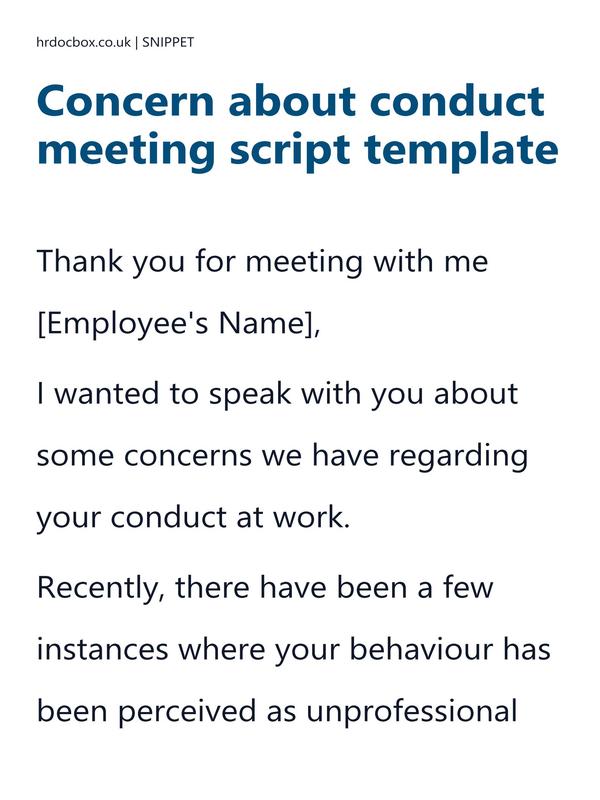
A practical meeting script to help managers handle an initial concern about an employee's conduct in a fair, structured and proportionate way before deciding whether formal action is required.

Use this template to:
  • Raise concerns about an employee's conduct clearly and calmly
  • Give the employee an opportunity to explain what happened
  • Establish the relevant facts before deciding what action is appropriate
  • Distinguish between an informal concern and a potential disciplinary matter
  • Agree appropriate actions, expectations and follow-up
  • Create a consistent approach for managers dealing with conduct concerns
Concern about conduct meeting script template
2026 Reviewed

What's included in this template?

This template brings together the key information, sections and considerations you need to create a clear, comprehensive and professional HR document. Preview the document below.

  • Meeting preparation
  • Opening the discussion
  • Explaining the concern
  • Questions for the employee
  • Exploring mitigating circumstances
  • Agreeing expectations and next steps
  • Recording the discussion
Specifications
Access 12 months (includes updates)
Length 3 pages • 1,038 words
Jurisdiction England, Wales and Scotland
Based on UK employment law, ACAS guidance
Last review 06/09/2026
Next review 06/03/2027
Delivery Instant download
Formats .doc · .txt · email

Download .doc

Copy [to paste]

Email
Template

Concern About Conduct Meeting Script

Meeting details

Employee:  
Manager:  
Date:  
Time:  
Location / method:  
Others present:  

Before the meeting

Before meeting with the employee, make sure you understand the concern and have identified the specific behaviour or incident that needs to be discussed.

Consider:

  • What exactly happened?
  • When and where did it happen?
  • Who was involved?
  • What information or evidence is currently available?
  • Has the behaviour previously been discussed with the employee?
  • Is the concern sufficiently minor to deal with informally?
  • Could the matter require a formal investigation or disciplinary process instead?
  • Are there any relevant workplace, personal or operational circumstances that should be considered?

Do not approach the meeting on the assumption that the employee is responsible for the conduct. The purpose of the discussion is to raise the concern and understand what happened.

Opening the meeting

Manager:

"Thanks for meeting with me. I wanted to have a conversation with you about a concern that has been raised regarding your conduct at work.

This is intended to be an opportunity for me to explain the concern, hear your perspective and understand what happened. I am not coming into the meeting having already decided that you have done anything wrong, and I want to hear your side before deciding what, if anything, needs to happen next."

Explain the concern

"The concern I want to discuss relates to [describe the behaviour or incident].

Specifically, it is understood that on [date / occasion], [describe the conduct factually and objectively].

The reason I am raising this with you is that the behaviour has caused concern because [explain the impact or expected standard]."

Where appropriate:

"There has also been

PREVIEW ENDS HERE

This is the end of the preview

You've seen just 30% of how the Concern about conduct meeting script template is structured. Get the complete editable template instantly and customise it for your organisation.

£14.99

Need the complete Disciplinary process?

Explore the Disciplinary templates toolkit

What is a concern about conduct meeting script?

Concern about conduct meeting script template preview

When a manager has concerns about an employee's conduct, an early conversation can often help establish what has happened and address inappropriate behaviour before matters escalate. This script provides a structured framework for holding that conversation while giving the employee a fair opportunity to respond.

Raising the concern constructively

The script helps the manager explain the behaviour that has caused concern using specific, factual examples rather than assumptions or labels. It encourages a calm and respectful discussion so that the employee understands what the concern is and why it needs to be addressed.

Understanding the employee's explanation

A key part of the meeting is giving the employee a genuine opportunity to explain what happened. The suggested questions help managers explore the circumstances, identify any misunderstandings or relevant context, and establish whether there are factors that need further consideration.

Deciding what happens next

Not every conduct concern needs to become a formal disciplinary matter. The script helps the manager consider whether the issue can be resolved through clarification, coaching, an agreed improvement in behaviour or further investigation. More serious concerns may need to be referred into the company's formal disciplinary procedure.

Creating a clear record

The meeting should be documented so there is a clear record of the concern raised, the employee's response and any actions agreed. The record should remain factual and proportionate and should not prejudge the outcome of any subsequent formal process.

Example

A Production Team Leader becomes concerned after an employee repeatedly speaks to colleagues in an aggressive and dismissive manner. On one occasion, the employee allegedly shouted at a colleague on the production floor following a disagreement about a job. The Team Leader has spoken to the employee previously about the importance of respectful communication but has not formally raised the latest incident.

Rather than immediately starting a disciplinary process, the manager arranges a concern about conduct meeting. During the discussion, the manager explains the specific behaviour that has been reported and why it is a concern, making clear that the purpose of the meeting is to understand what happened rather than to assume the allegation is correct.

The employee accepts that they raised their voice but explains that they were under significant pressure because the job had been changed several times and they believed a colleague had ignored an agreed instruction. The manager explores the circumstances, but also makes clear that frustration does not justify shouting at colleagues.

The manager concludes that the matter can be addressed informally at this stage. The employee is reminded of the expected standards of behaviour and agrees to raise operational disagreements with the Team Leader rather than confronting colleagues. The manager records the discussion and explains that repeated or more serious conduct concerns may result in formal action under the disciplinary procedure.

Implementation guidance

Use these best practice actions, recommended timescales and process stages to understand when and how the Concern about conduct meeting script should be used, helping ensure each step is handled consistently and appropriately documented.

Step Description Responsibility Timing
1 Establish the facts currently known, identify the specific conduct concern and decide whether an informal meeting is appropriate or whether the matter may require formal investigation. Manager / HR Before meeting
2 Arrange a private meeting and explain to the employee that the purpose is to discuss a concern about conduct and understand their perspective. Manager As soon as practical
3 Explain the concern using factual examples, then give the employee a reasonable opportunity to respond and ask questions to establish the circumstances. Manager During meeting
4 Consider the explanation, seriousness of the conduct, previous discussions, relevant circumstances and whether further investigation or formal action is appropriate. Manager / HR During or after meeting
5 Confirm expectations and agreed actions, explain what will happen next and keep a factual record of the meeting and any follow-up required. Manager / HR After meeting
Premium content

To continue reading, purchase this item or a parent toolkit, library or our full library.

Common mistakes

Understand the common mistakes to avoid when using this HR template, helping you reduce risk, prevent unnecessary costs and ensure the process is handled correctly.

  • Starting the meeting with the assumption that the employee is guilty.
  • Using vague descriptions such as "bad attitude" without giving specific examples.
  • Failing to give the employee a genuine opportunity to explain what happened.
  • Turning an informal conversation into disciplinary action without following the appropriate procedure.
  • Making promises about the outcome before all relevant information has been considered.
  • Keeping either no record or an unnecessarily subjective record of the discussion.
Premium content

To continue reading, purchase this item or a parent toolkit, library or our full library.

HR considerations

UK employment law and best practice

This template is designed to support the process, but the document should be used alongside the relevant HR procedure and applied to the circumstances of the individual case.

Fair disciplinary procedures

An informal conduct meeting can be useful where the issue is relatively minor and may be resolved through discussion, clarification, coaching or an agreed improvement. However, employers should distinguish an informal management conversation from a formal disciplinary process and follow their disciplinary procedure where formal action is appropriate. Acas provides guidance on disciplinary procedures and handling misconduct at work. https://www.acas.org.uk/disciplinary-and-grievances-at-work

Right to be heard

Although an informal concern meeting is not necessarily a formal disciplinary hearing, the employee should be given a reasonable opportunity to explain their perspective. If the matter progresses to formal disciplinary action, the employee should be told the allegations and given an opportunity to respond before a decision is made.

Acas Code of Practice

The Acas Code of Practice on disciplinary and grievance procedures provides a framework for handling formal disciplinary matters fairly and reasonably. It emphasises investigating the issues, informing the employee of the basis of the problem and giving the employee an opportunity to put their case before a decision is reached. https://www.acas.org.uk/acas-code-of-practice-on-disciplinary-and-grievance-procedures

Investigation and fact-finding

Where the concern is disputed, potentially serious or could result in disciplinary action, the employer should consider whether further investigation is required rather than treating the initial allegation as established fact. The extent of the investigation should be proportionate to the circumstances.

Consistency and reasonable management

Employers should deal with similar conduct concerns consistently while recognising that each situation needs to be considered on its own facts. Previous warnings, workplace context, the seriousness of the behaviour and any relevant mitigating circumstances may all be relevant when deciding how to respond.

Discrimination and reasonable adjustments

Managers should consider whether a disability or other relevant circumstance may affect how the employee communicates, behaves or participates in the meeting. Where the Equality Act 2010 applies, reasonable adjustments may be required to avoid substantial disadvantage. https://www.legislation.gov.uk/ukpga/2010/15/section/20

Confidentiality and records

Notes from the meeting should be factual, relevant and limited to information necessary for managing the conduct concern. Employee information should be handled appropriately and in accordance with UK data protection requirements. https://ico.org.uk/for-organisations/uk-gdpr-guidance-and-resources/employment/

You may also need these resources

FAQs

Is this a formal disciplinary meeting?

Not necessarily. This script is designed primarily for an initial concern about conduct where an informal discussion may be appropriate. If the matter is sufficiently serious, disputed or likely to result in formal disciplinary action, the employer should follow its formal disciplinary procedure instead.

Do I need to tell the employee exactly what the concern is?

Yes. The manager should explain the specific behaviour or incident causing concern and provide enough information for the employee to understand what is being discussed. Avoid vague labels such as "poor attitude" without explaining the underlying behaviour.

Can I give the employee a warning during the meeting?

An informal conversation should not normally be used to issue a formal disciplinary warning. If a formal warning may be appropriate, the employer should follow its disciplinary procedure, including giving the employee appropriate information about the allegations and a fair opportunity to respond.

What if the employee denies the conduct?

Do not assume that the denial means the matter is resolved or that the employee is being dishonest. Consider what evidence is available and whether further investigation is necessary. The outcome should be based on the facts established rather than the initial allegation alone.

Should the meeting be recorded?

A factual note of the discussion should normally be kept. Audio or video recording is a separate issue and should not be undertaken routinely without considering the circumstances, the company's policy and applicable data protection requirements.

Why use HRDocBox rather than AI?

AI can produce a generic conversation script, but it may not distinguish properly between an informal conduct conversation and a formal disciplinary process. HRDocBox templates are structured specifically around practical UK HR processes, helping managers raise concerns consistently while avoiding language that could unnecessarily prejudge an employee or bypass procedural safeguards. The template can then be adapted to the organisation's own policies and circumstances.

How this content is developed and reviewed

The Concern about conduct meeting script template is developed using a practical HR methodology that considers current UK employment legislation, ACAS guidance, CIPD good practice and the real-world HR process it supports. Templates and supporting information are regularly reviewed and updated, with additional reviews triggered by significant changes to legislation, guidance or established HR practice, helping ensure each document remains practical, relevant and suitable for UK employers.

About the author

Darryl Horn, Chartered HR Director

Darryl is a Chartered HR professional with over 25 years' experience in senior HR and employee relations roles.

He has extensive practical experience of managing disciplinary HR processes and founded hrdocbox to provide businesses with practical, professionally developed HR resources grounded in UK employment law and best practice.

HRDocBox has been creating practical UK HR documents since 2009.

Executive recommendation

"Darryl provides support and advice with excellent judgement, and has a strong understanding of people, policies and UK employment legislation."

"He is someone I trust; consistent, dependable, and committed to doing things properly."

RB
Ruth Brock Chief Executive Officer The Hygiene Bank
The Concern about conduct meeting script template is also included in these bundles:

Disciplinary toolkit Disciplinary toolkit 50 templates
£34.90

Management library Management library 470 templates
£79.99

Full library Full library 778 templates
£99.99

Get started today

HR confidence starts here

Whether you employ 5 people or 50, hrdocbox gives you the structure, documents and expertise needed to manage employees professionally and legally.

Download your FREE UK employment contract template

Professionally written and fully compliant with UK employment law
Download FREE contract
Free UK employment contract template