Disciplinary hearing invitation letter template

£14.99

UK-specific • Editable • Instant download • 12 months' updates

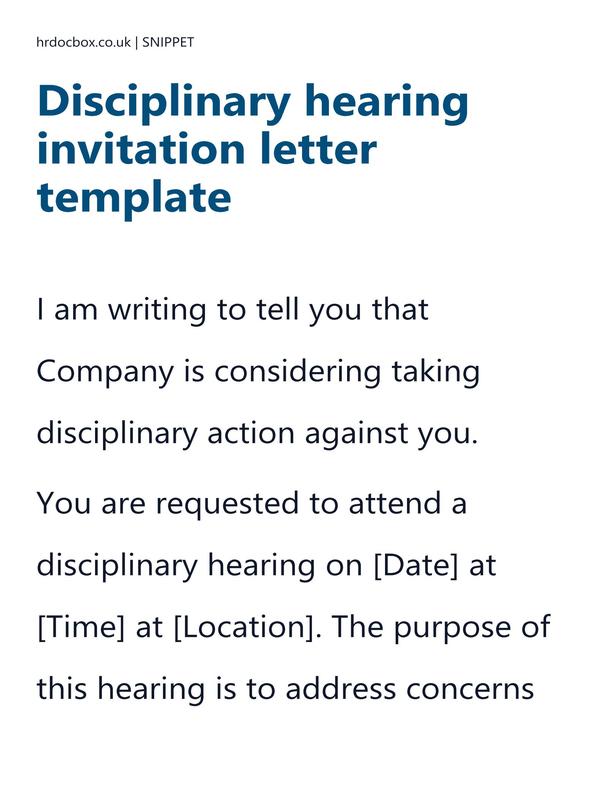
A Disciplinary Hearing Invitation Letter is used to formally invite an employee to a disciplinary hearing where there are concerns about their conduct, behaviour or other alleged misconduct. It explains the concerns, confirms the hearing arrangements and gives the employee a reasonable opportunity to prepare and respond.

Use this template to:
  • Formally invite an employee to a disciplinary hearing.
  • Set out the allegations or concerns being considered.
  • Provide sufficient information for the employee to prepare.
  • Confirm the date, time, location and attendees.
  • Explain the employee's right to be accompanied.
  • Set out the potential consequences where appropriate.
Disciplinary hearing invitation letter template
2026 Reviewed

What's included in this template?

This template brings together the key information, sections and considerations you need to create a clear, comprehensive and professional HR document. Preview the document below.

  • Formal disciplinary hearing invitation
  • Details of allegations
  • Relevant policy or procedure
  • Date, time and location
  • Hearing attendees
  • Evidence and supporting documents
  • Right to be accompanied
  • Potential disciplinary outcome
  • Employee preparation and response
Specifications
Access 12 months (includes updates)
Length 2 pages • 504 words
Jurisdiction England, Wales and Scotland
Based on UK employment law, ACAS guidance
Last review 27/08/2026
Next review 27/02/2027
Delivery Instant download
Formats .doc · .txt · email

Download .doc

Copy [to paste]

Email
Template

[Sender name]

[Sender address]

[date]

[Recipient name]

[Recipient address]


Dear [Recipient first name],

Request to attend disciplinary hearing

I am writing to formally invite you to a disciplinary hearing to discuss concerns regarding [briefly describe the nature of the concerns / alleged misconduct].

The hearing will take place as follows:

  • Date: [date]
  • Time: [time]
  • Location: [location / meeting room / video meeting details]
  • Chair: [name and job title]
  • Note-taker: [name and job title, if applicable]

Matters to be considered

The allegations / concerns that will be considered at the hearing are as follows:

  • [Allegation / concern 1]
  • [Allegation / concern 2]
  • [Allegation / concern 3]

The concerns relate to events which are alleged to have occurred on or around [date(s)] and concern [briefly explain the relevant circumstances].

The matters will be considered in accordance with the Company's [Disciplinary Policy / Disciplinary Procedure] and, where applicable, the following provisions of that policy: [insert relevant section].

Information and evidence

The information and evidence currently being considered includes:

  • [Document /

PREVIEW ENDS HERE

This is the end of the preview

You've seen just 30% of how the Disciplinary hearing invitation letter template is structured. Get the complete editable template instantly and customise it for your organisation.

£14.99

Need the complete Disciplinary process?

Explore the Disciplinary templates toolkit

What is a disciplinary hearing invitation letter?

Disciplinary hearing invitation letter template preview

A disciplinary hearing should give an employee a fair opportunity to understand the allegations against them and respond before the employer decides whether disciplinary action is appropriate. This Disciplinary Hearing Invitation Letter provides a structured way to communicate the concerns, supporting information and hearing arrangements in advance.

Setting out the allegations

The template provides space to clearly identify each allegation or concern, including relevant dates and circumstances. This helps the employee understand what they are being asked to respond to rather than being presented with unexpected allegations at the hearing.

Providing information before the hearing

The letter allows the employer to identify the evidence and documents being relied upon and confirm that relevant information has been provided in advance. This gives the employee a meaningful opportunity to prepare their response.

Making the hearing arrangements clear

The invitation confirms the date, time, location, chair and other attendees, together with information about the employee's right to be accompanied. It also provides an opportunity to identify any reasonable adjustments or practical issues before the meeting.

Keeping an outcome open

The template makes clear that no decision has been made before the hearing. It also allows the employer to explain the potential range of outcomes without giving the impression that a particular sanction has already been decided.

Supporting a fair disciplinary process

A well-structured invitation helps establish a clear audit trail and demonstrates that the employee was given appropriate information and an opportunity to respond. It can also help the disciplinary hearing remain focused on the allegations that have been properly raised and investigated.

Example

An employee is alleged to have repeatedly failed to follow a required health and safety procedure. An investigation is carried out, including discussions with the employee and relevant colleagues, and documents relating to the incidents are gathered.

The investigating manager concludes that there is a case to answer and refers the matter to a formal disciplinary hearing. HR prepares an invitation letter setting out the specific allegations, the relevant dates, the disciplinary policy being followed and the evidence that will be considered.

The employee is given the relevant documentation and reasonable notice of the hearing. The letter explains their right to be accompanied and makes clear that no decision has yet been made.

At the hearing, the employee provides an explanation and submits additional information. The chair considers this before deciding whether the allegations are upheld and, if so, what disciplinary action is appropriate.

The wider HR process

Related HR resources and workflow

Explore the HR resources that may be relevant before and / or after using the Disciplinary hearing invitation letter, helping you understand the wider process, maintain appropriate documentation and follow a consistent approach.

Previous
Forms
Investigation report form

An Investigation Report is used to record the findings of a workplace investigation into an employee concern, complaint, alleged misconduct, grievance or other workplace issue.

This
Disciplinary hearing invitation letter
Next
Scripts
Disciplinary hearing script

Our Disciplinary Hearing Script Template ensures structured proceedings, promoting fairness and adherence to disciplinary policies during hearings.

Premium content

To continue reading, purchase this item or a parent toolkit, library or our full library.

Implementation guidance

Use these best practice actions, recommended timescales and process stages to understand when and how the Disciplinary hearing invitation letter should be used, helping ensure each step is handled consistently and appropriately documented.

Step Description Responsibility Timing (Days from Hearing)
1 Establish the Allegations: Confirm the concerns, relevant dates, evidence and applicable disciplinary procedure before issuing the invitation. Manager / HR Day -14 to Day -10
2 Prepare the Evidence: Gather the documents, witness information and other evidence that the employee will need to understand and respond to the allegations. HR / Investigating Manager Day -10 to Day -7
3 Issue the Invitation: Send the employee the formal invitation with reasonable notice, the allegations, relevant evidence, hearing arrangements and right to be accompanied. HR / Manager Day -7 onwards
4 Hold the Hearing: Give the employee a genuine opportunity to respond to the allegations, present evidence and explain any relevant circumstances before reaching a decision. Hearing Chair Day 0
5 Consider and Confirm the Outcome: Consider all relevant information before deciding the outcome and confirm the decision and any right of appeal in writing. Hearing Chair / HR Day +1 onwards
Premium content

To continue reading, purchase this item or a parent toolkit, library or our full library.

Common mistakes

Understand the common mistakes to avoid when using this HR template, helping you reduce risk, prevent unnecessary costs and ensure the process is handled correctly.

  • Failing to clearly explain the allegations or concerns the employee is being asked to answer.
  • Providing insufficient information or evidence for the employee to prepare properly for the hearing.
  • Giving inadequate notice of the hearing or failing to consider a reasonable request to rearrange it.
  • Failing to inform the employee of their statutory right to be accompanied where it applies.
  • Giving the impression that the outcome has already been decided before the hearing takes place.
  • Using a hearing manager who has had inappropriate involvement in the investigation or allegations.
Premium content

To continue reading, purchase this item or a parent toolkit, library or our full library.

HR considerations

UK employment law and best practice

This template is designed to support the process, but the document should be used alongside the relevant HR procedure and applied to the circumstances of the individual case.

Employers should follow a fair and reasonable disciplinary process and give the employee an opportunity to understand the allegations and respond before a disciplinary decision is made. The ACAS Code of Practice on disciplinary and grievance procedures provides a framework for handling disciplinary cases fairly and reasonably. https://www.acas.org.uk/acas-code-of-practice-on-disciplinary-and-grievance-procedures

ACAS Code of Practice

Employers should follow the principles set out in the ACAS Code when handling disciplinary matters. Employment tribunals can take the Code into account where relevant, and unreasonable failure to follow it can affect compensation in applicable cases. https://www.acas.org.uk/acas-code-of-practice-on-disciplinary-and-grievance-procedures

Written notification of the allegations

The employee should be told in writing about the allegations and the possible consequences so that they have an opportunity to prepare for the disciplinary meeting. https://www.acas.org.uk/disciplinary-procedure-step-by-step

Reasonable opportunity to prepare

Employers should provide sufficient information and give the employee reasonable time to prepare before the disciplinary hearing. This includes providing relevant written evidence where appropriate. https://www.acas.org.uk/disciplinary-procedure-step-by-step

Right to be accompanied

Workers have a statutory right to be accompanied at a disciplinary hearing where the hearing could result in the employer administering a formal warning or taking another disciplinary action. The companion can be a colleague or trade union representative, subject to the statutory rules. https://www.acas.org.uk/disciplinary-procedure-step-by-step

Impartial decision-making

Where practicable, the person hearing the disciplinary case should not have been involved in the investigation. Separating the investigation and disciplinary decision-making stages can help demonstrate a fair process. https://www.acas.org.uk/acas-code-of-practice-on-disciplinary-and-grievance-procedures

Potential disciplinary outcome

The invitation should explain the possible consequences where appropriate, particularly where dismissal could potentially result. Employers should avoid giving the impression that the outcome has already been decided before the hearing. https://www.acas.org.uk/disciplinary-procedure-step-by-step

Appeal

Where disciplinary action is taken, the employee should normally be given the right to appeal the decision. The employer should explain the appeal process and the deadline for submitting an appeal in the disciplinary outcome letter. https://www.acas.org.uk/disciplinary-procedure-step-by-step

You may also need these resources

FAQs

How much notice should an employee receive for a disciplinary hearing?

The employee should be given reasonable notice of the hearing and sufficient time to prepare. There is no single statutory number of days that applies to every disciplinary hearing, so the circumstances and the employer's disciplinary procedure should be considered.

What should a disciplinary hearing invitation contain?

It should normally explain the allegations, provide or identify relevant evidence, confirm the hearing arrangements, explain the potential consequences where appropriate and tell the employee about their right to be accompanied.

Can an employee bring someone to a disciplinary hearing?

Where the statutory right applies, an employee can be accompanied by a workplace colleague or trade union representative. An employer's own disciplinary procedure may provide additional rights.

Does a disciplinary hearing mean the employee will receive a warning?

No. The purpose of the hearing is to consider the allegations and give the employee an opportunity to respond before a decision is made. The outcome should not be predetermined.

Why use HRDocBox for a Disciplinary Hearing Invitation?

HRDocBox combines deep HR knowledge, practical application and experience of real workplace situations. This template helps employers structure the invitation around the allegations, evidence, hearing arrangements, employee rights and potential outcomes.

Why use HRDocBox rather than asking AI to create the invitation?

A generic AI-generated letter may produce a professional-looking invitation without properly considering the procedural steps needed for a fair disciplinary process. HRDocBox combines UK employment-law knowledge, practical HR experience and regular review of employment developments to provide a more considered starting point.

How this content is developed and reviewed

The Disciplinary hearing invitation letter template is developed using a practical HR methodology that considers current UK employment legislation, ACAS guidance, CIPD good practice and the real-world HR process it supports. Templates are regularly reviewed and updated, with additional reviews triggered by significant changes to legislation, guidance or established HR practice, helping ensure each document remains practical, relevant and suitable for UK employers.

About the author

Darryl Horn, Chartered HR Director

Darryl is a Chartered HR professional with over 25 years' experience in senior HR and employee relations roles.

He has extensive practical experience of managing disciplinary processes and founded hrdocbox to provide businesses with practical, professionally developed HR resources grounded in UK employment law and best practice.

HRDocBox has been creating practical UK HR documents since 2009.

Executive recommendation

"Darryl provides support and advice with excellent judgement, and has a strong understanding of people, policies and UK employment legislation."

"He is someone I trust; consistent, dependable, and committed to doing things properly."

RB
Ruth Brock Chief Executive Officer The Hygiene Bank
The Disciplinary hearing invitation letter template is also included in these bundles:

Disciplinary toolkit Disciplinary toolkit 50 templates
£34.90

Management library Management library 468 templates
£79.99

Full library Full library 776 templates
£99.99

Get started today

HR confidence starts here

Whether you employ 5 people or 50, hrdocbox gives you the structure, documents and expertise needed to manage employees professionally and legally.

Download your FREE UK employment contract template

Professionally written and fully compliant with UK employment law
Download FREE contract
Free UK employment contract template