First written warning letter template

Quick preview
£9.99
5.0
Customer reviews 1 review
UK-specific Editable Instant download 12 months' updates

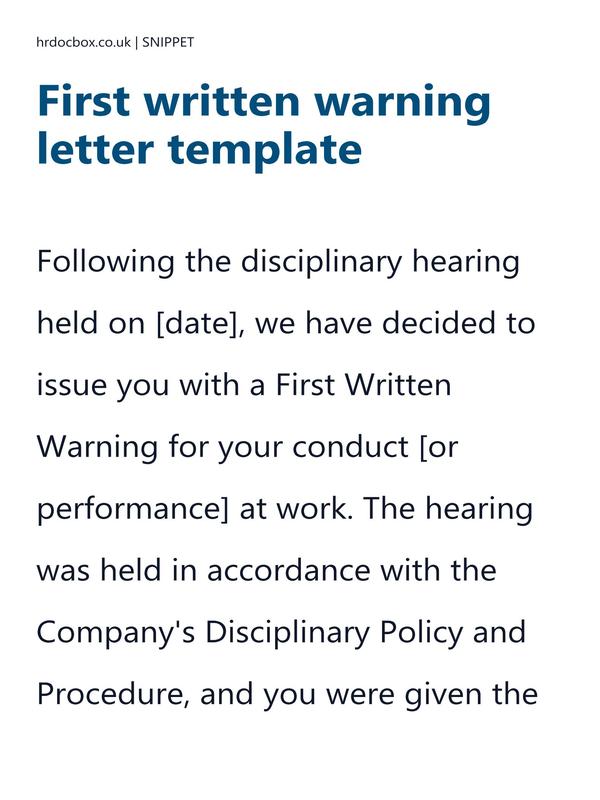
This First Written Warning Letter confirms the outcome of a formal disciplinary process where misconduct or unsatisfactory performance has been established. It records the concerns, required improvement, warning period, potential consequences and right of appeal.

Use this template to:
  • Confirm that a first written warning has been issued following a disciplinary hearing
  • Clearly record the misconduct or performance concern
  • Set out the improvement or behavioural standard required
  • Specify the timescale for improvement and monitoring
  • Explain how long the warning will remain current
  • Confirm the employee's right of appeal
First written warning letter template
2026 Reviewed
Get the complete resource

Don't just buy one template — get the complete Disciplinary templates toolkit

If you are managing a disciplinary process, the toolkit brings together practical HR templates covering investigations, hearings, warnings, appeals and outcomes.

50 templates • £24.99 • 12 months' access & updates
View the complete toolkit

What's included in this template?

This template brings together the key information, sections and considerations you need to create a clear, comprehensive and professional HR document. Preview the document below.

  • Confirmation of the disciplinary hearing and outcome
  • Details of the misconduct or performance concern
  • Employee explanation and decision rationale
  • Required improvement and monitoring arrangements
  • Warning duration and consequences of further issues
  • Appeal arrangements and timescale
Template

Download .doc

Copy [to paste]

Email

[Sender name]

[Sender address]

[date]

[Recipient name]

[Recipient address]


Dear [Recipient first name],

Outcome of disciplinary hearing

Thank you for attending the disciplinary hearing on [date]. The hearing was held to consider concerns regarding [misconduct / unsatisfactory performance] relating to [brief description of issue].

I have now considered the evidence available, the matters discussed during the disciplinary process and the explanation you provided at the hearing.

I am writing to confirm that the outcome of the disciplinary process is that you are being issued with a first written warning.

The reason for the warning

The concern considered during the disciplinary process was:

[Set out clearly and factually the conduct or performance issue, including relevant dates, events, standards, policies or instructions where appropriate.]

The evidence considered included [briefly identify the relevant evidence, for example records, documents, statements, training

PREVIEW ENDS HERE

This is the end of the preview

You've seen 20% of how the First written warning letter template is structured. Get the complete editable template instantly and customise it for your organisation.

£9.99
Specifications
Access 12 months, with updates
Length 2 pages • 603 words
Jurisdiction England, Wales, Scotland
Based on UK law, ACAS guidance
Last update 29/09/2026
Update reason Enhanced template description.
Next review 29/03/2027
Delivery & Format Instant digital delivery, .doc · .txt · email

What is a first written warning letter?

First written warning letter template preview

This First Written Warning Letter provides a formal written record of a disciplinary outcome following a fair disciplinary process. It is suitable where misconduct or unsatisfactory performance has been established and a first written warning is considered an appropriate response.

Confirming the disciplinary outcome

The letter clearly confirms that a first written warning has been issued and links the decision to the disciplinary hearing and evidence considered. This provides the employee with a clear record of the outcome.

Explaining the concern

The letter records the specific conduct or performance issue rather than relying on general statements. It can also explain how the employee's response was considered before the decision was reached.

Setting clear expectations

A warning should explain what needs to change and, where appropriate, the timescale for improvement. For performance matters, the employer can also identify support, training, supervision or other measures that will assist the employee.

Explaining the warning period

The letter confirms how long the warning will remain current and what may happen if there is further misconduct or performance does not improve during the relevant period.

Providing an appeal route

The employee is given a clear opportunity to appeal the decision. The appeal arrangements should be consistent with the organisation's disciplinary procedure and should normally be handled impartially by someone who was not previously involved.

Example

An employee had received informal reminders about repeatedly failing to follow the Company's required stock-checking procedure. The issue continued and a formal disciplinary investigation was carried out, including a review of stock records, relevant procedures and discussions with the employee.

The employee attended a disciplinary hearing and explained that they had been under significant workload pressure and had occasionally prioritised customer orders over the stock checks. The manager considered this explanation but concluded that the required procedure was clear and that the employee had received sufficient instruction.

The manager decided that the circumstances justified a first written warning rather than no formal action or a final written warning. The warning required the employee to follow the stock-checking procedure consistently with immediate effect and set out a review period during which compliance would be monitored.

The outcome letter confirmed the warning period, explained that further similar misconduct could lead to further disciplinary action and reminded the employee of their right to appeal the decision.

The wider HR process

Related HR resources and workflow

Explore the HR resources that may be relevant before and / or after using the First written warning letter, helping you understand the wider process, maintain appropriate documentation and follow a consistent approach.

Previous
Forms
Disciplinary decision scoring matrix form

This Disciplinary Decision Scoring Matrix provides a structured framework for assessing the relevant factors when deciding a disciplinary outcome.

This
First written warning letter
Next
Letters
Disciplinary outcome appeal letter

Our Disciplinary Outcome Appeal Letter Template empowers employees to seek fair resolution, addressing concerns and ensuring procedural fairness.

Premium content

To continue reading, purchase this item or a parent toolkit, library or our full library.

Implementation guidance

Use these best practice actions, recommended timescales and process stages to understand when and how the First written warning letter should be used, helping ensure each step is handled consistently and appropriately documented.

Step Description Responsibility Timing
1 Complete the disciplinary hearing and consider the investigation findings, evidence, employee response, relevant policies and any mitigating circumstances before deciding the outcome. Disciplinary decision-maker After hearing
2 Decide whether a first written warning is reasonable and proportionate in the circumstances, taking account of any comparable cases where appropriate. Disciplinary decision-maker / HR As soon as reasonably practicable after hearing
3 Prepare the outcome letter, clearly setting out the issue, decision, required improvement, warning period, monitoring arrangements and potential consequences. HR / Disciplinary decision-maker Normally within 2–5 working days
4 Issue the letter to the employee and implement any agreed support, training, monitoring or review arrangements. Manager / HR As soon as reasonably practicable after decision
5 Monitor the required improvement during the warning period and deal with any further concerns through the appropriate disciplinary or performance process. Manager / HR Throughout warning period
Premium content

To continue reading, purchase this item or a parent toolkit, library or our full library.

Common mistakes

Understand the common mistakes to avoid when using this HR template, helping you reduce risk, prevent unnecessary costs and ensure the process is handled correctly.

  • Issuing a warning without first following a fair disciplinary process
  • Failing to explain precisely what conduct or performance was unacceptable
  • Using vague improvement requirements that the employee cannot reasonably understand
  • Failing to consider the employee's explanation or relevant mitigating circumstances
  • Failing to state how long the warning will remain current
  • Failing to provide a clear right of appeal
Premium content

To continue reading, purchase this item or a parent toolkit, library or our full library.

HR considerations

UK employment law and best practice

This template is designed to support the process, but the document should be used alongside the relevant HR procedure and applied to the circumstances of the individual case.

Fair disciplinary procedure

A first written warning should follow a fair disciplinary process. This normally involves an appropriate investigation, written notification of the concerns, a disciplinary hearing giving the employee an opportunity to respond, consideration of the evidence and a written outcome. https://www.acas.org.uk/acas-code-of-practice-on-disciplinary-and-grievance-procedures/html

Written warning as a disciplinary outcome

Acas states that a first written warning is usually the first formal disciplinary step where misconduct or poor performance has been confirmed. The decision should be based on the investigation and meetings, what is fair and reasonable, and relevant comparable cases. https://www.acas.org.uk/disciplinary-procedure-step-by-step/step-5-deciding-on-the-disciplinary-outcome

Contents of a first written warning

A first written warning should explain the misconduct or performance issue, the change in behaviour or improvement required, the timescale for improvement and how long the warning will remain in place. It should also explain the potential consequences of further misconduct or failure to improve. https://www.acas.org.uk/disciplinary-procedure-step-by-step/step-5-deciding-on-the-disciplinary-outcome

Consistency and proportionality

Employers should act consistently when dealing with disciplinary matters, while recognising that each case must be considered on its own facts. Relevant circumstances, previous disciplinary records and comparable cases may need to be considered when deciding an appropriate outcome. https://www.acas.org.uk/acas-code-of-practice-on-disciplinary-and-grievance-procedures/html

Support and improvement

Where the warning relates to performance, the employer should identify specific improvement requirements and appropriate timescales. Where relevant, the employer should also identify any support or training that will be provided to help the employee achieve the required standard. https://www.acas.org.uk/disciplinary-procedure-step-by-step/step-5-deciding-on-the-disciplinary-outcome

Right to appeal

An employee should be given the opportunity to appeal a formal disciplinary decision. The appeal should be dealt with impartially and, wherever possible, by someone who has not previously been involved in the matter. Acas recommends 5 working days as an appropriate period for submitting an appeal where the organisation's own procedure does not specify a different period. https://www.acas.org.uk/how-to-appeal-a-disciplinary-or-grievance-outcome

Right to be accompanied

Employees have a statutory right to be accompanied at a formal disciplinary hearing and at an appeal hearing by a qualifying companion, subject to the statutory requirements. https://www.gov.uk/disciplinary-procedures-and-action-at-work/disciplinary-hearings

Record keeping and data protection

The employer should retain an appropriate record of the disciplinary process and outcome, while ensuring that personal information is handled securely and only retained for as long as necessary. https://ico.org.uk/for-organisations/uk-gdpr-guidance-and-resources/principle-a-accuracy-storage-limitation-and-accountability/storage-limitation/how-long-should-we-keep-personal-data/

You may also need these resources

FAQs

When should an employee receive a first written warning?

A first written warning is usually appropriate where misconduct or unsatisfactory performance has been established following a fair disciplinary process and formal action is considered reasonable and proportionate.

How long should a first written warning remain active?

There is no single statutory period that applies to every employer. The organisation's disciplinary procedure should state its normal warning periods. The letter should clearly tell the employee how long the particular warning will remain current.

Does a first written warning mean the employee will be dismissed next time?

No. Further misconduct or failure to improve may lead to further disciplinary action, potentially including a final written warning or, depending on the circumstances and the applicable procedure, dismissal. The outcome should not be presented as automatic.

Can a first written warning be issued for poor performance?

Yes. A formal warning can be appropriate for unsatisfactory performance as well as misconduct. However, the employer should make clear what improvement is required and provide appropriate support or training where relevant.

Can an employee appeal a first written warning?

Yes. Employees should be given an opportunity to appeal a formal disciplinary decision. The appeal should normally be handled by someone who was not previously involved in the decision where this is reasonably practicable.

Why use HRDocBox rather than AI?

HRDocBox provides structured, UK-focused HR templates designed around practical employment processes and current Acas and employment law guidance. AI can help adapt wording, but a ready-to-use template provides a consistent starting point and helps ensure important procedural points are covered.

Customer reviews

What people are saying

Back to product

The final version worked well in practice

lucy williams • 15 Sep 2026

The manager could use it without needing a long explanation first. The finished letter looked professional without sounding overly corporate. The wording gave us a clear basis for the correspondence.

How this content is developed and reviewed

The First written warning letter template is developed using a practical HR methodology that considers current UK employment legislation, ACAS guidance, CIPD good practice and the real-world HR process it supports. Templates and supporting information are regularly reviewed and updated, with additional reviews triggered by significant changes to legislation, guidance or established HR practice, helping ensure each document remains practical, relevant and suitable for UK employers.

About the author

Darryl Horn, Chartered HR Director

Darryl is a Chartered HR professional with over 25 years' experience in senior HR and employee relations roles.

He has extensive practical experience of managing disciplinary HR processes and founded hrdocbox to provide businesses with practical, professionally developed HR resources grounded in UK employment law and best practice.

HRDocBox has been creating practical UK HR documents since 2009.

Executive recommendation

"Darryl provides support and advice with excellent judgement, and has a strong understanding of people, policies and UK employment legislation."

"He is someone I trust; consistent, dependable, and committed to doing things properly."

RB
Ruth Brock Chief Executive Officer The Hygiene Bank
Get started today

HR confidence starts here

Whether you employ 5 people or 50, hrdocbox gives you the structure, documents and expertise needed to manage employees professionally and legally.

Download your FREE UK employment contract template

Professionally written and fully compliant with UK employment law
Download FREE contract
Free UK employment contract template