Right to work policy template

£14.99

UK-specific • Editable • Instant download • 12 months' updates

A Right to Work Policy sets out how an organisation will check and record an individual's legal right to work in the UK before employment begins and, where necessary, throughout employment. It provides a consistent process for completing checks, handling time-limited permissions and avoiding unlawful discrimination.

Use this template to:
  • Set out the organisation's right to work checking process.
  • Explain when and how checks must be completed.
  • Cover manual, online and digital right to work checks.
  • Explain how follow-up checks are managed for time-limited permissions.
  • Set out responsibilities for HR, managers and employees.
  • Reduce the risk of illegal working, civil penalties and discriminatory recruitment practices.
Right to work policy template
2026 Reviewed

What's included in this template?

This template brings together the key information, sections and considerations you need to create a clear, comprehensive and professional HR document. Preview the document below.

  • Purpose and scope
  • Right to work checking principles
  • When checks are required
  • Manual and online checks
  • Digital verification
  • Time-limited right to work
  • Follow-up checks
  • Employer Checking Service
  • Record keeping
  • Responsibilities
  • Preventing discrimination
  • Failure to establish right to work
Specifications
Access 12 months (includes updates)
Length 3 pages • 761 words
Jurisdiction England, Wales and Scotland
Based on UK employment law, ACAS guidance
Last review 27/08/2026
Next review 27/02/2027
Delivery Instant download
Formats .doc · .txt · email

Download .doc

Copy [to paste]

Email
Template

Right to work policy

1   Overview

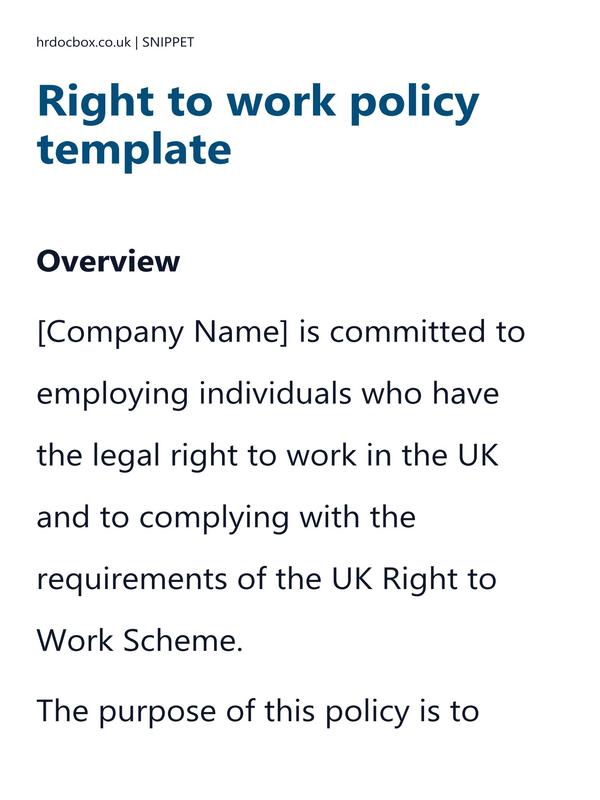
1.1   [Company Name] is committed to employing individuals who have the legal right to work in the UK and to complying with the requirements of the UK Right to Work Scheme.

1.2   The purpose of this policy is to explain the Company's approach to checking and confirming an individual's right to work, maintaining appropriate records and carrying out follow-up checks where an individual's permission to work is time-limited.

1.3   The Company will apply its right to work procedures consistently and fairly and will not make assumptions about an individual's right to work based on their nationality, race, ethnic or national origin, accent, name, appearance or any other protected characteristic.

2   Scope

2.1   This policy applies to all employees, workers, apprentices and other individuals engaged by [Company Name] where the Right to Work Scheme applies. It also applies to candidates being considered for employment or engagement.

2.2   The policy applies throughout the recruitment and employment lifecycle, including initial right to work checks and any follow-up checks required where permission to work is time-limited.

3   General principles

3.1   The Company will:

  • Complete the appropriate right to work check before an individual starts work.
  • Use a permitted Home Office checking process appropriate to the individual's circumstances.
  • Check that the individual is permitted to undertake the specific work being offered.
  • Keep appropriate evidence of completed right to work checks.
  • Record and monitor expiry dates where an individual's

PREVIEW ENDS HERE

This is the end of the preview

You've seen just 30% of how the Right to work policy template is structured. Get the complete editable template instantly and customise it for your organisation.

£14.99

Need the complete Recruitment and selection process?

Explore the Recruitment and selection policy templates

What is a right to work policy?

Right to work policy template preview

Employers have a legal responsibility to prevent illegal working and must establish that an individual has the right to undertake the work in question before employment begins. This Right to Work Policy provides a practical framework for carrying out checks consistently, recording the outcome and managing follow-up checks where permission to work is time-limited.

Setting out a consistent checking process

The policy explains when checks are required and the different prescribed routes that may apply, including manual document checks, Home Office online checks, digital verification and the Employer Checking Service. It is designed to give HR and managers a clear process rather than leaving individual checks to personal judgement.

Managing time-limited permission

A right to work check is not necessarily a one-off exercise. Where an individual's permission is time-limited, the employer needs an appropriate system for recording the expiry date and completing a follow-up check. The policy sets out how these checks should be diarised and managed.

Protecting the organisation

Correctly conducted prescribed checks can provide an employer with a statutory excuse against a civil penalty if an individual is subsequently found not to have permission to work. The policy therefore covers record keeping, evidence of checks and the responsibilities of HR and managers.

Preventing discriminatory checks

Right to work obligations do not give employers permission to make assumptions about someone's immigration status. The policy establishes a consistent approach and specifically addresses discrimination based on nationality, race, ethnic or national origin and other characteristics.

Keeping the policy current

Right to work requirements and Home Office processes can change, particularly as digital immigration status and eVisas develop. The policy includes a review requirement so the organisation's process can be checked regularly against current Home Office guidance and statutory requirements.

Example

A UK employer recruits a new employee who has time-limited permission to work in the UK. Before the employee starts, HR obtains the appropriate share code and completes the Home Office online right to work check.

The result confirms the employee's identity and that they are permitted to undertake the role, subject to a specified expiry date. HR saves the required evidence of the online check, records the date it was completed and diarises the follow-up check.

Several months later, HR contacts the employee before their existing permission expires. The employee confirms that they have made an application to extend their permission. HR follows the applicable Home Office process and, where required, contacts the Employer Checking Service rather than simply assuming that the employee can continue working.

Throughout the process, the employer applies the same right to work principles consistently and does not make assumptions about the employee's immigration status based on their nationality or background.

Implementation guidance

Use these best practice actions, recommended timescales and process stages to understand when and how the Right to work policy should be used, helping ensure each step is handled consistently and appropriately documented.

Step Description Responsibility Timing
1 Establish the Process: Confirm who is responsible for right to work checks, which checking methods are used and how records will be maintained. HR / People Team Before recruitment
2 Complete the Pre-Employment Check: Establish the individual's right to undertake the specific work before employment starts using the applicable prescribed checking route. HR / Authorised Checker Before start date
3 Record the Check: Retain the required evidence and record the date of the check in accordance with Home Office requirements. HR At the time of check
4 Manage Follow-Up Checks: Diarise and complete any required repeat check before a time-limited right to work expires. HR Before expiry
5 Review the Process: Regularly review the policy, checking methods, training and records against current Home Office requirements and discrimination guidance. HR / People Team Regularly
Premium content

To continue reading, purchase this item or a parent toolkit, library or our full library.

Common mistakes

Understand the common mistakes to avoid when using this HR template, helping you reduce risk, prevent unnecessary costs and ensure the process is handled correctly.

  • Allowing someone to start work before the required right to work check has been completed.
  • Failing to check whether a time-limited right to work contains restrictions on the type or hours of work permitted.
  • Failing to diarise and complete follow-up checks before a time-limited permission expires.
  • Accepting documents or checking methods that are no longer valid instead of following the current Home Office process.
  • Applying additional checks only to people who appear to be foreign nationals or otherwise making assumptions based on nationality, race or ethnicity.
  • Failing to retain sufficient evidence of the check and the date on which it was completed.
Premium content

To continue reading, purchase this item or a parent toolkit, library or our full library.

HR considerations

UK employment law and best practice

This template is designed to support the process, but the document should be used alongside the relevant HR procedure and applied to the circumstances of the individual case.

UK employers have a legal responsibility to prevent illegal working and must establish that a person is permitted to undertake the work in question before employing them. Correctly completing the prescribed checks can provide a statutory excuse against a civil penalty where an individual is subsequently found to be working unlawfully. https://www.gov.uk/check-job-applicant-right-to-work

Right to work checks before employment

Employers must check an individual's right to work before employing them. The check must establish that the person is permitted to undertake the particular work being offered. https://www.gov.uk/check-job-applicant-right-to-work

Acceptable checking methods

Depending on the individual's circumstances, employers can use a manual document check, the Home Office online right to work checking service or an approved digital verification route where the relevant requirements are met. https://www.gov.uk/government/publications/right-to-work-checks-employers-guide/employers-guide-to-right-to-work-checks-26-june-2025-accessible

Time-limited right to work

Where an individual's right to work is time-limited, the employer must carry out a follow-up check before the permission expires to maintain the statutory excuse. https://www.gov.uk/government/publications/right-to-work-checks-employers-guide/employers-guide-to-right-to-work-checks-26-june-2025-accessible

Employer Checking Service

The Employer Checking Service should be used in the circumstances specified by the Home Office, including certain cases where an individual has an outstanding immigration application, appeal or administrative review. A Positive Verification Notice can provide the relevant statutory excuse where the prescribed conditions are met. https://www.gov.uk/government/publications/right-to-work-checks-employers-guide/employers-guide-to-right-to-work-checks-26-june-2025-accessible

Record keeping

Employers should keep evidence of the right to work check, including copies or records of the relevant documents or online check and the date on which the check was conducted. Records should be retained for the required period. https://www.gov.uk/government/publications/right-to-work-checks-employers-guide/employers-guide-to-right-to-work-checks-26-june-2025-accessible

Consistency and discrimination

Employers must not discriminate when carrying out right to work checks. They should not make assumptions about someone's immigration status because of nationality, race, ethnic or national origin, accent, surname or length of residence in the UK. The Home Office's code of practice requires employers to apply checks consistently. https://www.gov.uk/government/publications/right-to-work-checks-code-of-practice-on-avoiding-discrimination/code-of-practice-for-employers-avoiding-unlawful-discrimination-while-preventing-illegal-working-in-force-from-6-april-2022-accessible

Digital immigration status and eVisas

Many individuals now demonstrate immigration status digitally. Employers should use the Home Office's current online checking process where applicable rather than relying on documents or online services that are not valid for right to work checking purposes. https://www.gov.uk/government/publications/right-to-work-checks-employers-guide/employers-guide-to-right-to-work-checks-26-june-2025-accessible

Future requirements

The Home Office is updating its right to work and anti-discrimination codes, including changes applying from 1 October 2026. Employers should therefore review their procedures regularly rather than relying indefinitely on an old checklist or policy. https://www.gov.uk/government/consultations/right-to-work-draft-code-of-practice-for-employers-avoiding-unlawful-discrimination

You may also need these resources

FAQs

When must a right to work check be completed?

The check must normally be completed before the individual starts employment or engagement. The employer needs to establish that the person is permitted to undertake the specific work in question. https://www.gov.uk/check-job-applicant-right-to-work

Do employers have to check every employee?

Employers should operate their right to work checking process consistently. The current Home Office guidance sets out who falls within the Right to Work Scheme and the circumstances in which checks are required. Employers should not selectively check people because they appear to be from a particular nationality or ethnic background.

What happens if an employee has a time-limited right to work?

The employer should record the expiry date and complete a follow-up check before the existing permission expires. This is important for maintaining the employer's statutory excuse. https://www.gov.uk/government/publications/right-to-work-checks-employers-guide/employers-guide-to-right-to-work-checks-26-june-2025-accessible

Can an employer use a manual passport check?

A manual check can be used where the individual's circumstances and documents fall within the permitted manual checking process. Employers should use the current Home Office list of acceptable documents and follow the prescribed checking procedure. https://www.gov.uk/government/publications/right-to-work-checks-employers-guide/employers-guide-to-right-to-work-checks-26-june-2025-accessible

What happens if an employee cannot prove their right to work?

The employer should establish whether another prescribed checking route is available, including the Employer Checking Service where applicable. Managers should refer the matter to HR rather than making assumptions about the individual's status or immediately taking employment action.

Why use HRDocBox for a Right to Work Policy?

HRDocBox combines deep HR knowledge, practical application and experience of real workplace situations. This policy provides a structured approach to right to work checks, follow-up checks, record keeping and discrimination prevention, while recognising that employers need to keep their process aligned with changing Home Office requirements.

How this content is developed and reviewed

The Right to work policy template is developed using a practical HR methodology that considers current UK employment legislation, ACAS guidance, CIPD good practice and the real-world HR process it supports. Templates are regularly reviewed and updated, with additional reviews triggered by significant changes to legislation, guidance or established HR practice, helping ensure each document remains practical, relevant and suitable for UK employers.

About the author

Darryl Horn, Chartered HR Director

Darryl is a Chartered HR professional with over 25 years' experience in senior HR and employee relations roles.

He has extensive practical experience of managing recruitment and selection processes and founded hrdocbox to provide businesses with practical, professionally developed HR resources grounded in UK employment law and best practice.

HRDocBox has been creating practical UK HR documents since 2009.

Executive recommendation

"Darryl provides support and advice with excellent judgement, and has a strong understanding of people, policies and UK employment legislation."

"He is someone I trust; consistent, dependable, and committed to doing things properly."

RB
Ruth Brock Chief Executive Officer The Hygiene Bank
Get started today

HR confidence starts here

Whether you employ 5 people or 50, hrdocbox gives you the structure, documents and expertise needed to manage employees professionally and legally.

Download your FREE UK employment contract template

Professionally written and fully compliant with UK employment law

Download FREE contract
Free UK employment contract template