Libraries
780+ HR templates
Everything your business needs to stay compliant
Policies, contracts, letters, guidance and HR support tools for UK employers.
View full libraryPolicies, contracts, letters, guidance and HR support tools for UK employers.
View full libraryUse this Exit Interview Preparation Plan to organise a structured, professional exit interview with a departing employee. It sets out the preparation, interview and follow-up activities needed to gather meaningful feedback, identify recurring workplace issues and support improvements in employee engagement and retention.
Use this template to:
<p>If you are conducting employee exit interviews, the toolkit brings together practical HR templates covering preparation, questions, feedback, recording and follow-up.</p>
Employee Name: [Employee Name]
Job Title: [Job Title]
Department: [Department]
Line Manager: [Manager Name]
Leaving Date: [Date]
Interview Date: [Date]
Interview Time: [Time]
Location / Meeting Link: [Details]
Interviewer: [Name / Job Title]
Purpose
To prepare for and conduct a structured exit interview, obtain constructive feedback about the employee's experience, identify relevant concerns and improvement opportunities, and ensure that appropriate follow-up action is taken.
Preparation and Interview Checklist
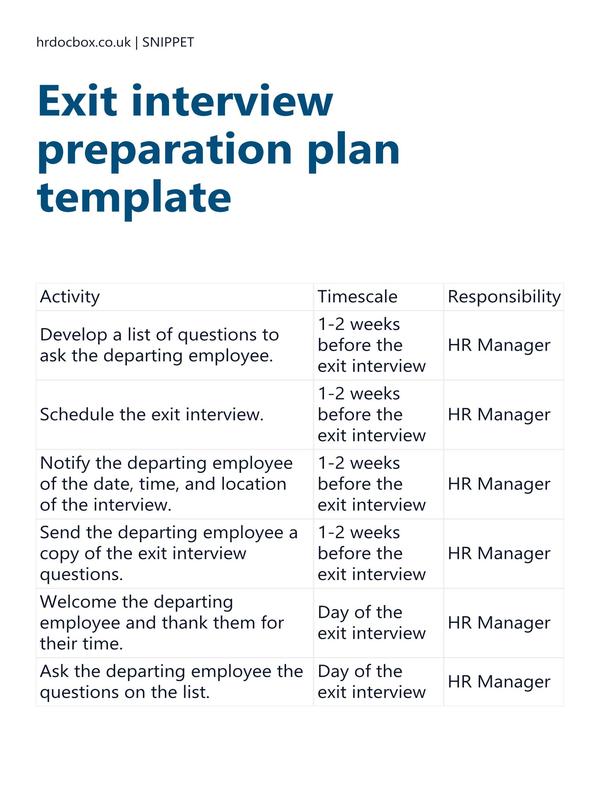
| Activity | Timescale | Responsibility | Completed |
| Review the employee's role, leaving arrangements and any relevant background information needed to prepare appropriately. | 1–2 weeks before the interview | HR Manager | [ ] |
| Develop a list of relevant, open-ended exit interview questions tailored to the employee's role and circumstances. | 1–2 weeks before the interview | HR Manager | [ ] |
| Schedule the interview and confirm the date, time, location or meeting link. | 1–2 weeks before the interview | HR Manager | [ ] |
| Notify the employee of the arrangements, explain the purpose of the interview and clarify that participation is voluntary. | 1–2 weeks before the interview | HR Manager | [ ] |
| Send the employee the questions or an outline of the topics to be discussed, where appropriate. | Before the interview | HR Manager | [ ] |
| Prepare a suitable meeting space or online meeting, an interview record and any necessary supporting documents. | Before the interview | HR Manager | [ ] |
| Welcome the employee, explain the purpose and limits of confidentiality, and confirm how feedback will be recorded and used. | On the interview date | HR Manager / Interviewer | [ ] |
| Ask the prepared questions, listen actively, ask relevant follow-up questions and allow the employee to explain their experience. | During the interview | HR Manager / Interviewer | [ ] |
| Record the feedback accurately, distinguish facts from opinions and identify any serious concerns requiring separate consideration. | During and immediately after the interview | HR Manager / Interviewer | [ ] |
| Review the interview notes, identify themes and refer any concerns requiring formal investigation or urgent action. | Within 1–2 weeks after the interview | HR Manager | [ ] |
| Develop an improvement plan with specific actions, named owners, target dates and review arrangements. | Within 1–2 weeks after the interview | HR Manager / Relevant Managers | [ ] |
| Communicate appropriate actions to relevant stakeholders, protect confidential information and monitor agreed improvements. | Within 1–2 weeks after the interview, then ongoing | HR Manager / Relevant Managers | [ ] |
Key Topics to Consider
Use the following topics to guide preparation. Select those relevant to the employee rather than asking every question automatically.
Confidentiality and Sensitive Concerns
Before the interview, check the organisation's data protection and relevant HR procedures. Explain that feedback will be handled appropriately but that information may need to be shared where necessary to address serious concerns or meet legal obligations. Refer allegations of misconduct, discrimination, harassment, health and safety issues or possible whistleblowing to the appropriate process.
Post-Interview Review and Action Plan
| Main feedback themes | |
| Issues requiring individual follow-up | |
| Areas for organisational improvement | |
| Agreed action and owner | |
| Target completion date | |
| Review date and progress |
Completion and Review
Interview completed by: [Name]
Date notes reviewed: [Date]
Follow-up actions assigned to: [Name / Department]
Next review date: [Date]
Record stored in: [Approved HR system / secure location]

An Exit Interview Preparation Plan helps an organisation gather useful feedback when an employee leaves. A structured approach reduces the risk of overlooking important questions, makes the process more consistent and helps the organisation identify opportunities to improve the employee experience, management practices and retention. This template provides a practical sequence of activities before, during and after the interview.
HR should arrange a suitable date, time and location, select questions relevant to the employee's experience and explain the purpose of the discussion. Sending questions in advance can help the employee reflect on their experience. The interview should be arranged sensitively and should not interfere unnecessarily with handover responsibilities or other leaving arrangements.
The interviewer should welcome the employee, explain how the feedback will be used and listen without becoming defensive. Open questions can explore reasons for leaving, management support, workload, development opportunities, working relationships, culture and what might have improved the employee's experience. The interviewer should ask appropriate follow-up questions, distinguish facts from opinions and avoid promising outcomes that cannot be guaranteed.
Employees may raise concerns about bullying, discrimination, health and safety, safeguarding, misconduct or other serious matters. These should not simply be treated as general feedback: HR should consider whether a separate formal process, investigation or urgent action is required. The interviewer should explain the limits of confidentiality and ensure personal information is recorded, shared and retained appropriately.
Following the interview, HR should review the notes, identify relevant themes and decide whether any individual concerns require action. Where appropriate, feedback should be considered alongside other exit interviews, engagement surveys and workforce information. Improvement actions should have a named owner, a target date and a review point so that the organisation learns from feedback rather than merely collecting it.
This plan can be used by small businesses and larger employers alike. It should be adapted to the organisation's grievance, whistleblowing, data protection and offboarding procedures, and used alongside a suitable exit interview questions form and interview record.
Use these best practice actions, recommended timescales and process stages to understand when and how the Exit interview preparation plan should be used, helping ensure each step is handled consistently and appropriately documented.
Understand the common mistakes to avoid when using this HR template, helping you reduce risk, prevent unnecessary costs and ensure the process is handled correctly.
It is often useful to arrange the interview during the employee's notice period, commonly in the final one or two weeks. Choose a time that allows a constructive discussion without disrupting handover or other leaving arrangements. If the employee prefers not to participate, respect that decision.
Prepare open questions about the employee's reasons for leaving, role expectations, workload, management support, working relationships, development opportunities, culture and suggestions for improvement. Adapt the questions to the individual's circumstances and allow appropriate follow-up questions rather than treating the interview as a rigid checklist.
Listen carefully, record the information accurately and assess whether any immediate action is needed. Allegations involving bullying, discrimination, harassment, serious misconduct, health and safety or possible whistleblowing may require a separate formal process. Follow the relevant procedure, protect personal information and avoid promising absolute confidentiality.
Review feedback for individual concerns and recurring themes. Where appropriate, compare findings with other exit interviews, engagement surveys and workforce data. Turn improvement opportunities into specific actions with named owners and target dates, then monitor progress. Share aggregated themes where useful, taking care not to identify individuals unnecessarily.
HRDocBox provides practical, editable HR templates designed for UK employers and SMEs. Its resources help organisations follow a structured approach, document key activities consistently and turn HR processes into practical actions. Templates should be adapted to the organisation's circumstances and reviewed when relevant requirements change.
HRDocBox provides purpose-built HR documentation structured around practical workplace processes and UK employment considerations. A dedicated template helps ensure that important preparation, recording and follow-up activities are not overlooked. AI can help tailor wording and support planning, but legal requirements and sensitive employee matters should still be checked against current official guidance and the organisation's procedures.
How this content is developed and reviewed
The Exit interview preparation plan template is developed using a practical HR methodology that considers current UK employment legislation, ACAS guidance, CIPD good practice and the real-world HR process it supports. Templates and supporting information are regularly reviewed and updated, with additional reviews triggered by significant changes to legislation, guidance or established HR practice, helping ensure each document remains practical, relevant and suitable for UK employers.
Darryl Horn, Chartered HR Director
Darryl is a Chartered HR professional with over 25 years' experience in senior HR and employee relations roles.
He has extensive practical experience of managing exit interview HR processes and founded hrdocbox to provide businesses with practical, professionally developed HR resources grounded in UK employment law and best practice.
HRDocBox has been creating practical UK HR documents since 2009.
"Darryl provides support and advice with excellent judgement, and has a strong understanding of people, policies and UK employment legislation."
"He is someone I trust; consistent, dependable, and committed to doing things properly."




















Whether you employ 5 people or 50, hrdocbox gives you the structure, documents and expertise needed to manage employees professionally and legally.
Professionally written and fully compliant with UK employment law
Access a free contract template instantly - or save 10% on any document today.
Use this code at checkout for 10% off anything!
Includes instant download, updates, and full access to your HR templates.