Libraries
780+ HR templates
Everything your business needs to stay compliant
Policies, contracts, letters, guidance and HR support tools for UK employers.
View full libraryPolicies, contracts, letters, guidance and HR support tools for UK employers.
View full libraryA manager's guide to supporting menopause at work provides practical guidance for UK managers on recognising workplace support needs, having sensitive conversations and responding appropriately to employees experiencing perimenopause, menopause or post-menopause.
Use this guide to:
If you are supporting employee wellbeing, the toolkit brings together practical HR templates covering wellbeing needs, assessment, support, communication and review.
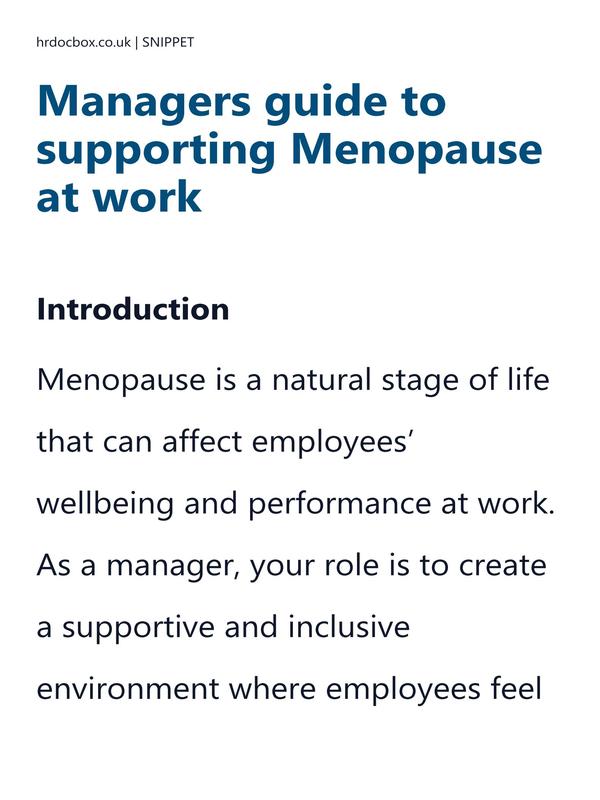
This guide brings together the key information, considerations and practical guidance you need to understand the subject, make informed decisions and take an appropriate and consistent approach. Preview the document below.
Purpose of this guide
This guide helps managers support employees experiencing perimenopause, menopause or post-menopause. It explains how to approach conversations, consider workplace support, respond to absence or performance concerns and seek further advice when needed.
Menopause affects people differently. Managers should respond to the individual, respect confidentiality and focus on practical steps that help employees work safely and effectively.
Section 1: Understanding menopause at work
What is menopause?
Menopause is a natural stage of life that may involve physical, psychological and other symptoms. Perimenopause is the period leading up to menopause, and some symptoms may continue after menopause.
Symptoms and their impact vary considerably. Some people experience few difficulties, while others may find that symptoms affect their comfort, sleep, concentration, confidence or ability to manage particular working conditions.
Menopause can affect cisgender women and some transgender, non-binary and intersex people. Managers should avoid assumptions about who may be affected.
How can menopause affect work?
Potential workplace concerns may include:
These are examples only. Managers should ask what matters to the individual rather than assume that any particular symptom is present.
Section 2: The manager's responsibilities
Create a supportive environment
Managers should help create a workplace where employees feel able to raise concerns without embarrassment or fear of unfair treatment. Menopause should be approached professionally, just like other workplace health and wellbeing matters.
Listen and respond fairly
Take concerns seriously, avoid dismissive comments and consider the employee's individual circumstances. Do not make assumptions about age, capability, commitment or future performance.
Consider workplace support
Explore practical options that may help the employee manage their work. Follow organisational procedures and seek HR or specialist advice where appropriate.
You've seen 20% of how the Managers guide to supporting Menopause at work is structured. Get the complete editable template instantly and customise it for your organisation.

Managers play an important role in creating a workplace where employees can discuss menopause-related concerns without embarrassment or fear of being treated unfairly. Menopause affects people differently, and symptoms may change over time. For some employees, symptoms can affect sleep, concentration, confidence, physical comfort or the ability to manage particular working conditions.
This managers guide to supporting menopause at work provides practical advice on how to recognise potential support needs, approach conversations and consider proportionate workplace measures. It is suitable for organisations looking to give managers a consistent approach while allowing decisions to reflect individual circumstances and operational requirements.
The guide explains how to approach the subject sensitively, listen without making assumptions and ask open questions about the employee's experience at work. Managers should not diagnose symptoms, press employees to disclose personal medical information or assume that everyone experiencing menopause needs the same support.
Managers are encouraged to consider the working environment, access to facilities, rest breaks, shift patterns, workload and temporary flexibility where appropriate. The guide also explains when to involve HR, consider a workplace risk assessment or seek occupational health advice. Any proposed measures should be assessed individually and implemented consistently with applicable legal duties and workplace requirements.
Menopause-related concerns should be handled sensitively within the organisation's normal absence and performance management processes. Managers should explore whether workplace factors or unmet support needs are contributing to difficulties, consider relevant reasonable adjustments and avoid assumptions about capability or commitment. Decisions should be evidence-based, fair and consistent with the organisation's policies.
The guide covers relevant equality, health and safety and confidentiality considerations, helping managers understand when to seek specialist advice rather than make decisions outside their authority. It encourages managers to record necessary actions securely, agree responsibilities and review whether support is effective. Used alongside a menopause policy, the guide can help turn organisational commitments into consistent day-to-day management practice.
Related HR resources and workflow
Explore the HR resources that may be relevant before and / or after using the Managers guide to supporting Menopause at work, helping you understand the wider process, maintain appropriate documentation and follow a consistent approach.

The Menopause Policy explains how the organisation will support employees experiencing menopause or perimenopause and promote a respectful, inclusive workplace.
Use the following as a practical framework for assessing the situation, considering the available options and deciding on the appropriate course of action. Follow each step in sequence to support consistent, informed and appropriate decision-making.
Understand the common mistakes to avoid when using this HR template, helping you reduce risk, prevent unnecessary costs and ensure the process is handled correctly.
It is a practical resource that helps managers understand menopause-related workplace concerns, hold sensitive conversations and consider appropriate support. It also explains when to involve HR or other specialists and how to approach confidentiality, absence and performance matters fairly.
No. Managers need to listen, understand the potential impact of menopause at work, avoid assumptions and know where to obtain further advice. They should not diagnose symptoms or attempt to provide medical treatment. Occupational health or an appropriate healthcare professional may help where specialist advice is needed.
Depending on the employee's circumstances, options may include additional breaks, flexibility in working hours, changes to duties, access to drinking water and toilets, improved ventilation or a suitable place to rest. Discuss options individually, consider operational and safety requirements and seek HR advice where necessary. Where the legal duty to make reasonable adjustments applies, the employer must meet that duty.
Follow the organisation's procedures while considering the employee's circumstances and any relevant support needs. ACAS advises employers to handle menopause-related absence sensitively and consider whether symptoms may be affecting performance. Recording menopause-related sickness absence separately can help avoid unfair treatment through indiscriminate attendance measures. Seek HR advice before formal action where relevant circumstances may affect the decision.
HRDocBox provides customisable HR resources designed for UK employers. This guide gives managers a structured starting point for supportive conversations, practical workplace action and consistent decision-making. It can be adapted to reflect your organisation's menopause policy, management responsibilities and internal procedures.
A dedicated HRDocBox guide provides a structured resource that can be incorporated into your management toolkit and aligned with your policies. AI can help tailor wording or explore individual scenarios, but its output still needs checking for legal accuracy, practical suitability and consistency with your organisation's procedures. Employers remain responsible for the decisions they make and the support they provide.
How this content is developed and reviewed
The Managers guide to supporting Menopause at work is developed using a practical HR methodology that considers current UK employment legislation, ACAS guidance, CIPD good practice and the real-world HR process it supports. Templates and supporting information are regularly reviewed and updated, with additional reviews triggered by significant changes to legislation, guidance or established HR practice, helping ensure each document remains practical, relevant and suitable for UK employers.
Darryl Horn, Chartered HR Director
Darryl is a Chartered HR professional with over 25 years' experience in senior HR and employee relations roles.
He has extensive practical experience of managing wellbeing HR processes and founded hrdocbox to provide businesses with practical, professionally developed HR resources grounded in UK employment law and best practice.
HRDocBox has been creating practical UK HR documents since 2009.
"Darryl provides support and advice with excellent judgement, and has a strong understanding of people, policies and UK employment legislation."
"He is someone I trust; consistent, dependable, and committed to doing things properly."














Whether you employ 5 people or 50, hrdocbox gives you the structure, documents and expertise needed to manage employees professionally and legally.
Professionally written and fully compliant with UK employment law
Access a free contract template instantly - or save 10% on any document today.
Use this code at checkout for 10% off anything!
Includes instant download, updates, and full access to your HR templates.