Medical report request to GP letter template

Quick preview
£9.99
4.0
Customer reviews 1 review
UK-specific Editable Instant download 12 months' updates

This Medical Report Request to GP Letter provides a structured way for an employer to request relevant medical information from an employee's GP or other medical practitioner responsible for their clinical care. It helps employers ask focused questions about fitness for work, likely absence, adjustments and return-to-work considerations while respecting the employee's medical confidentiality and legal rights.

Use this template to:

  • Request relevant medical information about an employee's health and ability to work
  • Explain why the medical report is required
  • Ask focused questions relevant to the employee's employment
  • Confirm that the employee has provided the required consent
  • Establish whether adjustments, rehabilitation or alternative duties may be appropriate
  • Support informed absence, capability and return-to-work decisions
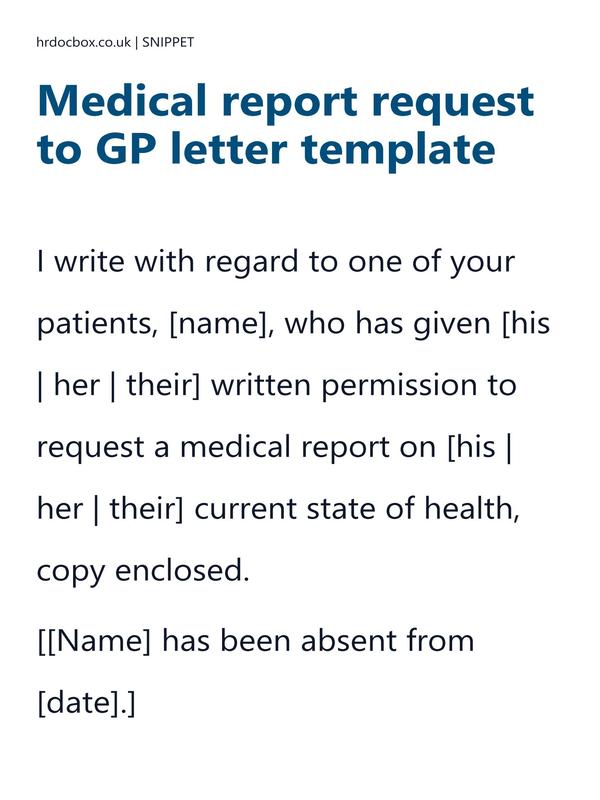
Medical report request to GP letter template
2026 Reviewed
Get the complete resource

Don't just buy one template — get the complete Sick management templates toolkit

If you are managing sickness absence, the toolkit brings together practical HR templates covering absence reporting, return-to-work meetings, reviews, support and formal action.

49 templates • £24.99 • 12 months' access & updates
View the complete toolkit

What's included in this template?

This template brings together the key information, sections and considerations you need to create a clear, comprehensive and professional HR document. Preview the document below.

  • Employee and employment details
  • Confirmation of employee consent
  • Reason for requesting the medical report
  • Focused questions for the GP or medical practitioner
  • Information about fitness, prognosis and workplace adjustments
  • Confidentiality, report handling and return arrangements
Template

Download .doc

Copy [to paste]

Email

[Sender name]

[Sender address]

[date]

[Recipient name]

[Recipient address]


Dear [Recipient first name],

Request for Medical Report – [Employee Full Name]

I am writing to request a medical report concerning your patient, [Employee Full Name], who is employed by [Company] as [Job Title].

We have obtained the employee's written consent to make this request and attach the signed consent documentation for your records.

The employee has confirmed that they:

[Do want / Do not want] to see the report before it is supplied to the organisation.

Reason for the request

We are requesting the report to assist us with:

[For example: managing the employee's sickness absence / planning a return to work / considering workplace adjustments / assessing fitness for the employee's role / understanding the likely prognosis / considering appropriate support / managing a capability process.]

Employment information

Employee name [Employee Full Name]
Job title [Job Title]
Length of service [Length of Service]
Normal working pattern [Working Hours / Days / Shift Pattern]
Date absence commenced [Date]
Current absence

PREVIEW ENDS HERE

This is the end of the preview

You've seen 20% of how the Medical report request to GP letter template is structured. Get the complete editable template instantly and customise it for your organisation.
£9.99
Specifications
Access 12 months, with updates
Length 3 pages • 785 words
Jurisdiction England, Wales, Scotland
Based on UK law, ACAS guidance
Last update 29/09/2026
Update reason Terminology update.
Next review 29/03/2027
Delivery & Format Instant digital delivery, .doc · .txt · email

What is a medical report request to GP letter?

Medical report request to GP letter template preview

This letter provides a practical framework for requesting relevant medical information from an employee's GP or another medical practitioner responsible for their clinical care. It is designed for situations where medical information is needed to help the employer understand the employee's ability to work and make appropriate employment decisions.

Explaining why information is required

The request should explain the employment-related reason for seeking medical information, such as managing long-term absence, planning a return to work, considering reasonable adjustments or understanding whether the employee is fit to continue in their role.

Asking focused questions

The GP should only be asked for information that is relevant and necessary for the purpose. Questions can cover likely duration of absence, fitness for work, functional restrictions, adjustments, treatment-related considerations and the likely timescale for returning to work.

Confirming employee consent

The employer must obtain the employee's permission before applying to a GP or other medical practitioner responsible for their clinical care for a medical report covered by the Access to Medical Reports Act 1988. The employee has specific rights regarding access to and disclosure of the report.

Supporting employment decisions

The report should provide information to help the employer make informed decisions rather than asking the GP to decide employment matters. The employer remains responsible for considering the medical evidence alongside the employee's circumstances, role requirements and applicable employment law.

Protecting medical information

Medical information is highly sensitive personal information and should only be accessed by people who genuinely need it. The organisation should explain how the report will be used, stored and shared and should apply appropriate security and retention controls.

Example

An employee has been absent from work for several months following a health condition. The employee has provided fit notes, but the organisation needs more information to understand whether a return to work is likely and whether adjustments could support that return.

HR discusses the situation with the employee and explains that the organisation would like to request a medical report from their GP. The employee is given information about their rights under the Access to Medical Reports Act 1988 and provides written consent. They also request the opportunity to see the report before it is sent to the employer.

The employer's letter to the GP asks focused questions about the employee's likely prognosis, fitness to return to their role, any functional restrictions and whether workplace adjustments could assist. It does not ask for the employee's complete medical history or unrelated medical information.

When the report is received, HR reviews it confidentially and discusses the relevant implications with the manager. The organisation considers the medical advice alongside the employee's views, role requirements and any reasonable adjustments before deciding what steps to take next.

The wider HR process

Related HR resources and workflow

Explore the HR resources that may be relevant before and / or after using the Medical report request to GP letter, helping you understand the wider process, maintain appropriate documentation and follow a consistent approach.

Previous
Forms
Medical declaration form

A medical declaration form to disclose information that may impact an ability to perform tasks or may require adjustments to ensure workplace safety.

This
Medical report request to GP letter
Next
Letters
Medical report consent request to employee letter

This Medical Report Consent Request to Employee Letter asks an employee for permission for the employer to approach their doctor for a medical report.

Premium content

To continue reading, purchase this item or a parent toolkit, library or our full library.

Implementation guidance

Use these best practice actions, recommended timescales and process stages to understand when and how the Medical report request to GP letter should be used, helping ensure each step is handled consistently and appropriately documented.

Step Description Responsibility Timing
1 Identify why medical information is required and what specific employment-related questions need to be answered. HR / Manager Before requesting consent
2 Explain the proposed medical report to the employee, including why it is required, what information is being requested and the employee's rights. HR / Manager Before contacting the GP
3 Obtain the employee's written consent and establish whether they want to see the report before it is supplied to the employer. HR / Employee Before the report is requested
4 Send the GP or medical practitioner a focused request, including the employee's consent and relevant employment information. HR Promptly after consent is received
5 Review the report confidentially, discuss relevant findings with the employee where appropriate and consider adjustments, return-to-work options or other employment steps. HR / Manager As soon as practicable after receiving the report
Premium content

To continue reading, purchase this item or a parent toolkit, library or our full library.

Common mistakes

Understand the common mistakes to avoid when using this HR template, helping you reduce risk, prevent unnecessary costs and ensure the process is handled correctly.

  • Requesting a medical report without obtaining the employee's required consent
  • Asking the GP for the employee's complete medical records or unrelated medical information
  • Asking the GP to make the employment decision rather than provide medical information
  • Failing to tell the GP whether the employee wants to see the report before it is supplied
  • Allowing medical information to be accessed by people who do not genuinely need it
  • Failing to consider reasonable adjustments or alternative working arrangements after receiving the report
Premium content

To continue reading, purchase this item or a parent toolkit, library or our full library.

HR considerations

UK employment law and best practice

This template is designed to support the process, but the document should be used alongside the relevant HR procedure and applied to the circumstances of the individual case.

Employee consent

An employer must obtain the employee's permission before applying to their GP or another medical practitioner responsible for their clinical care for a medical report covered by the Access to Medical Reports Act 1988. The employee must also be informed in writing of their rights under the Act. https://www.acas.org.uk/getting-a-doctors-report-about-an-employees-health https://www.legislation.gov.uk/ukpga/1988/28/contents

Employee rights under the Access to Medical Reports Act 1988

The employee has the right to refuse permission for the report to be obtained, ask to see the report before it is supplied to the employer, ask the doctor to amend information that is inaccurate or misleading, refuse to allow the report to be supplied after seeing it, and request access to the report for up to six months after it has been supplied. Where the employee wishes to see the report before it is supplied, they must normally contact the doctor within 21 days of the employer applying for the report. https://www.acas.org.uk/getting-a-doctors-report-about-an-employees-health https://www.legislation.gov.uk/ukpga/1988/28/contents

Only request information that is necessary

An employer should request only the medical information needed for the employment purpose. Employers should not normally seek access to an employee's complete GP records or comprehensive medical history. The request should instead ask focused questions about matters such as fitness for work, likely absence, functional restrictions, return to work and workplace adjustments. https://www.acas.org.uk/getting-a-doctors-report-about-an-employees-health https://ico.org.uk/for-organisations/uk-gdpr-guidance-and-resources/employment/information-about-workers-health/what-if-we-use-occupational-health-schemes/

Health information is special category data

Information about an employee's physical or mental health is special category personal data under UK GDPR and requires both an appropriate lawful basis under Article 6 and a condition for processing under Article 9, together with any additional requirements that apply under the Data Protection Act 2018. Employers should document the basis on which they process health information. https://ico.org.uk/for-organisations/uk-gdpr-guidance-and-resources/employment/information-about-workers-health/data-protection-and-workers-health/ https://ico.org.uk/for-organisations/uk-gdpr-guidance-and-resources/lawful-basis/special-category-data/what-are-the-conditions-for-processing/

Confidentiality and access

Medical information should be kept confidential and only made available to people who genuinely need access to it. Employers should apply appropriate security controls to health information and should explain to the employee how the report will be stored and used. https://www.acas.org.uk/getting-a-doctors-report-about-an-employees-health https://ico.org.uk/for-organisations/uk-gdpr-guidance-and-resources/employment/information-about-workers-health/data-protection-and-workers-health/

Long-term sickness absence

Medical evidence can help an employer understand an employee's likely absence, ability to return to work and possible support or adjustments. Employers should not rely solely on a medical report to make an employment decision and should consider the employee's own views and circumstances as part of a fair process. https://www.acas.org.uk/long-term-sickness-absence

Reasonable adjustments

Where an employee may be disabled under the Equality Act 2010, the employer should consider whether reasonable adjustments are required. Medical information may help identify appropriate adjustments, but employers should consider the available evidence and discuss potential adjustments with the employee rather than simply relying on a diagnosis. https://www.acas.org.uk/reasonable-adjustments https://www.gov.uk/rights-disabled-person/employment

Medical evidence and capability decisions

Where medical evidence is being obtained as part of a capability process, the information should be used to understand the employee's ability to carry out their role and the support or adjustments that may be appropriate. If dismissal is ultimately being considered, the employer should follow a fair capability procedure and consider alternatives before reaching a decision. https://www.acas.org.uk/capability-procedures

Occupational health

An occupational health assessment may be more appropriate than approaching a GP where the organisation needs advice specifically about the employee's ability to work, workplace adjustments, rehabilitation or a return-to-work plan. If an occupational health provider needs further clinical information from the employee's doctor, the relevant consent and medical report requirements should still be considered. https://www.acas.org.uk/using-occupational-health-at-work/using-occupational-health-to-help-someone-at-work https://ico.org.uk/for-organisations/uk-gdpr-guidance-and-resources/employment/information-about-workers-health/what-if-we-use-occupational-health-schemes/

Keeping the report

The employer should retain the medical report only for as long as it is needed for the purpose for which it was obtained and in accordance with its data retention arrangements. Access should be restricted and the report should be stored securely because it contains health information.

You may also need these resources

FAQs

Do I need the employee's permission before contacting their GP?

Yes. Where the Access to Medical Reports Act 1988 applies, the employer must obtain the employee's permission before applying to their GP or another medical practitioner responsible for their clinical care for a medical report.

Can I ask the GP for the employee's full medical records?

Normally, no. The request should be limited to the information that is genuinely needed for the employment purpose. For example, the employer may ask about likely duration of absence, fitness for work, functional restrictions or possible workplace adjustments.

Can the employee see the report before the employer?

Yes. An employee has the right to ask to see the report before it is supplied to the employer. If they want to do this, the employer should tell the doctor when making the application and the employee will normally need to contact the doctor within 21 days of the application.

What if the employee refuses consent?

An employee can refuse permission for the employer to obtain a medical report. The employer may then need to make decisions using other available information, such as information provided by the employee, fit notes or an occupational health report where one is available.

Should I ask the GP whether the employee is disabled?

You can ask relevant questions about whether the employee's health may affect their work and whether adjustments may help, but employers should avoid seeking unnecessary diagnostic information. Whether an employee meets the legal definition of disability is ultimately an employment and legal consideration rather than simply a medical diagnosis.

Why use HRDocBox rather than AI?

HRDocBox templates provide a structured starting point designed for UK employers, combining practical HR wording with relevant employment law, Acas guidance and data protection considerations. AI can generate a letter, but a structured template helps ensure the consent, medical confidentiality and focused-information requirements are not overlooked.

Customer reviews

What people are saying

Back to product

This was a pleasant surprise when we had several things on

robert • 23 May 2026

The manager could use it without needing a long explanation first. It gave us a useful reference when checking the final correspondence.

How this content is developed and reviewed

The Medical report request to GP letter template is developed using a practical HR methodology that considers current UK employment legislation, ACAS guidance, CIPD good practice and the real-world HR process it supports. Templates and supporting information are regularly reviewed and updated, with additional reviews triggered by significant changes to legislation, guidance or established HR practice, helping ensure each document remains practical, relevant and suitable for UK employers.

About the author

Darryl Horn, Chartered HR Director

Darryl is a Chartered HR professional with over 25 years' experience in senior HR and employee relations roles.

He has extensive practical experience of managing sick management HR processes and founded hrdocbox to provide businesses with practical, professionally developed HR resources grounded in UK employment law and best practice.

HRDocBox has been creating practical UK HR documents since 2009.

Executive recommendation

"Darryl provides support and advice with excellent judgement, and has a strong understanding of people, policies and UK employment legislation."

"He is someone I trust; consistent, dependable, and committed to doing things properly."

RB
Ruth Brock Chief Executive Officer The Hygiene Bank
Get started today

HR confidence starts here

Whether you employ 5 people or 50, hrdocbox gives you the structure, documents and expertise needed to manage employees professionally and legally.

Download your FREE UK employment contract template

Professionally written and fully compliant with UK employment law
Download FREE contract
Free UK employment contract template