File note form template

£14.99

UK-specific • Editable • Instant download • 12 months' updates

The File Note Form provides a structured way for HR professionals and managers to record important workplace conversations, meetings, incidents and decisions. It creates a clear contemporaneous record of what was discussed, the employee's response, any actions agreed and relevant follow-up.

Use this template to:

  • Record important workplace conversations and discussions.
  • Create a clear contemporaneous HR record.
  • Capture the employee's comments and response.
  • Record actions, decisions and follow-up requirements.
  • Support consistent employee relations documentation.
  • Maintain an organised record for future reference.
File note form template
2026 Reviewed

What's included in this template?

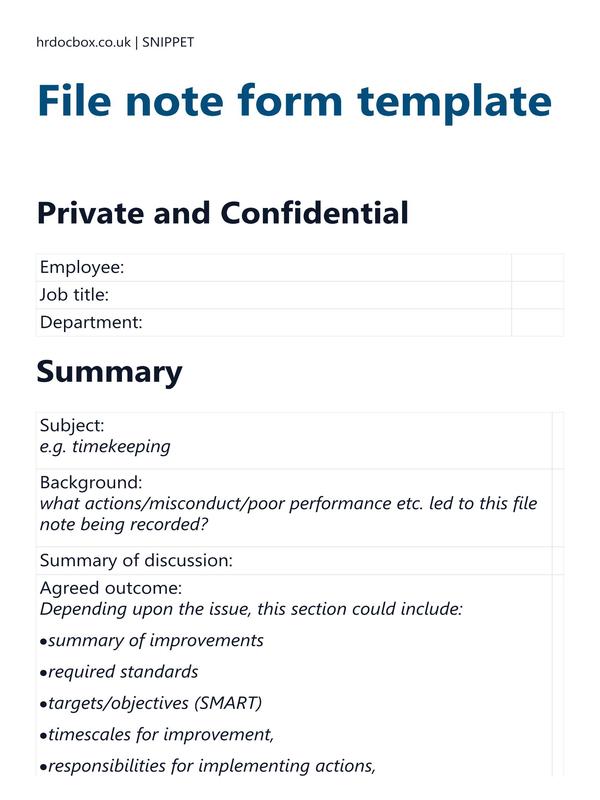
This template brings together the key information, sections and considerations you need to create a clear, comprehensive and professional HR document. Preview the document below.

  • Meeting and conversation details
  • Reason for the file note
  • Discussion and employee response
  • Evidence and supporting information
  • Actions and decisions
  • Follow-up and record confirmation
Specifications
Access 12 months (includes updates)
Length 2 pages • 313 words
Jurisdiction England, Wales and Scotland
Based on UK employment law, ACAS guidance
Last review 24/08/2026
Next review 24/02/2027
Delivery Instant download
Formats .doc · .xls · .txt · email

Download .doc

Edit .xls

Copy [to paste]

Email
Template

File note

File Note Form

Meeting / conversation details

Employee name:  
Job title:  
Department:  
Date:  
Time:  
Location / method:  
Person making the note:  
Others present:  

Reason for the file note

Subject / reason for discussion:  
Background / relevant context:  
PREVIEW ENDS HERE

This is the end of the preview

You've seen just 30% of how the File note form template is structured. Get the complete editable template instantly and customise it for your organisation.
£14.99

Need the complete Disciplinary process?

Explore the Disciplinary templates toolkit

What is a file note form?

File note form template preview

A File Note Form is used to create a contemporaneous written record of an important workplace conversation, meeting, incident or decision. It provides a consistent structure for recording what happened, what was discussed and what was agreed.

A well-prepared file note can provide useful evidence of how an issue was managed and help ensure that important information is not lost or dependent on someone's recollection at a later date.

What is it used for?

The form can be used for a wide range of HR situations, including informal performance discussions, absence conversations, employee concerns, management discussions, return-to-work conversations, conduct issues and follow-up meetings.

It is particularly useful where the conversation does not require formal meeting minutes but there is still value in creating an accurate record.

Who should use it?

The template is suitable for HR professionals, managers and employers who need to maintain clear records of employee-related conversations and decisions.

How should it be used?

The file note should be completed as soon as reasonably practicable after the conversation while the details remain fresh. It should record factual information and the key points discussed rather than subjective commentary or unnecessary assumptions.

Example

A manager has an informal conversation with an employee after concerns are raised about repeated missed deadlines. The manager explains the concerns and asks the employee whether there is anything affecting their ability to complete the work on time.

The employee explains that they have recently taken responsibility for an additional process and have been struggling to manage the increased workload. The manager agrees to review the workload and provides additional support.

After the meeting, the manager completes a file note recording the concerns discussed, the employee's explanation, the agreed actions and the date for a follow-up discussion.

The file note provides a contemporaneous record of the conversation if the issue needs to be revisited later.

The wider HR process

Related HR resources and workflow

Explore the HR resources that may be relevant before and / or after using the File note form, helping you understand the wider process, maintain appropriate documentation and follow a consistent approach.

Previous
Letters
Concern about performance letter

Use this model letter to notify an employee that you have a concern over their performance, that may warrant disciplinary action should it happen again.

This
File note form
Next
Letters
Verbal (informal) warning letter

Our Verbal Warning Letter Template facilitates prompt informal resolution of performance issues, ensuring clear communication and promoting improvement.

Premium content

To continue reading, purchase this item or a parent toolkit, library or our full library.

Implementation guidance

Use these best practice actions, recommended timescales and process stages to understand when and how the File note form should be used, helping ensure each step is handled consistently and appropriately documented.

Step Description Responsibility Timing (Days from Issue)
1 Prepare for the Discussion: Identify the reason for the conversation and gather any relevant information or records before meeting with the employee. Manager / HR Day -3 to Day -1
2 Hold the Conversation: Discuss the relevant issue and give the employee an appropriate opportunity to provide their explanation or response. Manager / HR / Employee Day 0
3 Complete the File Note: Record the key points discussed, evidence considered, employee response and any agreed actions as soon as reasonably practicable. Manager / HR Day 0 to Day 1
4 Record Actions: Confirm who is responsible for any agreed actions and record relevant deadlines, support or follow-up arrangements. Manager / HR Day 1
5 Store the Record: Retain the completed file note securely in accordance with the Company's HR record-keeping and data protection arrangements. HR / Management Day 1 onwards
Premium content

To continue reading, purchase this item or a parent toolkit, library or our full library.

Common mistakes

Understand the common mistakes to avoid when using this HR template, helping you reduce risk, prevent unnecessary costs and ensure the process is handled correctly.

  • Writing subjective or judgmental comments instead of factual observations.
  • Recording the employee's comments inaccurately or leaving out relevant responses.
  • Waiting too long before completing the file note.
  • Failing to record agreed actions and follow-up dates.
  • Including unnecessary personal or sensitive information.
  • Failing to store the completed record securely.
Premium content

To continue reading, purchase this item or a parent toolkit, library or our full library.

HR considerations

UK employment law and best practice

This template is designed to support the process, but the document should be used alongside the relevant HR procedure and applied to the circumstances of the individual case.

Good HR record keeping helps employers demonstrate what was discussed, what information was considered and what actions were taken. ACAS recommends keeping written records where appropriate when managing disciplinary, grievance and performance matters. https://www.acas.org.uk/acas-code-of-practice-on-disciplinary-and-grievance-procedures

Accurate and contemporaneous records

A file note should be prepared as close to the conversation as reasonably practicable and should distinguish between factual information, what people said and the manager's own observations or conclusions.

Accurate records can be particularly important if an informal issue subsequently progresses into a formal capability, disciplinary or grievance process.

Fair performance management

ACAS recommends that employers discuss performance concerns with employees and give them an opportunity to explain what is happening before deciding what action may be appropriate. https://www.acas.org.uk/improving-performance-and-conduct

A file note can record both the employer's concerns and the employee's response, helping to demonstrate that the discussion was not based solely on one-sided assumptions.

Disciplinary and grievance procedures

Where an issue progresses into a formal disciplinary or grievance process, employers should follow a fair procedure and keep appropriate records of the process. The ACAS Code of Practice emphasises the importance of establishing the necessary facts and giving employees an opportunity to respond. https://www.acas.org.uk/acas-code-of-practice-on-disciplinary-and-grievance-procedures

Data protection

File notes are likely to contain personal information and should therefore be handled in accordance with UK data protection requirements. The ICO explains that employers should ensure personal data is processed fairly, securely and only retained for as long as necessary. https://ico.org.uk/for-organisations/sme-web-hub/employment/

Employers should avoid recording unnecessary personal information or speculative comments that are not relevant to the purpose of the record.

Consistency and objectivity

Managers should focus on relevant facts and avoid loaded language, assumptions or personal judgements. A good file note records what was discussed rather than attempting to rewrite the conversation in a way that supports a predetermined outcome.

You may also need these resources

FAQs

What is a file note used for?

A file note provides a written record of an important workplace conversation, meeting, incident or decision. It is particularly useful for informal HR discussions that do not require formal meeting minutes.

Does an employee have to sign a file note?

Not necessarily. A file note is normally the manager's or HR professional's record of the conversation. If appropriate, the employee can be given an opportunity to comment on factual inaccuracies, but their signature is not automatically required.

Why use HRDocBox for a File Note Form?

HRDocBox combines deep HR knowledge, practical application and years of experience with real employee relations situations. The form provides a structured way to capture the facts, employee response and agreed actions without turning every workplace conversation into an unnecessarily formal process.

Why use HRDocBox rather than asking AI to create the form?

AI can produce a generic meeting-notes template, but HR file notes need to balance useful evidence with factual, proportionate and appropriate record keeping. HRDocBox combines UK employment-law knowledge, ACAS guidance and practical HR experience.

How much detail should a file note contain?

Enough to provide a reliable record of the reason for the discussion, key points raised, employee response, evidence considered and actions agreed. It should avoid unnecessary detail, speculation or subjective commentary.

Can a file note be used as evidence in a formal HR process?

Yes. A contemporaneous and accurate file note may provide useful evidence of what was discussed and what actions were taken. Its value will depend on its accuracy, context and how it was created and maintained.

How this content is developed and reviewed

The File note form template is developed using a practical HR methodology that considers current UK employment legislation, ACAS guidance, CIPD good practice and the real-world HR process it supports. Templates are regularly reviewed and updated, with additional reviews triggered by significant changes to legislation, guidance or established HR practice, helping ensure each document remains practical, relevant and suitable for UK employers.

About the author

Darryl Horn, Chartered HR Director

Darryl is a Chartered HR professional with over 25 years' experience in senior HR and employee relations roles.

He has extensive practical experience of managing disciplinary processes and founded hrdocbox to provide businesses with practical, professionally developed HR resources grounded in UK employment law and best practice.

HRDocBox has been creating practical UK HR documents since 2009.

Executive recommendation

"Darryl provides support and advice with excellent judgement, and has a strong understanding of people, policies and UK employment legislation."

"He is someone I trust; consistent, dependable, and committed to doing things properly."
RB
Ruth Brock Chief Executive Officer The Hygiene Bank
Get started today

HR confidence starts here

Whether you employ 5 people or 50, hrdocbox gives you the structure, documents and expertise needed to manage employees professionally and legally.

Download your FREE UK employment contract template

Professionally written and fully compliant with UK employment law
Download FREE contract
Free UK employment contract template