Libraries
780+ HR templates
Everything your business needs to stay compliant
Policies, contracts, letters, guidance and HR support tools for UK employers.
View full libraryPolicies, contracts, letters, guidance and HR support tools for UK employers.
View full libraryThis Grievance Policy provides a clear and fair process for employees to raise concerns or complaints about their work, working relationships or treatment at work. It explains how grievances should be raised, investigated and resolved, including the formal hearing and appeal stages.
Use this policy to:

If you are establishing clear workplace standards, these conduct policy templates give you a practical set of policies covering expected behaviour, employee responsibilities and managing concerns.
This template brings together the key information, sections and considerations you need to create a clear, comprehensive and professional HR document. Preview the document below.
1 Overview
1.1 The organisation is committed to providing a fair, respectful and supportive working environment. Where an employee has a concern or complaint about their work, working relationships or treatment at work, they should have a clear and appropriate way to raise that concern.
1.2 The organisation encourages employees and managers to resolve concerns informally wherever this is appropriate. However, employees can raise a formal grievance where they wish to do so or where the nature of the concern makes a formal process appropriate.
1.3 Grievances will be handled fairly, consistently and as promptly as reasonably practicable. The organisation will seek to establish the relevant facts, give those involved an appropriate opportunity to explain their position and reach a reasonable decision based on the information available.
2 Scope
2.1 This policy applies to all employees and workers of the organisation.
2.2 It covers concerns relating to matters such as:
2.3 This policy does not replace specific procedures that may apply to particular matters, such as whistleblowing, disciplinary action, safeguarding or health and safety reporting. Where an issue could fall under more than one procedure, the organisation will determine the most appropriate way to deal with it.
3 General principles
3.1 Raising concerns informally
3.1.1 Employees are encouraged, where appropriate, to raise concerns with their manager in the first instance. A straightforward conversation may resolve a misunderstanding or relatively minor issue without the need for a formal process.
3.1.2 Informal resolution may include:
3.1.3 Employees are not required to attempt informal resolution where the matter is serious, where they do not feel comfortable doing so or where they reasonably believe that a formal process is more appropriate.
3.2 Raising a formal grievance
3.2.1 An employee who wishes to raise a formal grievance should normally do so in writing to their manager or HR.
3.2.2 The grievance should explain:
If the grievance concerns the employee's manager,
You've seen 20% of how the Grievance policy template is structured. Get the complete editable template instantly and customise it for your organisation.
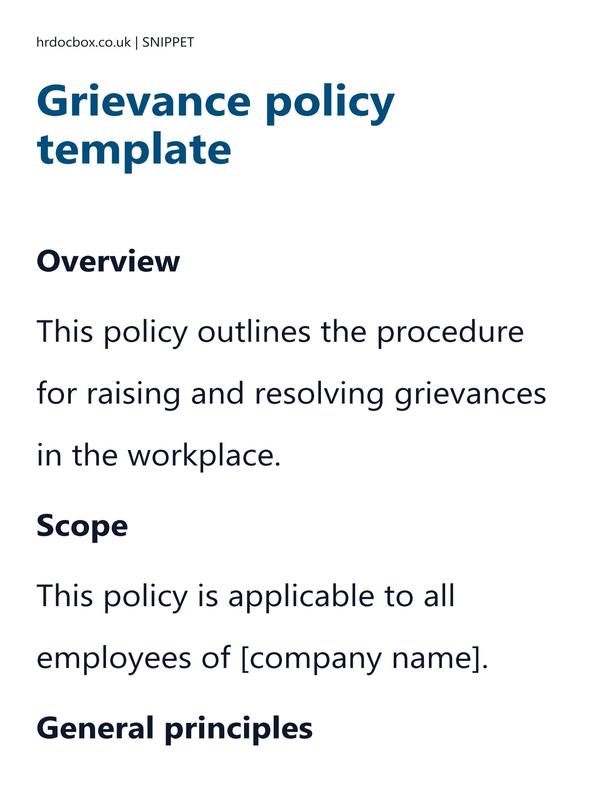
A clear grievance process gives employees a structured way to raise concerns when they believe something at work has gone wrong or has not been resolved informally. It also gives managers a consistent framework for responding to concerns, establishing the relevant facts and reaching a fair and proportionate outcome.
Where appropriate, employees should be encouraged to raise concerns informally in the first instance. Early discussion can often resolve misunderstandings or workplace issues without the need for a formal procedure. However, employees should not be required to attempt informal resolution where the circumstances are serious or where they do not feel it is appropriate.
Where an employee wishes to raise a formal grievance, the concern should normally be submitted in writing and should explain the issue and, where possible, the outcome the employee is seeking. The organisation should acknowledge the grievance, investigate where necessary and arrange a formal grievance meeting without unreasonable delay.
A grievance should be investigated to establish the relevant facts and obtain information from the appropriate people. The investigator should approach the matter impartially, consider evidence from all relevant sides and avoid reaching conclusions before the necessary information has been gathered.
The employee should have an appropriate opportunity to explain their grievance, provide evidence and respond to relevant information before a decision is made. Following the hearing and any necessary further investigation, the organisation should provide the outcome in writing and explain any action that will be taken.
An employee who remains dissatisfied with the outcome should have the opportunity to appeal. The appeal should be considered impartially and, wherever possible, by someone who was not previously involved in the matter. The appeal process should provide a genuine opportunity to review the original decision, procedure and any relevant new evidence.
Use these best practice actions, recommended timescales and process stages to understand when and how the Grievance policy should be used, helping ensure each step is handled consistently and appropriately documented.
Understand the common mistakes to avoid when using this HR template, helping you reduce risk, prevent unnecessary costs and ensure the process is handled correctly.
No. Informal discussion is often encouraged because it can resolve problems quickly, but an employee should not normally be required to attempt informal resolution where the issue is serious, where they do not feel able to do so or where a formal grievance is otherwise appropriate.
A formal grievance should normally be made in writing and explain the nature of the concern, the relevant facts or examples and, where possible, what outcome the employee would like the organisation to consider. The organisation can ask for further information if necessary.
The person responsible should be sufficiently impartial and should not have a personal interest in the outcome. Where possible, the person handling the grievance should not be directly involved in the circumstances giving rise to it. The complexity and size of the organisation will affect who can reasonably undertake the role.
There is a statutory right to be accompanied at a formal grievance meeting where the grievance concerns a complaint about a legal or contractual duty owed by the employer. This policy can also provide a broader right to accompaniment if the employer chooses to do so. The statutory companion is normally a fellow worker or an appropriate trade union representative.
The organisation will consider whether the grievance and disciplinary matters are connected. Depending on the circumstances, the disciplinary process may be paused while the grievance is considered, or related matters may be dealt with together where this provides a fairer and more efficient approach.
HRDocBox policies are designed specifically for UK employers and combine practical HR experience with employment law, Acas guidance and established HR practice. This provides a structured process that can be adapted to an organisation's circumstances rather than relying on a generic AI-generated grievance procedure.
How this content is developed and reviewed
The Grievance policy template is developed using a practical HR methodology that considers current UK employment legislation, ACAS guidance, CIPD good practice and the real-world HR process it supports. Templates and supporting information are regularly reviewed and updated, with additional reviews triggered by significant changes to legislation, guidance or established HR practice, helping ensure each document remains practical, relevant and suitable for UK employers.
Darryl Horn, Chartered HR Director
Darryl is a Chartered HR professional with over 25 years' experience in senior HR and employee relations roles.
He has extensive practical experience of managing conduct HR processes and founded hrdocbox to provide businesses with practical, professionally developed HR resources grounded in UK employment law and best practice.
HRDocBox has been creating practical UK HR documents since 2009.
"Darryl provides support and advice with excellent judgement, and has a strong understanding of people, policies and UK employment legislation."
"He is someone I trust; consistent, dependable, and committed to doing things properly."




















Whether you employ 5 people or 50, hrdocbox gives you the structure, documents and expertise needed to manage employees professionally and legally.
Professionally written and fully compliant with UK employment law
Access a free contract template instantly - or save 10% on any document today.
Use this code at checkout for 10% off anything!
Includes instant download, updates, and full access to your HR templates.