Heat of the moment resignation response letter template

£9.99
UK-specific Editable Instant download 12 months' updates

A heat of the moment resignation response letter for responding to an employee who appears to have resigned impulsively during an emotional or difficult situation and giving them an opportunity to confirm whether they genuinely intend to leave.

Use this template to:

  • Acknowledge an apparent resignation made during an emotional situation
  • Pause the normal resignation process while the employee confirms their intention
  • Give the employee an opportunity to reconsider without pressure
  • Record the circumstances surrounding the resignation
  • Confirm that no final decision will be made until the employee has clarified their position
  • Provide a fair and measured response to a potentially impulsive resignation
Heat of the moment resignation response letter template
2026 Reviewed
Get the complete resource

Don't just buy one template — get the complete Resignation templates toolkit

If you are managing employee resignations, the toolkit brings together practical HR templates covering resignation, notice, handover, exit and final pay.

9 templates £24.99 12 months' access & updates
View the complete toolkit

What's included in this template?

This template brings together the key information, sections and considerations you need to create a clear, comprehensive and professional HR document. Preview the document below.

  • Acknowledgement of the resignation
  • Reference to the circumstances
  • Opportunity to reconsider
  • Confirmation deadline
  • Support and discussion arrangements
  • Next steps once the position is confirmed
Template

Download .doc

Copy [to paste]

Email

[Sender name]

[Sender address]

[date]

[Recipient name]

[Recipient address]


Dear [Recipient first name],

Confirmation of your recent resignation

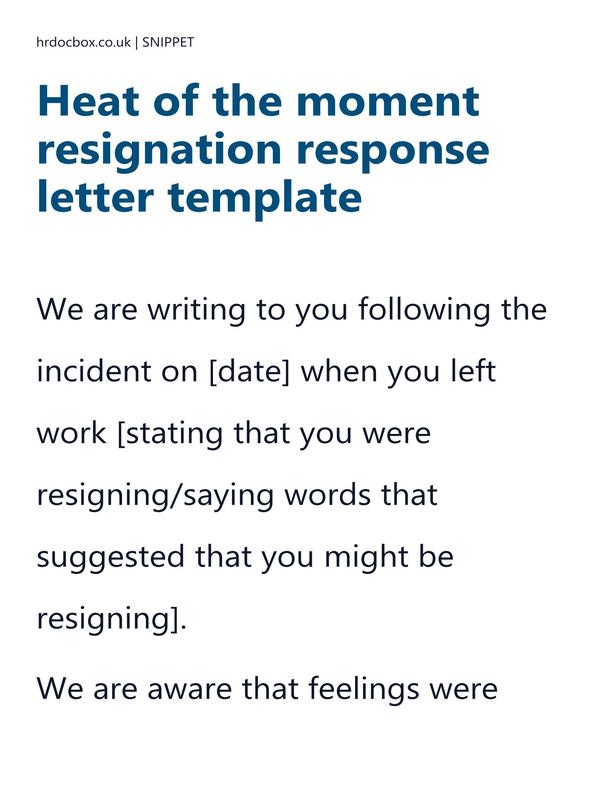
I am writing following our discussion on [date], during which you stated that you were resigning from your position as [job title].

We recognise that the discussion took place in difficult and/or emotional circumstances, and we do not want to make assumptions about your intentions or proceed with your resignation without first giving you an opportunity to reflect and confirm your position.

We therefore ask you to consider carefully whether you genuinely intend to resign from your employment with [Company Name].

Your opportunity to clarify your position

If you do intend to resign, please confirm this to [Manager / HR Contact] in writing by [date]. We will then confirm the applicable notice period and the arrangements for your departure.

If you do not intend to resign, please let us know by the same date so that we can confirm that your employment will continue.

You are not being asked to make a decision under pressure. The purpose of this letter is to make sure that we understand your genuine intention

PREVIEW ENDS HERE

This is the end of the preview

You've seen 40% of how the Heat of the moment resignation response letter template is structured. Get the complete editable template instantly and customise it for your organisation.
£9.99
Specifications
Access 12 months, with updates
Length 2 pages • 428 words
Jurisdiction England, Wales, Scotland
Based on UK law, ACAS guidance
Last review 08/09/2026
Next review 08/03/2027
Delivery Instant digital delivery
Formats .doc · .txt · email

What is a heat of the moment resignation response letter?

Heat of the moment resignation response letter template preview

An employee may sometimes say that they are resigning during an argument, following upsetting news or while experiencing a particularly emotional situation, only to reconsider afterwards. This letter provides a measured way for an employer to respond without immediately treating an apparently impulsive statement as a final resignation.

Responding to an apparent resignation

The letter acknowledges what the employee said or communicated while making clear that the employer wants to ensure there is no misunderstanding about their intention. This is particularly useful where the resignation was made verbally or in circumstances where the employee appeared highly distressed or emotional.

Giving the employee time to reconsider

The employee is given a reasonable opportunity to reflect and confirm whether they genuinely intend to resign. The approach should be supportive rather than coercive, particularly where the circumstances suggest that the employee may not have intended to make a final decision.

Understanding what led to the resignation

The employer can invite the employee to discuss what happened and whether there is an underlying workplace issue that needs to be addressed. This may identify a grievance, management issue, relationship problem or other concern that could potentially be resolved.

Confirming the next steps

Once the employee has confirmed their position, the employer can either proceed with the resignation and normal leaving arrangements or discuss appropriate steps if the employee wishes to remain. The letter creates a clear record of the interim position and avoids unnecessary assumptions.

Example

An employee has a difficult conversation with their manager about a change to their working arrangements. During the discussion, they become upset and say, "That's it, I'm resigning," before leaving the meeting. The manager does not immediately process the statement as a confirmed resignation.

Later that day, the employee contacts their manager and says they were extremely upset and are not sure whether they genuinely want to leave. HR recommends giving the employee an opportunity to reflect rather than treating the original statement as an unequivocal resignation.

HR sends a letter acknowledging what happened and inviting the employee to confirm whether they intend to resign. The letter makes clear that the employee is not being pressured either way and offers an opportunity to discuss the circumstances that led to the statement.

The employee confirms the following day that they do not wish to resign. The manager then discusses the underlying concerns with them and agrees some practical changes to address the issue. A record of the discussion is retained, but the resignation is not progressed because the employee confirmed that they did not intend to leave.

The wider HR process

Related HR resources and workflow

Explore the HR resources that may be relevant before and / or after using the Heat of the moment resignation response letter, helping you understand the wider process, maintain appropriate documentation and follow a consistent approach.

This
Heat of the moment resignation response letter
Next
Letters
Resignation acceptance letter

The Resignation Acceptance Letter formally acknowledges an employee's resignation and confirms the arrangements for the end of their employment.

Premium content

To continue reading, purchase this item or a parent toolkit, library or our full library.

Implementation guidance

Use these best practice actions, recommended timescales and process stages to understand when and how the Heat of the moment resignation response letter should be used, helping ensure each step is handled consistently and appropriately documented.

Step Description Responsibility Timing
1 Record what the employee said or communicated, the circumstances in which it occurred and whether there is any uncertainty about their intention. Manager / HR Immediately
2 Avoid immediately treating an apparently emotional or impulsive statement as a final resignation where there is genuine uncertainty about the employee's intention. Manager / HR Immediately
3 Provide the employee with an opportunity to reflect and discuss what happened, including any underlying concerns they may wish to raise. Manager / HR As soon as appropriate
4 Issue the letter asking the employee to confirm clearly whether they intend to resign and provide a reasonable timeframe for doing so. HR After initial discussion
5 Once the employee confirms their position, either proceed with the resignation and normal leaver process or address the underlying concerns and confirm that employment will continue. Manager / HR After confirmation
Premium content

To continue reading, purchase this item or a parent toolkit, library or our full library.

Common mistakes

Understand the common mistakes to avoid when using this HR template, helping you reduce risk, prevent unnecessary costs and ensure the process is handled correctly.

  • Immediately treating an emotional statement as an unequivocal resignation.
  • Pressuring the employee to confirm that they are leaving.
  • Assuming that the employee has changed their mind without obtaining confirmation.
  • Ignoring an underlying grievance or workplace problem that may have contributed to the resignation.
  • Allowing uncertainty to continue without asking the employee to clarify their position.
  • Failing to keep a clear record of what was said and the subsequent discussions.
Premium content

To continue reading, purchase this item or a parent toolkit, library or our full library.

HR considerations

UK employment law and best practice

This template is designed to support the process, but the document should be used alongside the relevant HR procedure and applied to the circumstances of the individual case.

Resignation and employer response

An employer cannot reject an employee's resignation, but Acas recommends having an informal conversation where appropriate to avoid misunderstandings or disputes. Where an employee asks to withdraw a resignation, employers should give serious consideration to the request, particularly where the employee changed their mind very quickly or their state of mind was affected by another factor. https://www.acas.org.uk/resignation/responding-to-an-employees-resignation

Heat of the moment resignations

There is no simple rule that every resignation made during an emotional conversation is automatically invalid. The circumstances, the employee's words and conduct, and whether they genuinely intended to resign may all be relevant. Employers should therefore avoid making assumptions and should establish the employee's actual intention before finalising the position.

Opportunity to reconsider

Where there is genuine uncertainty about whether an employee intended to resign, allowing them a reasonable opportunity to reflect and confirm their decision is sensible and can help prevent unnecessary disputes. Acas specifically recommends being understanding and flexible where an employee asks to withdraw a resignation. https://www.acas.org.uk/resignation/responding-to-an-employees-resignation

Underlying workplace concerns

An employee who resigns during an emotional incident may be responding to an underlying workplace problem. Employers should consider whether the employee wishes to raise a grievance or discuss the issue informally before simply progressing the resignation.

Constructive dismissal

If an employee claims that they were effectively forced to resign because of serious employer conduct or a serious breach of contract, this may raise constructive dismissal issues. Employers should take particular care where a resignation follows allegations about bullying, harassment, discrimination, pay, contractual breaches or other serious workplace concerns. https://www.acas.org.uk/dismissals/constructive-dismissal

Disciplinary situations

If the resignation occurred during or immediately following a disciplinary matter, employers should avoid putting undue pressure on the employee to leave. Acas recommends talking through concerns and giving an employee the chance to change their decision to resign where they appear to want to leave during a disciplinary process. https://www.acas.org.uk/disciplinary-procedure-step-by-step/step-2-following-a-fair-procedure

Notice period

If the employee confirms that they genuinely intend to resign, the normal contractual and statutory notice arrangements should be established and confirmed. Employees generally need to provide the notice required by their contract, subject to the circumstances of the resignation. https://www.acas.org.uk/resignation/how-to-resign

Record keeping

Employers should keep an appropriate record of the circumstances, communications and the employee's eventual confirmation. A clear record can help demonstrate that the employer acted reasonably and gave the employee an opportunity to clarify their intentions.

You may also need these resources

FAQs

Does a heat of the moment resignation automatically count?

Not necessarily. There is no automatic rule that an emotional resignation is either valid or invalid. The circumstances and the employee's actual intention are important, so where there is genuine uncertainty it is sensible to give the employee an opportunity to clarify their position.

Can an employee withdraw a resignation?

An employee can ask to withdraw their resignation, but the employer does not have to accept the withdrawal. Acas recommends giving serious consideration to the request, particularly where the employee changed their mind very quickly or their state of mind was affected by another factor. https://www.acas.org.uk/resignation/how-to-resign

How long should I give an employee to reconsider?

There is no universal statutory period specifically for reconsidering an apparent heat of the moment resignation. The employer should allow a reasonable opportunity for the employee to reflect, taking account of the circumstances, while avoiding unnecessary delay or uncertainty.

What if the employee resigned during an argument with their manager?

It is sensible to pause before finalising the resignation if there is genuine uncertainty about whether the employee intended to make a final decision. The employer should allow the situation to settle, speak with the employee and establish whether they genuinely intend to resign.

What if the employee says they were forced to resign?

This may raise a potential constructive dismissal issue, particularly where the employee alleges a serious breach of contract or other serious workplace problem. The employer should take the allegation seriously and consider obtaining appropriate HR or legal advice where necessary. https://www.acas.org.uk/dismissals/constructive-dismissal

Why use HRDocBox rather than AI?

AI can generate a generic response to an employee who says they are resigning, but it may encourage an employer to treat the resignation as final without considering the circumstances in which it was made. HRDocBox templates are designed around practical UK HR processes and help employers take a measured approach, giving the employee an opportunity to clarify their intentions while creating a clear record of the steps taken.

How this content is developed and reviewed

The Heat of the moment resignation response letter template is developed using a practical HR methodology that considers current UK employment legislation, ACAS guidance, CIPD good practice and the real-world HR process it supports. Templates and supporting information are regularly reviewed and updated, with additional reviews triggered by significant changes to legislation, guidance or established HR practice, helping ensure each document remains practical, relevant and suitable for UK employers.

About the author

Darryl Horn, Chartered HR Director

Darryl is a Chartered HR professional with over 25 years' experience in senior HR and employee relations roles.

He has extensive practical experience of managing resignation HR processes and founded hrdocbox to provide businesses with practical, professionally developed HR resources grounded in UK employment law and best practice.

HRDocBox has been creating practical UK HR documents since 2009.

Executive recommendation

"Darryl provides support and advice with excellent judgement, and has a strong understanding of people, policies and UK employment legislation."

"He is someone I trust; consistent, dependable, and committed to doing things properly."

RB
Ruth Brock Chief Executive Officer The Hygiene Bank
Get started today

HR confidence starts here

Whether you employ 5 people or 50, hrdocbox gives you the structure, documents and expertise needed to manage employees professionally and legally.

Download your FREE UK employment contract template

Professionally written and fully compliant with UK employment law

Download FREE contract
Free UK employment contract template