Hybrid working trial period announcement letter template

Preview , or scroll for more content and supporting information
£9.99
UK-specific Editable Instant download 12 months' updates

This Hybrid Working Trial Period Announcement Letter provides a clear written record when an employee is invited to trial a hybrid working arrangement. It confirms the trial period, proposed working pattern, expectations, review arrangements and what happens when the trial ends.

Use this template to:
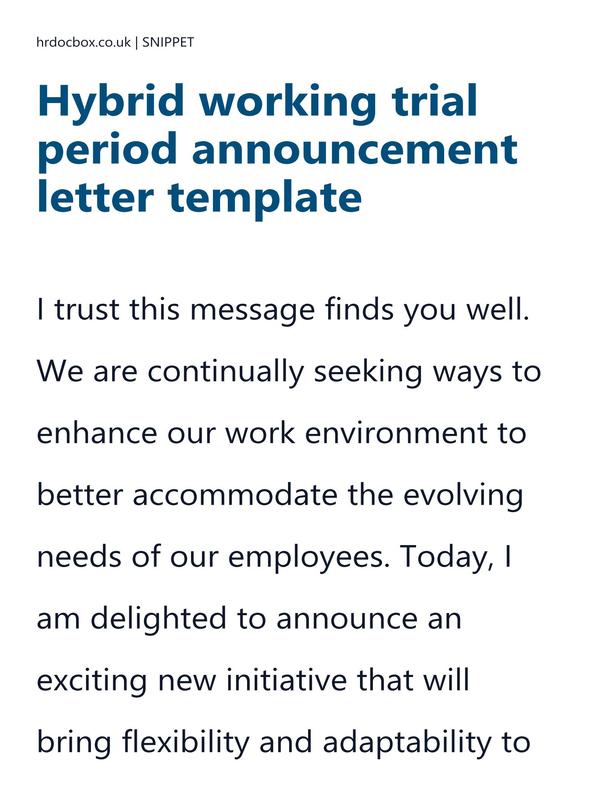
  • Confirm the start and end dates of a hybrid working trial
  • Set out the agreed balance between home and workplace working
  • Clarify working hours, availability and communication expectations
  • Explain performance, attendance and collaboration expectations
  • Set review points and criteria for assessing the trial
  • Confirm that the trial does not automatically create a permanent contractual change
Hybrid working trial period announcement letter template
2026 Reviewed
Get the complete resource

Don't just buy one template — get the complete Flexible and hybrid working templates toolkit

If you are managing flexible or hybrid working, the toolkit brings together practical HR templates covering requests, assessment, discussion, decisions and review.

30 templates • £24.99 • 12 months' access & updates
View the complete toolkit

What's included in this template?

This template brings together the key information, sections and considerations you need to create a clear, comprehensive and professional HR document. Preview the document below.

  • Confirmation of the hybrid working trial and its duration
  • Agreed home and workplace working pattern
  • Working hours, availability and communication arrangements
  • Performance, productivity, collaboration and attendance expectations
  • Trial review arrangements and factors to be considered
  • Confirmation of the temporary nature of the trial and next steps
Template

Download .doc

Copy [to paste]

Email

[Sender name]

[Sender address]

[date]

[Recipient name]

[Recipient address]


Dear [Recipient first name],

Hybrid Working Trial Period

Following our recent discussions, I am pleased to confirm that we have agreed to introduce a temporary hybrid working arrangement for you on a trial basis.

The purpose of the trial is to allow both you and [Company] to assess how the arrangement works in practice and whether it provides an effective working arrangement for you, your role and the wider team.

Trial period

Your hybrid working trial will begin on [Start Date] and will run until [End Date].

We will review the arrangement during the trial and again towards the end of the trial period before deciding whether any changes should be made or whether the arrangement should continue.

Agreed working arrangement

During the trial, your normal working pattern will be:

Day Normal location Working hours Additional arrangements
PREVIEW ENDS HERE

This is the end of the preview

You've seen 20% of how the Hybrid working trial period announcement letter template is structured. Get the complete editable template instantly and customise it for your organisation.

£9.99
Specifications
Access 12 months, with updates
Length 2 pages • 712 words
Jurisdiction England, Wales, Scotland
Based on UK law, ACAS guidance
Last update 26/09/2026
Update reason Process wording update.
Next review 26/03/2027
Delivery & Format Instant digital delivery, .doc · .txt · email

What is a hybrid working trial period announcement letter?

Hybrid working trial period announcement letter template preview

This letter provides a practical way for an employer to formally communicate a temporary hybrid working trial. It can be used where the organisation wants to test whether a combination of home and workplace working is effective before deciding whether the arrangement should continue.

Confirming the trial arrangement

The letter records when the trial starts and ends and sets out the proposed working pattern. This gives both the employer and employee a clear understanding of what has been agreed during the trial.

Setting clear expectations

Hybrid working should not create uncertainty about working hours, availability, communication, meetings, performance or responsibilities. The letter provides space to set practical expectations appropriate to the role.

Reviewing how the arrangement works

The trial provides an opportunity for both the organisation and employee to assess how the arrangement works in practice. Reviews can consider performance, service delivery, collaboration, communication, workload, attendance and the needs of the wider team.

Managing the end of the trial

The letter explains what will happen when the trial ends. The arrangement may be confirmed, amended, extended or brought to an end, depending on the circumstances and any further discussion required.

Keeping the arrangement clear

Where the trial is temporary, the letter should make this clear. If a permanent change to contractual terms is subsequently agreed, the employer should confirm the change in writing within the required timescale.

Best in class example

An employee normally works five days a week from the organisation's office. Following discussions with their manager, the organisation agrees to trial a hybrid arrangement under which the employee works from home on Mondays and Fridays and from the workplace on Tuesday to Thursday.

The employer issues a letter confirming that the arrangement will operate for three months. The letter explains that the employee's normal working hours remain unchanged and that they are expected to be available during their normal working hours, attend meetings as required and maintain appropriate communication with colleagues.

Two formal review points are scheduled during the trial. The manager considers the employee's performance, workload, communication, collaboration and the impact of the arrangement on the wider team. The employee is also invited to provide feedback about how the arrangement is working.

At the end of the trial, the manager and employee discuss the outcome. The arrangement has generally worked well, but one day of home working is changed to a different day to improve team collaboration. The revised arrangement is then considered for permanent agreement and the contractual change is confirmed separately in writing.

Implementation guidance

Use these best practice actions, recommended timescales and process stages to understand when and how the Hybrid working trial period announcement letter should be used, helping ensure each step is handled consistently and appropriately documented.

Step Description Responsibility Timing
1 Discuss the proposed hybrid arrangement with the employee and agree the intended working pattern, trial period and practical expectations. Manager / Employee Before trial starts
2 Confirm the arrangement in writing, including the home and workplace days, hours, availability, equipment and any specific requirements. Manager / HR Before or at start of trial
3 Operate the agreed arrangement while monitoring performance, communication, workload, collaboration and any practical issues. Manager / Employee Throughout trial
4 Hold a formal review and discuss what is working, any concerns and whether adjustments are required before the trial ends. Manager / Employee Midpoint / within 5 working days of review date
5 Confirm whether the arrangement will end, be amended, be extended or be considered for permanent agreement, and document any agreed contractual change. Manager / HR By trial end / within 1 month of permanent change
Premium content

To continue reading, purchase this item or a parent toolkit, library or our full library.

Common mistakes

Understand the common mistakes to avoid when using this HR template, helping you reduce risk, prevent unnecessary costs and ensure the process is handled correctly.

  • Failing to state clearly that the arrangement is a trial and giving no end date
  • Leaving working hours, availability or office attendance expectations unclear
  • Measuring only whether the employee is physically present rather than considering performance and outcomes
  • Failing to give the employee an opportunity to discuss problems with the arrangement
  • Allowing a temporary arrangement to continue indefinitely without deciding whether it should become permanent
  • Failing to put a subsequent permanent contractual change in writing
Premium content

To continue reading, purchase this item or a parent toolkit, library or our full library.

HR considerations

UK employment law and best practice

This template is designed to support the process, but the document should be used alongside the relevant HR procedure and applied to the circumstances of the individual case.

Flexible working

Employees have a statutory right to request flexible working from the first day of employment. Hybrid working can involve changing where an employee works, including the balance between working from home and working at the workplace.

https://www.acas.org.uk/requests-for-home-and-hybrid-working

Trial periods

Acas recognises that an employer and employee may agree a trial period where there is uncertainty about whether a flexible working arrangement will work in practice. The trial should be long enough to properly implement and assess the arrangement and should be confirmed in writing, including its start and end dates.

https://www.acas.org.uk/example-flexible-working-policy-template

Temporary versus permanent changes

Where a hybrid working arrangement is intended to be temporary, the employer should make this clear in writing. If the arrangement is subsequently agreed as a permanent change to the employee's contractual terms, the change must be put in writing within one month.

https://www.acas.org.uk/changing-an-employment-contract/employer-responsibilities/if-employment-contract-changes-are-agreed

Flexible working requests

Where the hybrid working trial follows a statutory flexible working request, the employer must handle the request reasonably and in accordance with the statutory framework and Acas Code of Practice. Where a request is agreed in full, there is no requirement to consult, although the arrangement should still be confirmed clearly in writing.

https://www.acas.org.uk/statutory-flexible-working-requests

Reasonable adjustments

Hybrid working may sometimes be requested as a reasonable adjustment for a disabled employee. Where this is the reason for the arrangement, the employer should consider the request under its Equality Act duties as well as any applicable flexible working process.

https://www.acas.org.uk/reasonable-adjustments

Health and safety when working from home

Employers should consider health and safety when employees work from home. The extent of the employer's responsibilities will depend on the circumstances and nature of the work, but appropriate arrangements should be made to identify and manage relevant risks.

https://www.hse.gov.uk/lung-disease/home-working.htm

Working time and availability

A hybrid arrangement does not remove the normal requirements relating to working time, rest breaks and working hours. Employers should make clear when employees are expected to be available and should ensure that working arrangements do not create inappropriate working-time expectations.

https://www.gov.uk/maximum-weekly-working-hours

Data protection and information security

Where employees work from home, employers should consider how personal and confidential information is accessed, stored and communicated outside the workplace. Appropriate technical and organisational measures should be maintained.

https://ico.org.uk/for-organisations/uk-gdpr-guidance-and-resources/security/

You may also need these resources

FAQs

Is a hybrid working trial a permanent change to the employee's contract?

Not necessarily. A trial can be agreed as a temporary arrangement with a defined start and end date. The letter should make the temporary nature of the arrangement clear. If the arrangement is later agreed permanently, the contractual change should be confirmed in writing.

How long should a hybrid working trial last?

There is no single statutory trial period. The trial should be long enough to allow the arrangement to operate properly and for both the employer and employee to assess whether it works. A period of several weeks or months may be appropriate depending on the role and circumstances.

What should we review during a hybrid working trial?

The review can consider performance, productivity, communication, collaboration, customer or service requirements, workload, attendance, availability, team impact and the employee's experience of the arrangement.

Can the employer end the hybrid working trial?

If the arrangement was agreed as a temporary trial with an agreed end date, the organisation can normally decide what arrangement should apply after the trial, subject to the terms of the agreement and any contractual or statutory rights. Any permanent change should be discussed and confirmed appropriately.

Does hybrid working count as flexible working?

Yes. Hybrid working can involve changing where an employee works and can therefore form part of a flexible working arrangement. An employee can make a statutory flexible working request to change where they work, including the balance between home and workplace working.

Why use HRDocBox rather than asking AI?

HRDocBox templates are designed specifically for UK employers and combine practical HR processes with relevant UK employment law and Acas guidance. This provides a structured starting point that can be adapted to the organisation's own hybrid working arrangements.

How this content is developed and reviewed

The Hybrid working trial period announcement letter template is developed using a practical HR methodology that considers current UK employment legislation, ACAS guidance, CIPD good practice and the real-world HR process it supports. Templates and supporting information are regularly reviewed and updated, with additional reviews triggered by significant changes to legislation, guidance or established HR practice, helping ensure each document remains practical, relevant and suitable for UK employers.

About the author

Darryl Horn, Chartered HR Director

Darryl is a Chartered HR professional with over 25 years' experience in senior HR and employee relations roles.

He has extensive practical experience of managing flexible and hybrid working HR processes and founded hrdocbox to provide businesses with practical, professionally developed HR resources grounded in UK employment law and best practice.

HRDocBox has been creating practical UK HR documents since 2009.

Executive recommendation

"Darryl provides support and advice with excellent judgement, and has a strong understanding of people, policies and UK employment legislation."

"He is someone I trust; consistent, dependable, and committed to doing things properly."

RB
Ruth Brock Chief Executive Officer The Hygiene Bank
Get started today

HR confidence starts here

Whether you employ 5 people or 50, hrdocbox gives you the structure, documents and expertise needed to manage employees professionally and legally.

Download your FREE UK employment contract template

Professionally written and fully compliant with UK employment law

Download FREE contract
Free UK employment contract template