Facilitation meeting outcome letter template

£9.99
UK-specific Editable Instant download 12 months' updates

This facilitation meeting outcome letter provides a clear written record of the outcome following a facilitated workplace discussion. It helps confirm what was discussed, record any areas of agreement or understanding and set out any actions or next steps agreed by those involved.

Use this letter to:

  • Confirm the outcome of a facilitated workplace meeting
  • Record areas of agreement and any actions identified
  • Clarify expectations and arrangements following the meeting
  • Provide a clear written record for those involved
Facilitation meeting outcome letter template
2026 Reviewed

What's included in this template?

This template brings together the key information, sections and considerations you need to create a clear, comprehensive and professional HR document. Preview the document below.

  • Confirmation of the facilitation meeting and its purpose
  • Summary of the key matters discussed
  • Areas of agreement or understanding
  • Agreed actions and responsibilities
  • Follow-up or review arrangements
  • Confirmation of next steps

Your complete Grievance resource

Templates. Knowledge. Guidance. Everything you need, all in one place.

Explore the Grievance templates toolkit
Template

Download .doc

Copy [to paste]

Email

[Sender name]

[Sender address]

[date]

[Recipient name]

[Recipient address]


Dear [Recipient first name],

Facilitation meeting – outcome

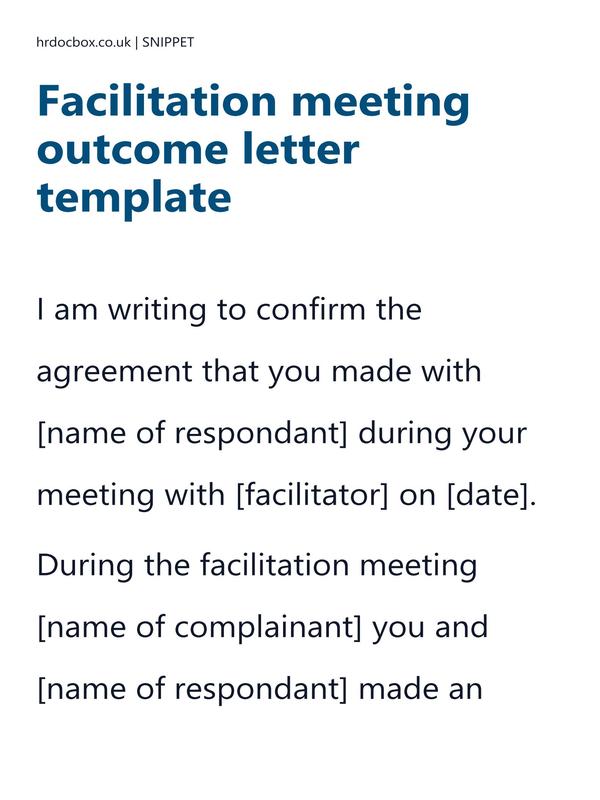
I am writing further to the facilitation meeting held on [date], which was arranged to discuss [briefly describe the issues or circumstances that led to the meeting].

The purpose of the meeting was to provide an opportunity for those involved to discuss the matters openly and constructively and to consider how the situation could be addressed going forward.

Matters discussed

During the meeting, we discussed [summarise the key issues discussed]. You explained [brief summary of relevant points raised], and [other participant / participants] explained [brief summary where appropriate].

The discussion identified [summarise any areas of misunderstanding, concern or common ground without making findings unless appropriate].

Agreed arrangements

As a result of the discussion,

PREVIEW ENDS HERE

This is the end of the preview

You've seen 40% of how the Facilitation meeting outcome letter template is structured. Get the complete editable template instantly and customise it for your organisation.
£9.99
Specifications
Access 12 months, with updates
Length 2 pages • 281 words
Jurisdiction England, Wales, Scotland
Based on UK law, ACAS guidance
Last review 16/09/2026
Next review 16/03/2027
Delivery Instant digital delivery
Formats .doc · .txt · email

What is a facilitation meeting outcome letter?

Facilitation meeting outcome letter template preview

This letter provides a clear written record following a facilitation meeting involving employees or other workplace participants. It helps confirm the purpose of the meeting, summarise the main points discussed and record any agreed actions or arrangements without unnecessarily formalising the process.

Recording the outcome

The letter can summarise the key areas discussed during the meeting and confirm the outcome reached. It should reflect what was actually discussed and agreed rather than attempting to provide a detailed transcript of the conversation.

Recognising areas of agreement

Facilitation can help people discuss workplace concerns, misunderstandings or differences in a constructive setting. Where participants have reached an understanding or agreement, the outcome letter can record this clearly so that everyone has a shared understanding of what was discussed.

Agreeing practical actions

The outcome can identify any actions that participants or managers have agreed to take following the meeting. These might include changes to communication, working arrangements, responsibilities or future discussions, depending on the circumstances.

Clarifying what happens next

The letter can explain any follow-up arrangements, review dates or further support that has been agreed. Where concerns remain unresolved, the letter can make clear that the facilitation meeting has not prevented the organisation from considering other appropriate steps if the situation requires further action.

Example

Two employees have experienced ongoing difficulties in their working relationship, including disagreements about communication and the way certain tasks are handled. Rather than immediately treating the matter as a formal disciplinary or grievance issue, the manager arranges a facilitated meeting to give both employees an opportunity to discuss their concerns.

During the meeting, each employee is given an opportunity to explain their perspective. The discussion identifies some misunderstandings about responsibilities and communication, and both employees agree that communication between them needs to improve.

The outcome letter confirms the main areas discussed and records the practical arrangements agreed, including clearer communication about responsibilities and an agreement to raise concerns directly rather than allowing them to develop into further conflict.

The letter also confirms that the manager will review the working relationship after an agreed period. It provides a clear record of the outcome while recognising that further action may be considered if the agreed arrangements do not resolve the underlying issues.

Implementation guidance

Use these best practice actions, recommended timescales and process stages to understand when and how the Facilitation meeting outcome letter should be used, helping ensure each step is handled consistently and appropriately documented.

Step Description Responsibility Timing
1 Review the purpose of the facilitation meeting, the issues discussed and any relevant notes or information before preparing the outcome. Facilitator / Manager Within 1–2 working days
2 Identify the key points discussed, including any areas where the participants reached an understanding or agreement. Facilitator Within 2 working days
3 Record any actions, responsibilities or practical arrangements agreed during the meeting. Facilitator / Participants Within 2–3 working days
4 Confirm any follow-up arrangements, review dates or further steps that may be appropriate. Facilitator / Manager Within 3 working days
5 Issue the outcome letter to the relevant participants and retain an appropriate record of the meeting and agreed actions. Facilitator / HR Within 5 working days
Premium content

To continue reading, purchase this item or a parent toolkit, library or our full library.

Common mistakes

Understand the common mistakes to avoid when using this HR template, helping you reduce risk, prevent unnecessary costs and ensure the process is handled correctly.

  • Turning the outcome into a meeting transcript – focus on the key issues, agreements and actions rather than attempting to record every part of the discussion.
  • Assigning blame – the purpose of facilitation is to help people address workplace difficulties constructively, so the outcome should remain factual and balanced.
  • Failing to record agreed actions – make clear what has been agreed, who is responsible and, where appropriate, when the action should be completed.
  • Presenting an informal discussion as a formal finding – avoid suggesting that the facilitation process has determined that one person's account is correct unless a separate formal process has established this.
  • Ignoring unresolved issues – where matters remain outstanding, the outcome should make this clear and explain any appropriate follow-up arrangements.
  • Failing to follow up – where actions or changes have been agreed, ensure they are reviewed within the timescale agreed at the meeting.
Premium content

To continue reading, purchase this item or a parent toolkit, library or our full library.

HR considerations

UK employment law and best practice

This template is designed to support the process, but the document should be used alongside the relevant HR procedure and applied to the circumstances of the individual case.

Fair and reasonable workplace processes

Employers should handle workplace concerns fairly and give those involved an appropriate opportunity to explain their perspective. A facilitated meeting can provide a constructive way of addressing interpersonal difficulties where formal proceedings are not considered necessary or appropriate.

Acas guidance

Acas encourages employers to try to resolve workplace problems informally where appropriate and identifies mediation as one possible way of helping people resolve workplace disputes. The approach taken should reflect the circumstances of the particular situation and should not prevent formal action where this becomes necessary. https://www.acas.org.uk/mediation

Grievances and formal procedures

Facilitation does not necessarily replace an employer's grievance or disciplinary procedures. Where an employee raises a formal grievance, or where the circumstances may warrant disciplinary action, the employer should consider whether its formal procedures need to be followed and whether the facilitated discussion is appropriate in those circumstances. https://www.acas.org.uk/grievance-procedure-step-by-step

Equality Act 2010

Employers should ensure that workplace concerns and facilitated discussions are handled without unlawful discrimination, harassment or victimisation. Particular care may be required where the issues raised relate to a protected characteristic or where reasonable adjustments may be relevant. https://www.legislation.gov.uk/ukpga/2010/15/contents

Confidentiality and data protection

Information arising from a facilitation meeting should be handled appropriately and only shared where there is a legitimate reason to do so. Records should be relevant, accurate and retained in accordance with the organisation's data protection and record-keeping arrangements. https://www.gov.uk/data-protection

Keeping an appropriate record

The outcome letter should provide a proportionate record of what was agreed without unnecessarily recording sensitive or irrelevant personal information. Where agreed actions are recorded, managers should ensure that these are followed up and that any subsequent concerns are dealt with through the appropriate workplace process.

You may also need these resources

FAQs

What is a facilitation meeting?

A facilitation meeting is a structured discussion intended to help people address workplace difficulties, misunderstandings or differences constructively. An impartial facilitator can help those involved communicate effectively and explore practical ways forward.

Is a facilitation meeting the same as mediation?

They can be similar, but the terms are not necessarily interchangeable. Mediation is a specific process involving an impartial mediator who helps participants work towards resolving a dispute, whereas facilitation can be used more broadly to support constructive workplace discussions.

Does the meeting need to produce a formal agreement?

No. The outcome may simply record the main points discussed and any practical arrangements agreed. The appropriate level of formality will depend on the circumstances and the organisation's approach.

What should an outcome letter include?

It should normally confirm the purpose of the meeting, summarise the key matters discussed, record any areas of agreement and set out agreed actions or follow-up arrangements. It should remain factual and proportionate.

Can formal action still be taken after facilitation?

Yes. Facilitation does not necessarily prevent an employer from taking further appropriate action if concerns remain unresolved or new issues arise. The organisation should consider its relevant policies and follow a fair process.

Why use HRDocBox rather than AI?

AI can produce a generic meeting outcome letter, but HRDocBox provides structured, UK-focused HR documentation designed around practical workplace processes. This letter provides a consistent framework for recording the outcome of a facilitated discussion while allowing the employer to tailor the content to the circumstances.

How this content is developed and reviewed

The Facilitation meeting outcome letter template is developed using a practical HR methodology that considers current UK employment legislation, ACAS guidance, CIPD good practice and the real-world HR process it supports. Templates and supporting information are regularly reviewed and updated, with additional reviews triggered by significant changes to legislation, guidance or established HR practice, helping ensure each document remains practical, relevant and suitable for UK employers.

About the author

Darryl Horn, Chartered HR Director

Darryl is a Chartered HR professional with over 25 years' experience in senior HR and employee relations roles.

He has extensive practical experience of managing grievance HR processes and founded hrdocbox to provide businesses with practical, professionally developed HR resources grounded in UK employment law and best practice.

HRDocBox has been creating practical UK HR documents since 2009.

Executive recommendation

"Darryl provides support and advice with excellent judgement, and has a strong understanding of people, policies and UK employment legislation."

"He is someone I trust; consistent, dependable, and committed to doing things properly."

RB
Ruth Brock Chief Executive Officer The Hygiene Bank
The Facilitation meeting outcome letter template is also included in these bundles:

Grievance toolkit Grievance toolkit 23 templates
£34.90

Management library Management library 472 templates
£79.99

Full library Full library 780 templates
£74.99

Get started today

HR confidence starts here

Whether you employ 5 people or 50, hrdocbox gives you the structure, documents and expertise needed to manage employees professionally and legally.

Download your FREE UK employment contract template

Professionally written and fully compliant with UK employment law
Download FREE contract
Free UK employment contract template