Investigation report form template

£9.99

UK-specific • Editable • Instant download • 12 months' updates

An Investigation Report is used to record the findings of a workplace investigation into an employee concern, complaint, alleged misconduct, grievance or other workplace issue. It provides a structured record of the allegations, evidence considered, interviews undertaken and findings reached, helping the decision-maker determine what action, if any, should follow.

Use this template to:

  • Record the scope and purpose of a workplace investigation.
  • Clearly set out the allegations or issues investigated.
  • Document evidence gathered and witnesses interviewed.
  • Record the employee's response and relevant explanations.
  • Assess the evidence objectively and reach findings on each allegation.
  • Create a clear audit trail for any subsequent disciplinary, grievance or other HR process.
Investigation report form template
2026 Reviewed

What's included in this template?

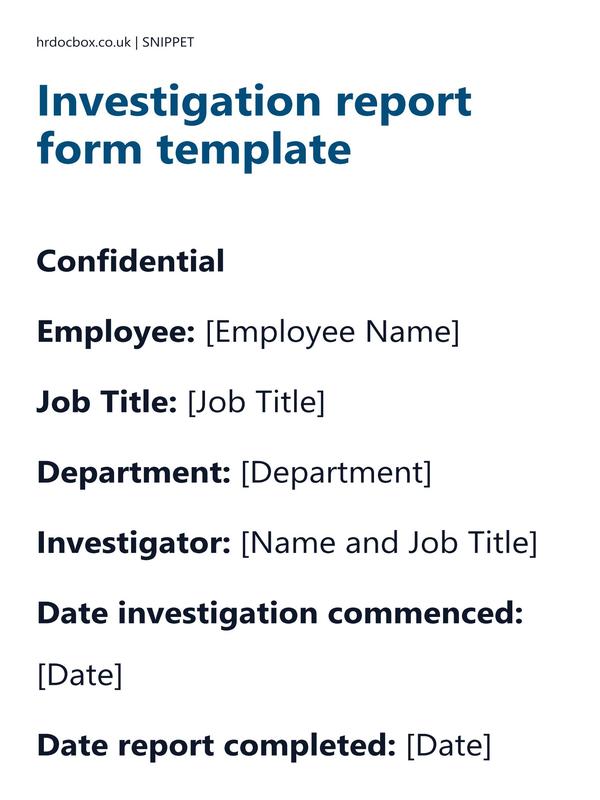
This template brings together the key information, sections and considerations you need to create a clear, comprehensive and professional HR document. Preview the document below.

  • Investigation details and scope
  • Allegations or issues investigated
  • Background and relevant circumstances
  • Evidence considered
  • Witness interviews
  • Employee response
  • Findings against each allegation
  • Investigator's conclusion
  • Recommendations and next steps
Specifications
Access 12 months (includes updates)
Length 3 pages • 776 words
Jurisdiction England, Wales and Scotland
Based on UK employment law, ACAS guidance
Last review 27/08/2026
Next review 27/02/2027
Delivery Instant download
Formats .doc · .xls · .txt · email

Download .doc

Edit .xls

Copy [to paste]

Email
Template

Investigation report

Confidential

Employee: [Employee Name]

Job Title: [Job Title]

Department: [Department]

Investigator: [Name and Job Title]

Date investigation commenced: [Date]

Date report completed: [Date]

Reference: [Reference Number, if applicable]

1. Purpose of the investigation

This investigation was undertaken following [a complaint / grievance / allegation / concern] raised on [date] regarding [brief description of the matter].

The purpose of the investigation was to establish the facts and determine, based on the available evidence, whether there is sufficient evidence to support the allegations or concerns identified below.

The investigation is a fact-finding process. It is not intended to determine any disciplinary sanction or other outcome.

2. Scope of the investigation

The investigation considered the following allegations / issues:

  • [Allegation / issue 1]
  • [Allegation / issue 2]
  • [Allegation / issue 3]

The investigation was limited to the matters identified above unless additional relevant information arose during the investigation.

3. Background

[Provide a concise and factual summary of the circumstances leading to the investigation, including relevant dates, events and previous discussions where appropriate.]

4. Investigation process

The following steps were undertaken as part of the investigation:

  • [Date] – [Investigation meeting / interview with employee]
  • [Date] – [Interview with witness]
  • [Date] – [Review of relevant documentation]
  • [Date] – [Review of electronic records / other evidence]
  • [Date] – [Further investigation undertaken]

The employee was given an opportunity to respond to the allegations and provide any information or evidence


PREVIEW ENDS HERE

This is the end of the preview

You've seen just 30% of how the Investigation report form template is structured. Get the complete editable template instantly and customise it for your organisation.

£9.99

Need the complete Investigation process?

Explore the Investigation templates toolkit

What is an investigation report form?

Investigation report form template preview

A workplace investigation should establish the facts before an employer decides what action, if any, is appropriate. This Investigation Report provides a structured record of the investigation, from the original allegations and scope through to the evidence considered, employee and witness accounts, findings and recommended next steps.

Clearly defining what was investigated

The report starts by identifying the allegations or issues being investigated and the scope of the investigation. This helps prevent the process from becoming unnecessarily broad and provides a clear reference point when assessing the evidence.

Recording the evidence and investigation process

The template provides space to record meetings, witnesses, documents, electronic records and other evidence considered. Keeping this information together creates a useful audit trail and makes it easier for another manager or HR professional to understand how the investigation was conducted.

Assessing conflicting accounts

Workplace investigations frequently involve different versions of events. The findings section encourages the investigator to consider the evidence, the employee's response and any conflicting information before explaining the reasoning behind each finding.

Separating investigation from decision-making

An investigation report should establish the facts rather than predetermine a disciplinary sanction. The template therefore separates the investigator's findings from any subsequent decision about disciplinary or other action.

Creating a defensible record

A well-prepared investigation report provides a clear record of what was considered, what could and could not be established and why particular findings were reached. This can be particularly valuable where the investigation leads to a formal disciplinary, grievance or other employment process.

Example

A manager raises concerns that an employee has repeatedly spoken aggressively to colleagues and that one incident may have involved inappropriate language. The employee denies behaving aggressively and says the accounts provided by colleagues have been exaggerated.

An independent manager is appointed to investigate. They interview the employee and three relevant witnesses and review emails, the employee's previous communications and the company's relevant policies. The investigator records each person's account and gives the employee an opportunity to respond to the information gathered.

The investigation report considers each allegation separately. One allegation is substantiated because several consistent accounts support it and the employee accepts part of what occurred. A second allegation is not substantiated because the available evidence is conflicting and there is insufficient reliable evidence to establish what happened.

The report records the reasoning behind each finding and recommends that the matter be referred to the appropriate manager to consider whether formal disciplinary action is warranted. It does not decide the disciplinary sanction itself.

The wider HR process

Related HR resources and workflow

Explore the HR resources that may be relevant before and / or after using the Investigation report form, helping you understand the wider process, maintain appropriate documentation and follow a consistent approach.

Previous
Scripts
Investigation meeting script

Efficiently conduct investigations with our structured meeting script, promoting fairness, consistency, and thoroughness in gathering evidence

.
This
Investigation report form
Next
Letters
Grievance hearing invitation letter

If an employee raises a formal grievance, use this model letter template as an invitation to a grievance hearing to discuss their issues or complaints in detail.

Premium content

To continue reading, purchase this item or a parent toolkit, library or our full library.

Implementation guidance

Use these best practice actions, recommended timescales and process stages to understand when and how the Investigation report form should be used, helping ensure each step is handled consistently and appropriately documented.

Step Description Responsibility Timing
1 Define the Investigation: Establish the allegations, issues to be investigated, scope and appropriate investigator. HR / Manager At commencement
2 Gather the Evidence: Interview relevant individuals and collect documents, records and other evidence needed to establish the facts. Investigator During investigation
3 Give the Employee an Opportunity to Respond: Ensure the employee understands the concerns being investigated and has a reasonable opportunity to provide their explanation and relevant evidence. Investigator During investigation
4 Assess and Record Findings: Consider the evidence objectively, address conflicting accounts and record a clear finding against each allegation with supporting reasoning. Investigator At conclusion
5 Determine the Next Stage: Submit the report to the appropriate decision-maker and determine whether further action, such as disciplinary proceedings, grievance action or informal management support, is appropriate. Manager / HR Following investigation
Premium content

To continue reading, purchase this item or a parent toolkit, library or our full library.

Common mistakes

Understand the common mistakes to avoid when using this HR template, helping you reduce risk, prevent unnecessary costs and ensure the process is handled correctly.

  • Starting an investigation with a predetermined conclusion rather than genuinely establishing the facts.
  • Failing to define the allegations or scope clearly, resulting in an investigation that becomes unnecessarily broad.
  • Ignoring evidence that supports the employee's account or failing to properly investigate conflicting evidence.
  • Recording conclusions without explaining how the evidence led to each finding.
  • Allowing the investigator to decide the disciplinary sanction rather than keeping fact-finding separate from the subsequent decision-making process.
  • Failing to keep a clear record of interviews, documents and other evidence considered.
Premium content

To continue reading, purchase this item or a parent toolkit, library or our full library.

HR considerations

UK employment law and best practice

This template is designed to support the process, but the document should be used alongside the relevant HR procedure and applied to the circumstances of the individual case.

There is no single statutory format for an investigation report, but employers should conduct workplace investigations fairly, reasonably and in accordance with their own policies and procedures. The ACAS Code provides guidance on handling disciplinary and grievance matters and emphasises the importance of establishing the facts before deciding what action is appropriate. https://www.acas.org.uk/acas-code-of-practice-on-disciplinary-and-grievance-procedures

Fair investigation

Investigations should establish the facts and gather relevant evidence rather than being used simply to prove an allegation. Employers should consider information that supports the allegation as well as information that may support the employee's explanation. https://www.acas.org.uk/disciplinary-procedure-step-by-step

Opportunity to respond

Where an investigation may lead to formal disciplinary action, the employee should be given an appropriate opportunity to respond to the concerns and provide relevant information or evidence before a decision is reached. https://www.acas.org.uk/disciplinary-procedure-step-by-step

Impartiality

Where practicable, the person conducting the investigation should not be directly involved in the matter or have a conflict of interest. Separating the investigation from the disciplinary decision can help support a fair process. https://www.acas.org.uk/acas-code-of-practice-on-disciplinary-and-grievance-procedures

Confidentiality and personal information

Investigation records can contain personal and potentially sensitive information. Employers should handle investigation records appropriately and only disclose information where there is a legitimate reason to do so. https://ico.org.uk/for-organisations/uk-gdpr-guidance-and-resources/employment/

Disciplinary process

If the investigation identifies a case to answer, the employer should normally follow its disciplinary procedure and give the employee an opportunity to respond at a formal disciplinary hearing before deciding whether disciplinary action is appropriate. https://www.acas.org.uk/disciplinary-procedure-step-by-step

Grievance investigations

Where an investigation concerns a grievance, employers should follow their grievance procedure and the principles in the ACAS Code. A thorough investigation can help establish the facts before the grievance outcome is determined. https://www.acas.org.uk/grievance-procedure-step-by-step

You may also need these resources

FAQs

What is an investigation report?

An investigation report is a formal record of a workplace investigation. It normally explains what was investigated, the evidence considered, the people interviewed, the employee's response, the findings reached and any recommended next steps.

Does every workplace investigation need a formal report?

Not necessarily. The appropriate level of documentation will depend on the circumstances and the employer's procedures. A formal report is particularly useful for more serious or complex matters and where the investigation may lead to formal disciplinary or grievance proceedings.

Should an investigation report recommend dismissal?

The investigator should generally focus on establishing the facts and recording findings rather than deciding the disciplinary sanction. Any subsequent disciplinary decision should be made by the appropriate decision-maker after giving the employee an opportunity to respond.

What standard of proof applies to a workplace investigation?

Employment disciplinary decisions are generally based on whether the employer has a reasonable belief in the facts following a reasonable investigation. The investigator should therefore assess the available evidence objectively rather than attempting to establish matters to the criminal standard of proof.

Can an employee see an investigation report?

Potentially. The report may contain personal information relating to the employee or other individuals, and disclosure will depend on the circumstances, the purpose for which the information is being used and applicable data protection requirements. Employers should consider carefully what information needs to be shared as part of the relevant process.

Why use HRDocBox for an Investigation Report?

HRDocBox combines deep HR knowledge, practical application and experience of real workplace situations. This template helps employers structure investigations around the allegations, evidence, employee response and findings without confusing the fact-finding process with the subsequent disciplinary or grievance decision.

How this content is developed and reviewed

The Investigation report form template is developed using a practical HR methodology that considers current UK employment legislation, ACAS guidance, CIPD good practice and the real-world HR process it supports. Templates are regularly reviewed and updated, with additional reviews triggered by significant changes to legislation, guidance or established HR practice, helping ensure each document remains practical, relevant and suitable for UK employers.

About the author

Darryl Horn, Chartered HR Director

Darryl is a Chartered HR professional with over 25 years' experience in senior HR and employee relations roles.

He has extensive practical experience of managing investigation processes and founded hrdocbox to provide businesses with practical, professionally developed HR resources grounded in UK employment law and best practice.

HRDocBox has been creating practical UK HR documents since 2009.

Executive recommendation

"Darryl provides support and advice with excellent judgement, and has a strong understanding of people, policies and UK employment legislation."

"He is someone I trust; consistent, dependable, and committed to doing things properly."

RB
Ruth Brock Chief Executive Officer The Hygiene Bank
Get started today

HR confidence starts here

Whether you employ 5 people or 50, hrdocbox gives you the structure, documents and expertise needed to manage employees professionally and legally.

Download your FREE UK employment contract template

Professionally written and fully compliant with UK employment law

Download FREE contract
Free UK employment contract template