Libraries
780+ HR templates
Everything your business needs to stay compliant
Policies, contracts, letters, guidance and HR support tools for UK employers.
View full libraryPolicies, contracts, letters, guidance and HR support tools for UK employers.
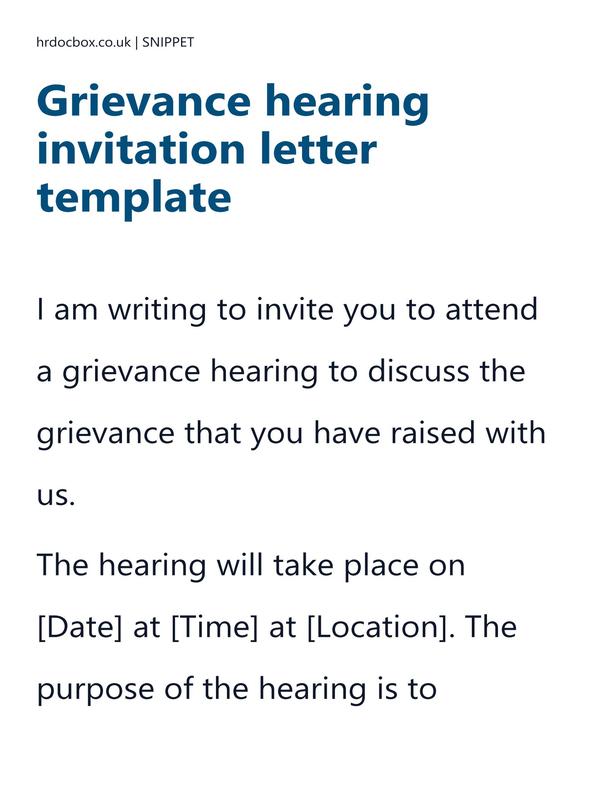
View full libraryA formal grievance hearing invitation letter for inviting an employee to a meeting to discuss a grievance they have raised, explain the issues to be considered and give them an opportunity to present their case and supporting evidence.
Use this template to:
<p>If you are managing an employee grievance, the toolkit brings together practical HR templates covering investigation, meetings, mediation, appeals and outcomes.</p>
[Sender name]
[Sender address]
[date]
[Recipient name]
[Recipient address]
Dear [Recipient first name],
Invitation to grievance hearing
Thank you for raising your formal grievance dated [date], concerning [brief description of the grievance].
I am writing to invite you to a formal grievance hearing to discuss the matters you have raised and to give you an opportunity to explain your grievance, provide any relevant information or evidence and discuss how you would like the matter to be resolved.
Meeting details
| Date: | |
| Time: | |
| Location / meeting method: | |
| Person hearing the grievance: | |
| Note taker: |
Purpose of the hearing
The purpose of the hearing is to provide you with an opportunity to
You've seen 20% of how the Grievance hearing invitation letter template is structured. Get the complete editable template instantly and customise it for your organisation.

A formal grievance hearing gives an employee an opportunity to explain a workplace concern or complaint and allows the employer to ask questions, consider evidence and determine whether further investigation is required. This invitation letter provides the employee with clear information about the hearing and enough time to prepare.
The letter identifies the formal grievance and summarises the matters that will be discussed. It should provide sufficient information for the employee to understand the scope of the hearing without prejudging the outcome or presenting allegations as established facts.
The employee is given information about the meeting and can be invited to bring relevant documents, evidence and details of witnesses they believe should be considered. The letter also explains the opportunity to explain how they would like the grievance to be resolved.
The hearing should be handled impartially, with the person hearing the grievance considering information from all relevant sides. Depending on the issues raised, further investigation may be required before an outcome can be reached.
The letter makes clear that the hearing is part of the grievance process and that a decision may not be made immediately. Where further investigation is required, the employee should be kept informed of the likely timescale and the eventual outcome should be confirmed in writing, with an appropriate opportunity to appeal.
Related HR resources and workflow
Explore the HR resources that may be relevant before and / or after using the Grievance hearing invitation letter, helping you understand the wider process, maintain appropriate documentation and follow a consistent approach.

An Investigation Report is used to record the findings of a workplace investigation into an employee concern, complaint, alleged misconduct, grievance or other workplace issue.

The Grievance Hearing Script provides HR professionals and managers with a structured framework for conducting a fair and thorough grievance hearing.
Use these best practice actions, recommended timescales and process stages to understand when and how the Grievance hearing invitation letter should be used, helping ensure each step is handled consistently and appropriately documented.
Understand the common mistakes to avoid when using this HR template, helping you reduce risk, prevent unnecessary costs and ensure the process is handled correctly.
There is no universal statutory number of days that must be given for every grievance hearing. The meeting should be arranged without unreasonable delay while allowing the employee reasonable time to prepare. The employer's own grievance procedure may specify a particular timescale.
Yes, where the statutory conditions for accompaniment at a grievance meeting are met. The statutory right allows the employee to be accompanied by a fellow worker, a certified trade union representative or an official employed by a trade union. Employers may provide a wider right under their own procedures.
Yes. The hearing provides an opportunity for the employee to explain their grievance and present relevant evidence. The employee can also identify witnesses they believe the employer should speak to. Further investigation may be required before an outcome can be reached.
They should be sufficiently impartial to consider the grievance fairly. Where possible, it is good practice to use someone who has not been directly involved in the matter being complained about. The size and structure of the organisation may affect who is available to hear the grievance.
Yes. If the hearing identifies information that needs further investigation, the employer can adjourn the meeting and continue the process once the relevant information has been obtained. The employee should be kept informed about the reason for any delay and the expected timescale.
AI can produce a generic meeting invitation, but grievance hearings require careful procedural wording around the issues being considered, preparation, evidence, accompaniment, impartiality and the possibility of further investigation. HRDocBox templates are structured around practical UK HR processes and can be adapted to the employer's own grievance procedure without presenting the grievance as already proven or prejudging the outcome.
How this content is developed and reviewed
The Grievance hearing invitation letter template is developed using a practical HR methodology that considers current UK employment legislation, ACAS guidance, CIPD good practice and the real-world HR process it supports. Templates and supporting information are regularly reviewed and updated, with additional reviews triggered by significant changes to legislation, guidance or established HR practice, helping ensure each document remains practical, relevant and suitable for UK employers.
Darryl Horn, Chartered HR Director
Darryl is a Chartered HR professional with over 25 years' experience in senior HR and employee relations roles.
He has extensive practical experience of managing grievance HR processes and founded hrdocbox to provide businesses with practical, professionally developed HR resources grounded in UK employment law and best practice.
HRDocBox has been creating practical UK HR documents since 2009.
"Darryl provides support and advice with excellent judgement, and has a strong understanding of people, policies and UK employment legislation."
"He is someone I trust; consistent, dependable, and committed to doing things properly."




















Whether you employ 5 people or 50, hrdocbox gives you the structure, documents and expertise needed to manage employees professionally and legally.
Professionally written and fully compliant with UK employment law
Access a free contract template instantly - or save 10% on any document today.
Use this code at checkout for 10% off anything!
Includes instant download, updates, and full access to your HR templates.