Libraries
780+ HR templates
Everything your business needs to stay compliant
Policies, contracts, letters, guidance and HR support tools for UK employers.
View full libraryPolicies, contracts, letters, guidance and HR support tools for UK employers.
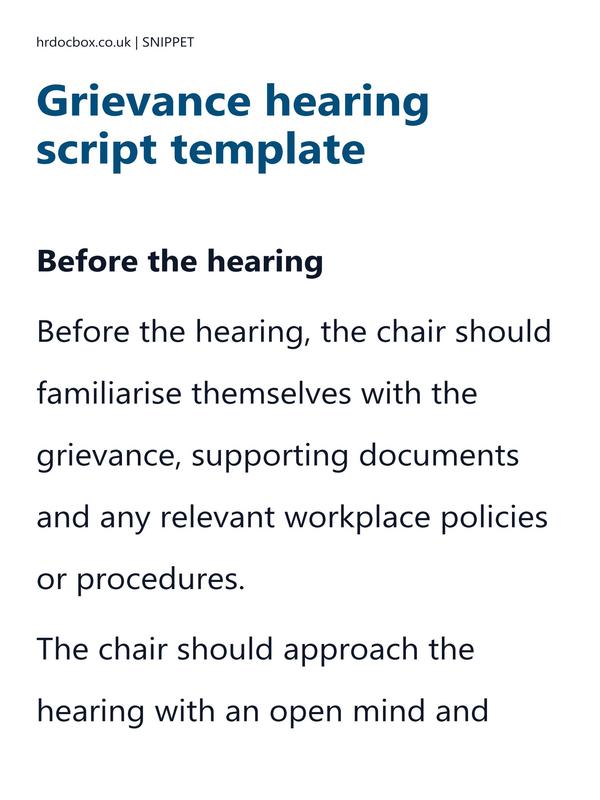
View full libraryThe Grievance Hearing Script provides HR professionals and managers with a structured framework for conducting a fair and thorough grievance hearing. It guides the chair through the complaint, evidence, employee's response, questions, possible outcomes and next steps while ensuring the employee has a proper opportunity to be heard.
Use this template to:
<p>If you are managing an employee grievance, the toolkit brings together practical HR templates covering investigation, meetings, mediation, appeals and outcomes.</p>
Before the hearing
Before the hearing, the chair should familiarise themselves with the grievance, supporting documents and any relevant workplace policies or procedures.
The chair should approach the hearing with an open mind and should not have predetermined the outcome. Identify any areas requiring clarification and prepare questions based on the information available.
1. Opening the hearing
Chair:
"Thank you for attending today. The purpose of this meeting is to hear and discuss the grievance you have raised."
"I want to make sure that you have a full opportunity to explain your concerns, provide any relevant information and tell us what you believe should be done to resolve the matter."
"I will listen carefully to what you have to say and may ask questions to clarify the issues or understand the evidence."
"No decision has been made about your grievance. I will consider the information provided before deciding what further action is appropriate."
2. Confirm the
You've seen 20% of how the Grievance hearing script template is structured. Get the complete editable template instantly and customise it for your organisation.

A Grievance Hearing Script provides a structured framework for conducting a formal grievance meeting. It helps the person hearing the grievance work through the employee's concerns systematically, ask appropriate questions and make sure the employee has a genuine opportunity to explain their position.
The script also helps the chair distinguish between hearing the grievance and deciding the outcome, allowing further investigation to take place where necessary before a decision is reached.
The script can be used where an employee has raised a formal grievance about a workplace issue, colleague, manager, decision, working arrangement or other employment matter. It provides a consistent structure for exploring the complaint, reviewing evidence and identifying what further investigation may be required.
It is designed to support the hearing itself and should be used alongside the employer's grievance procedure rather than as a replacement for it.
The template is suitable for HR professionals, managers, grievance hearing chairs and employers responsible for handling formal employee grievances.
The chair should consider the employee's evidence alongside any other relevant information and determine whether further investigation is necessary. Once the investigation is complete, the employer should communicate the grievance outcome in writing and explain any applicable right of appeal.
Related HR resources and workflow
Explore the HR resources that may be relevant before and / or after using the Grievance hearing script, helping you understand the wider process, maintain appropriate documentation and follow a consistent approach.

A formal grievance hearing invitation letter for inviting an employee to a meeting to discuss a grievance they have raised, explain the issues to be considered and give them an opportunity to present their case and supporting evidence.
Use this Grievance Hearing Outcome Confirmation Letter to formally communicate the outcome of an employee's grievance following a hearing.
Use these best practice actions, recommended timescales and process stages to understand when and how the Grievance hearing script should be used, helping ensure each step is handled consistently and appropriately documented.
Understand the common mistakes to avoid when using this HR template, helping you reduce risk, prevent unnecessary costs and ensure the process is handled correctly.
The employee is given an opportunity to explain their grievance, provide evidence and respond to questions. The chair should clarify the issues, identify any further investigation required and avoid reaching a decision until the relevant information has been considered.
Yes. If the hearing identifies additional evidence, witnesses or issues that need investigation, the chair can carry out further enquiries before reaching the grievance outcome.
HRDocBox combines deep HR knowledge, practical application and years of experience with real employee relations cases. The script gives the chair a structured way to hear the grievance fairly while keeping the focus on evidence, the employee's response and appropriate investigation.
AI can produce a list of questions for a grievance meeting, but a fair grievance hearing requires more than generic questions. HRDocBox combines UK employment-law knowledge, ACAS guidance and practical HR experience to help the chair manage the process properly and avoid turning the hearing into a predetermined outcome.
Enough to understand the grievance, clarify disputed facts and identify relevant evidence, but the chair should avoid unnecessary or repetitive questioning. The employee should be given sufficient space to explain their concerns in their own words.
No. It is often appropriate to take time after the hearing to review the evidence and carry out further investigation before reaching a decision. The outcome should be communicated once the relevant facts have been properly considered.
How this content is developed and reviewed
The Grievance hearing script template is developed using a practical HR methodology that considers current UK employment legislation, ACAS guidance, CIPD good practice and the real-world HR process it supports. Templates and supporting information are regularly reviewed and updated, with additional reviews triggered by significant changes to legislation, guidance or established HR practice, helping ensure each document remains practical, relevant and suitable for UK employers.
Darryl Horn, Chartered HR Director
Darryl is a Chartered HR professional with over 25 years' experience in senior HR and employee relations roles.
He has extensive practical experience of managing grievance HR processes and founded hrdocbox to provide businesses with practical, professionally developed HR resources grounded in UK employment law and best practice.
HRDocBox has been creating practical UK HR documents since 2009.
"Darryl provides support and advice with excellent judgement, and has a strong understanding of people, policies and UK employment legislation."
"He is someone I trust; consistent, dependable, and committed to doing things properly."




















Whether you employ 5 people or 50, hrdocbox gives you the structure, documents and expertise needed to manage employees professionally and legally.
Professionally written and fully compliant with UK employment law
Access a free contract template instantly - or save 10% on any document today.
Use this code at checkout for 10% off anything!
Includes instant download, updates, and full access to your HR templates.