Libraries
780+ HR templates
Everything your business needs to stay compliant
Policies, contracts, letters, guidance and HR support tools for UK employers.
View full libraryPolicies, contracts, letters, guidance and HR support tools for UK employers.
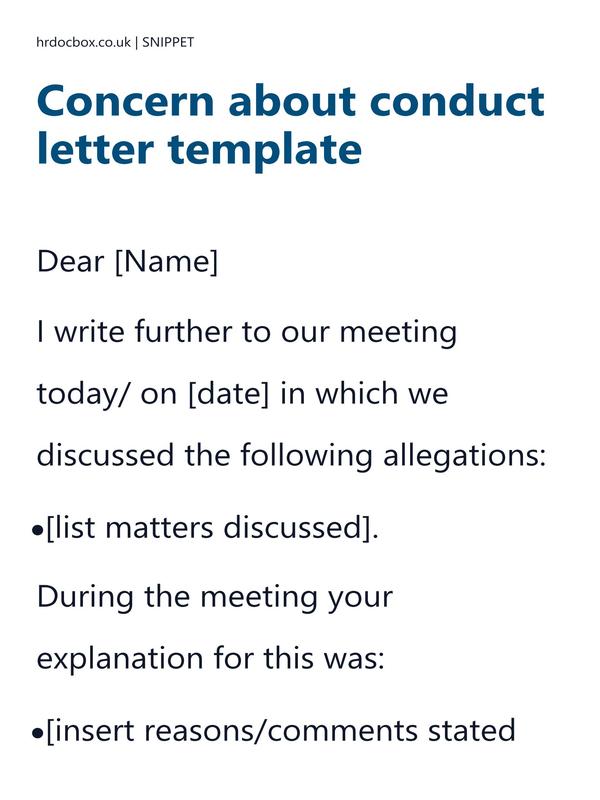
View full libraryUse this Concern About Conduct Letter to address an employee's conduct in a clear, professional and constructive way. It helps UK employers explain the concern, reinforce expected workplace standards, agree improvements and document follow-up arrangements before matters escalate unnecessarily.
Use this template to:
<p>If you are managing a disciplinary process, the toolkit brings together practical HR templates covering investigations, hearings, warnings, appeals and outcomes.</p>
This template brings together the key information, sections and considerations you need to create a clear, comprehensive and professional HR document. Preview the document below.
[Sender name]
[Sender address]
[date]
[Recipient name]
[Recipient address]
Dear [Recipient first name],
Concern About Conduct
Private and Confidential
Following our discussion on [Date of Discussion], I am writing to confirm the concerns we discussed regarding your conduct at work.
Details of the concern
The concern relates to the following incident or behaviour:
Date and time: [Date and Time]
Location or circumstances: [Location / Relevant Circumstances]
Description of the concern:
[Provide a factual, specific description of the behaviour or incident. Identify what happened, what was observed or reported, and why it caused concern. Avoid assumptions, personal criticism or conclusions that have not been established.]
This behaviour has raised concerns because [explain the impact on colleagues,
You've seen 20% of how the Concern about conduct letter template is structured. Get the complete editable template instantly and customise it for your organisation.

Concerns about conduct can include inappropriate language, disrespectful communication, failure to follow reasonable workplace instructions, repeated disruption or behaviour that falls below the organisation's expected standards. Addressing a minor concern early can help prevent misunderstandings from developing into more serious employee relations issues.
This letter gives managers a structured way to explain their concern, reinforce expectations and agree practical steps to improve the situation. It should be tailored to the facts and used alongside the organisation's disciplinary, dignity at work and other relevant policies.
Explain what happened, when it happened and why the behaviour caused concern. Use specific examples rather than labels such as "bad attitude" or "unprofessional". Distinguish what the manager directly observed from information reported by someone else, and avoid presenting disputed allegations as established facts.
The employee should have a reasonable opportunity to explain their perspective. Their explanation may reveal a misunderstanding, a training need, workplace pressures, a disability-related issue or another factor that requires consideration before deciding on next steps.
Explain the behaviour expected going forward and refer to any relevant policy, procedure or reasonable management instruction. The expectations should be specific and achievable. Where improvement is required, identify what needs to change and how the manager will assess progress.
Depending on the circumstances, support might include coaching, clearer instructions, refresher training, mediation or reasonable adjustments. Managers should consider these options where appropriate rather than assuming that every concern requires formal disciplinary action.
A short written record can help both the manager and employee understand what was discussed and what has been agreed. Include any actions, support, review arrangements and relevant dates. Keep the record confidential and consistent with the organisation's policies and data protection arrangements.
An informal concern letter should not be described or treated as a formal warning. If the concern is sufficiently serious to require formal action, or if an informal approach has not resolved the issue, the manager should consult HR and follow the appropriate formal procedure.
Allegations involving violence, threats, harassment, discrimination, serious safety breaches, dishonesty or other potentially serious misconduct may require a formal investigation. Managers should refer such matters to HR promptly rather than attempting to resolve them through an informal letter alone.
Where conduct may be connected to disability, health, protected disclosures, trade union activities or another legally protected matter, obtain HR advice before deciding how to proceed. Apply policies consistently and avoid prejudging the outcome of any investigation.
Related HR resources and workflow
Explore the HR resources that may be relevant before and / or after using the Concern about conduct letter, helping you understand the wider process, maintain appropriate documentation and follow a consistent approach.

This Disciplinary Policy provides a clear and consistent framework for managing concerns about employee conduct, behaviour, attendance or other breaches of workplace standards.

A verbal warning letter template for confirming an informal warning given to an employee following a conduct, attendance or performance concern, while making clear that the matter is being dealt with informally.
Use these best practice actions, recommended timescales and process stages to understand when and how the Concern about conduct letter should be used, helping ensure each step is handled consistently and appropriately documented.
Understand the common mistakes to avoid when using this HR template, helping you reduce risk, prevent unnecessary costs and ensure the process is handled correctly.
Not if it is genuinely intended as an informal management intervention. It should record the concern, discussion and agreed improvements without imposing a formal disciplinary sanction. If the employer intends to issue a formal warning, it should follow its disciplinary procedure instead.
For an informal conduct concern, a private conversation is generally a good starting point. Explain the concern, listen to the employee's perspective and discuss what needs to change. The letter can then confirm what was discussed and agreed. Serious allegations may require a different formal process.
Listen to their explanation and consider it fairly before deciding on next steps. Amend the record if necessary to reflect disputed facts or relevant context. If the matter is serious or cannot be resolved informally, consult HR about whether further investigation or a formal process is appropriate.
Review the agreed expectations, support and evidence of subsequent conduct. Discuss the position with the employee and consult HR. Depending on the circumstances, further informal action or a formal disciplinary procedure may be appropriate. Do not automatically escalate without considering the facts and the relevant policy.
HRDocBox provides practical, customisable HR resources designed to help UK employers manage employee relations consistently. This letter gives managers a clear structure for describing a concern, agreeing improvements and documenting follow-up, while helping distinguish informal management action from formal disciplinary proceedings.
HRDocBox provides a ready-to-adapt document with a practical structure and reminders about the process. AI can help tailor the wording to a specific situation, but the employer still needs to establish the facts, check its policies and decide whether informal or formal action is appropriate. The letter should be adapted to the circumstances rather than used as an automatic response to every concern.
How this content is developed and reviewed
The Concern about conduct letter template is developed using a practical HR methodology that considers current UK employment legislation, ACAS guidance, CIPD good practice and the real-world HR process it supports. Templates and supporting information are regularly reviewed and updated, with additional reviews triggered by significant changes to legislation, guidance or established HR practice, helping ensure each document remains practical, relevant and suitable for UK employers.
Darryl Horn, Chartered HR Director
Darryl is a Chartered HR professional with over 25 years' experience in senior HR and employee relations roles.
He has extensive practical experience of managing disciplinary HR processes and founded hrdocbox to provide businesses with practical, professionally developed HR resources grounded in UK employment law and best practice.
HRDocBox has been creating practical UK HR documents since 2009.
"Darryl provides support and advice with excellent judgement, and has a strong understanding of people, policies and UK employment legislation."
"He is someone I trust; consistent, dependable, and committed to doing things properly."




















Whether you employ 5 people or 50, hrdocbox gives you the structure, documents and expertise needed to manage employees professionally and legally.
Professionally written and fully compliant with UK employment law

Access a free contract template instantly - or save 10% on any document today.
Use this code at checkout for 10% off anything!
Includes instant download, updates, and full access to your HR templates.