Probation review meeting invitation letter template

£9.99
UK-specific Editable Instant download 12 months' updates

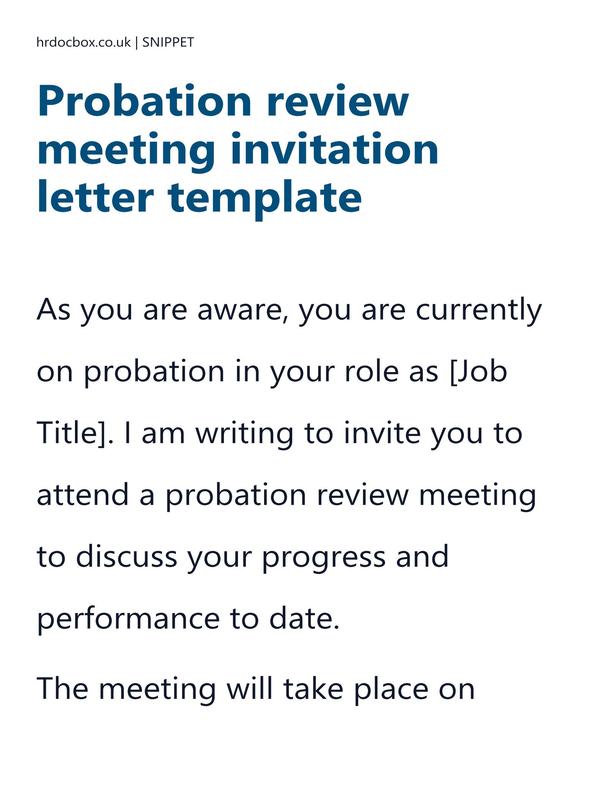
A practical letter inviting an employee to a probation review meeting to discuss their progress, performance, conduct, attendance and overall suitability for the role before the probationary period ends.

Use this template to:
  • Invite an employee to a formal probation review meeting
  • Explain the purpose and scope of the review
  • Give the employee an opportunity to discuss their progress and experience
  • Identify any concerns about performance, conduct or attendance
  • Explain the possible outcomes of the review
  • Create a clear and consistent probation review process
Probation review meeting invitation letter template
2026 Reviewed

What's included in this template?

This template brings together the key information, sections and considerations you need to create a clear, comprehensive and professional HR document. Preview the document below.

  • Meeting details and purpose
  • Probationary period information
  • Areas for discussion
  • Opportunity for employee feedback
  • Possible review outcomes
  • Preparation guidance

Your complete Probation resource

Templates. Knowledge. Guidance. Everything you need, all in one place.

Explore the Probation templates toolkit
Template

Download .doc

Copy [to paste]

Email

[Sender name]

[Sender address]

[date]

[Recipient name]

[Recipient address]


Dear [Recipient first name],

Invitation to probation review meeting

As you are approaching the end of your probationary period, I am writing to invite you to a probation review meeting to discuss your progress and experience since joining [Company Name].

Your probationary period commenced on [start date] and is currently due to end on [end date].

Meeting details

Date:  
Time:  
Location / meeting method:  
Manager:  

What we will discuss

The meeting will provide an opportunity to review your progress during your probationary period. This will include discussion of:

  • your performance against the requirements of your role;
  • the quality and standard of your work;
  • your attendance, punctuality and reliability;
  • your conduct and working relationships with colleagues;
  • training and development completed to date;
  • your understanding of the role and company expectations; and
  • any areas where further support, development or improvement may be required.

We will also give you an opportunity to discuss your experience of working at [Company

PREVIEW ENDS HERE

This is the end of the preview

You've seen 40% of how the Probation review meeting invitation letter template is structured. Get the complete editable template instantly and customise it for your organisation.

£9.99
Specifications
Access 12 months, with updates
Length 2 pages • 433 words
Jurisdiction England, Wales, Scotland
Based on UK law, ACAS guidance
Last review 06/09/2026
Next review 06/03/2027
Delivery Instant digital delivery
Formats .doc · .txt · email

What is a probation review meeting invitation letter?

Probation review meeting invitation letter template preview

A probation review meeting provides an opportunity for an employer and new employee to review how the employment relationship is progressing before the probationary period ends. This invitation letter gives the employee advance notice of the meeting and explains what will be discussed, helping the review to be constructive rather than simply an assessment of whether the employee has passed probation.

Reviewing progress against the role

The meeting can be used to review the employee's performance against the expectations established when they joined the organisation, including their responsibilities, objectives, quality of work, productivity and development. It also provides an opportunity to recognise achievements and identify areas where further improvement or support may be required.

Discussing conduct, attendance and workplace integration

Probation reviews can cover more than technical performance. The manager can consider attendance, reliability, conduct, communication, teamwork and how the employee has adapted to the organisation's working practices and expectations.

Giving the employee an opportunity to contribute

A review should be a two-way conversation. The invitation encourages the employee to prepare for the meeting and provides an opportunity to discuss their experience of the role, any challenges they have encountered, the support they need and any concerns they wish to raise.

Considering the probation outcome

The meeting can be used to confirm whether the employee has successfully completed probation, whether the probationary period should be extended where the contract and circumstances allow, or whether concerns require further action. The invitation should not suggest that the outcome has already been decided before the review takes place.

Example

A new Production Operative joined the company six months ago and is approaching the end of their six-month probationary period. Their manager is generally pleased with their progress but has identified some concerns about punctuality and the employee's consistency when completing certain production tasks.

The manager reviews the employee's probation objectives, attendance record, training completed and feedback from the Team Leader before arranging the review. The employee is sent an invitation explaining that the meeting will cover their progress, performance, attendance, conduct, training and overall experience of the role.

At the meeting, the manager recognises the employee's progress in learning the production processes but discusses the punctuality concern and explains the required standard. The employee explains that they have experienced some difficulties with their travel arrangements but confirms that these have now been resolved.

The manager decides that the employee has made sufficient progress to complete probation successfully, while making clear that punctuality must remain at the expected standard. The review also identifies some additional machine training that would help the employee develop further in the role.

The wider HR process

Related HR resources and workflow

Explore the HR resources that may be relevant before and / or after using the Probation review meeting invitation letter, helping you understand the wider process, maintain appropriate documentation and follow a consistent approach.

Previous
Letters
Probation introduction letter

Our Probation Introduction Letter Template clarifies probation terms, setting expectations for both employer and new employee with ease.

This
Probation review meeting invitation letter
Next
Forms
Probation review form

Our Probation Review Form Template streamlines evaluation, ensuring consistent and objective assessments during the probationary period.

Premium content

To continue reading, purchase this item or a parent toolkit, library or our full library.

Implementation guidance

Use these best practice actions, recommended timescales and process stages to understand when and how the Probation review meeting invitation letter should be used, helping ensure each step is handled consistently and appropriately documented.

Step Description Responsibility Timing
1 Review the employee's probation objectives, performance, attendance, conduct, training and any feedback received during the probationary period. Manager / HR Before invitation
2 Send the employee the meeting invitation, providing sufficient notice and explaining the purpose and areas that will be discussed. Manager / HR Before review
3 Hold the review as a two-way discussion, giving the employee an opportunity to comment on their progress, experience, support and any concerns. Manager / Employee Review meeting
4 Consider the employee's progress and determine the appropriate outcome in accordance with the contract, probation arrangements and company policy. Manager / HR After discussion
5 Confirm the outcome in writing and record any objectives, development actions, support or further review arrangements that have been agreed. Manager / HR Promptly after review
Premium content

To continue reading, purchase this item or a parent toolkit, library or our full library.

Common mistakes

Understand the common mistakes to avoid when using this HR template, helping you reduce risk, prevent unnecessary costs and ensure the process is handled correctly.

  • Leaving the review until immediately before or after the probationary period ends.
  • Failing to explain what the employee should expect to discuss at the meeting.
  • Focusing only on problems and failing to recognise progress or achievements.
  • Deciding the outcome before hearing the employee's perspective.
  • Ignoring attendance, conduct, training or workplace integration when assessing overall progress.
  • Extending probation without checking that the contract and circumstances allow this.
Premium content

To continue reading, purchase this item or a parent toolkit, library or our full library.

HR considerations

UK employment law and best practice

This template is designed to support the process, but the document should be used alongside the relevant HR procedure and applied to the circumstances of the individual case.

Probationary periods

There is no general statutory requirement for an employer to operate a probationary period. Where one is used, its length, terms and any consequences should normally be set out clearly in the employee's contract or written statement of employment particulars. Employers should follow their contractual arrangements consistently.

Notice and ending employment

If the employee does not successfully complete probation and the employer decides to terminate employment, the employer should check the contractual notice provisions and follow the applicable termination process. Statutory minimum notice may also apply depending on the employee's length of service and circumstances. https://www.gov.uk/dismiss-staff/notice-periods

Fairness and discrimination

Probation does not remove an employee's protection from unlawful discrimination. Decisions about whether an employee passes probation should not be influenced by a protected characteristic under the Equality Act 2010. https://www.legislation.gov.uk/ukpga/2010/15/contents

Reasonable adjustments

Where an employee has a disability, the employer should consider whether reasonable adjustments are required in relation to the employee's work, performance expectations or the review process. The duty to make reasonable adjustments can apply during probation in the same way as during other stages of employment. https://www.acas.org.uk/reasonable-adjustments

Performance and capability

If concerns about performance are identified during probation, the employer should explain the required standard, give the employee a reasonable opportunity to improve where appropriate and consider what support or training may be needed. The approach should be proportionate to the role, the circumstances and the seriousness of the concerns.

Record keeping and personal information

Notes from probation reviews should be factual, relevant and proportionate. Records relating to an employee should be handled in accordance with UK data protection requirements, including appropriate controls over access and retention. https://ico.org.uk/for-organisations/uk-gdpr-guidance-and-resources/employment/

Employment Rights Act 2025

Employers should keep probation arrangements under review as employment law develops. The Employment Rights Act 2025 introduced significant changes to employment rights, including changes affecting unfair dismissal and the statutory framework for new starters. Employers should ensure their probation and termination processes remain aligned with the legislation in force at the relevant time. https://www.gov.uk/government/collections/employment-rights-act-2025

You may also need these resources

FAQs

When should a probation review meeting take place?

The review should normally take place sufficiently before the probationary period ends to allow the employer to reach an informed decision and, where appropriate, provide further support or consider an extension if the contractual arrangements allow one. Employers should avoid leaving the review until the final day of probation.

What should be discussed at a probation review?

The discussion can cover performance against objectives, quality and quantity of work, attendance, punctuality, conduct, teamwork, training, development and the employee's overall experience of the role. It should also give the employee an opportunity to raise questions or concerns.

Can probation be extended?

Potentially, but the employer should first check the employee's contract and probation arrangements. An extension should be communicated clearly, including its length, the reasons for it, the improvements or objectives expected and when the next review will take place.

Does an employee have the right to a formal disciplinary hearing during probation?

Being on probation does not automatically remove an employee's employment rights. If the issue concerns alleged misconduct and the employer is considering formal disciplinary action, the appropriate disciplinary process should be followed rather than treating probation as a reason to bypass procedural safeguards.

What if the employee has not met the required standard?

The manager should explain the areas of concern, listen to the employee's explanation and consider whether additional support, training or time is appropriate. If the employee is unlikely to meet the required standard, the employer should follow the contractual probation arrangements and appropriate termination process.

Why use HRDocBox rather than AI?

AI can produce a generic meeting invitation, but probation reviews involve more than arranging a meeting: the wording needs to leave the outcome open, encourage a meaningful two-way discussion and fit with the employer's probation, performance and termination processes. HRDocBox templates provide a practical UK HR structure that can be adapted to the organisation's own procedures and contractual arrangements.

How this content is developed and reviewed

The Probation review meeting invitation letter template is developed using a practical HR methodology that considers current UK employment legislation, ACAS guidance, CIPD good practice and the real-world HR process it supports. Templates and supporting information are regularly reviewed and updated, with additional reviews triggered by significant changes to legislation, guidance or established HR practice, helping ensure each document remains practical, relevant and suitable for UK employers.

About the author

Darryl Horn, Chartered HR Director

Darryl is a Chartered HR professional with over 25 years' experience in senior HR and employee relations roles.

He has extensive practical experience of managing probation HR processes and founded hrdocbox to provide businesses with practical, professionally developed HR resources grounded in UK employment law and best practice.

HRDocBox has been creating practical UK HR documents since 2009.

Executive recommendation

"Darryl provides support and advice with excellent judgement, and has a strong understanding of people, policies and UK employment legislation."

"He is someone I trust; consistent, dependable, and committed to doing things properly."

RB
Ruth Brock Chief Executive Officer The Hygiene Bank
The Probation review meeting invitation letter template is also included in these bundles:

Probation toolkit Probation toolkit 12 templates
£34.90

Recruitment library Recruitment library 130 templates
£59.99

Full library Full library 780 templates
£74.99

Get started today

HR confidence starts here

Whether you employ 5 people or 50, hrdocbox gives you the structure, documents and expertise needed to manage employees professionally and legally.

Download your FREE UK employment contract template

Professionally written and fully compliant with UK employment law
Download FREE contract
Free UK employment contract template