Libraries
780+ HR templates
Everything your business needs to stay compliant
Policies, contracts, letters, guidance and HR support tools for UK employers.
View full libraryPolicies, contracts, letters, guidance and HR support tools for UK employers.
View full libraryOur Guide to Managing an Employee Resignation offers step-by-step instructions for a smooth transition, ensuring professionalism and maintaining positive relationships.
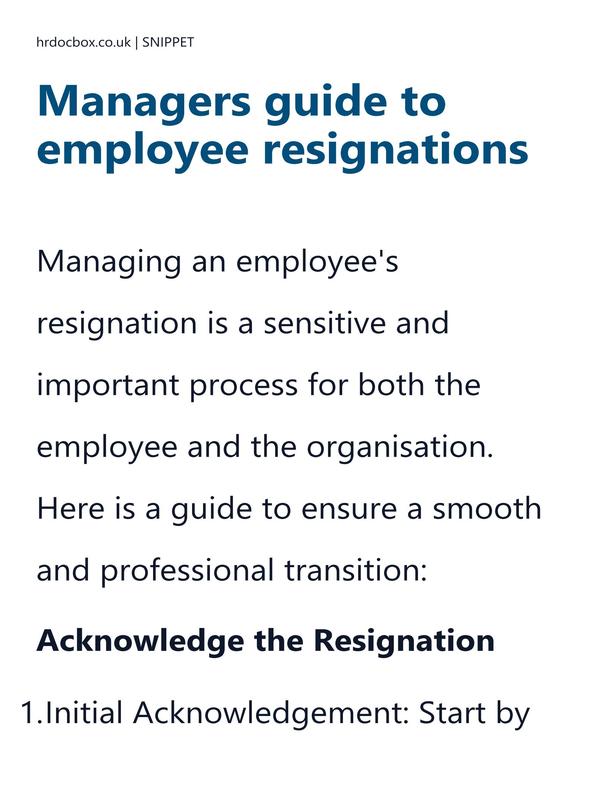
If you are managing employee resignations, the toolkit brings together practical HR templates covering resignation, notice, handover, exit and final pay.
Managing an employee's resignation is a sensitive and important process for both the employee and the organisation. Here is a guide to ensure a smooth and professional transition:
Acknowledge the Resignation
Initial Acknowledgement: Start by acknowledging the employee's resignation in writing, expressing appreciation for their contributions. This sets a positive tone and shows respect for their decision.
Immediate Reaction: Avoid reacting emotionally or impulsively. If the resignation was unexpected or delivered in the heat of the moment, give the employee time to reconsider their decision before formalising it.
Discuss Transition
Schedule a Meeting: Arrange a face-to-face meeting to discuss the transition. This meeting should cover the following aspects:
Responsibility
You've seen 20% of how the Managers guide to employee resignations is structured. Get the complete editable template instantly and customise it for your organisation.

The guide to managing an employee resignation is a comprehensive resource providing managers with practical steps to handle the resignation process smoothly.
It covers essential aspects such as exit interviews, transition planning, and maintaining positive relationships.
This guide's purpose is to assist managers in navigating employee departures with professionalism, ensuring a constructive departure experience for both the departing employee and the team.
Related HR resources and workflow
Explore the HR resources that may be relevant before and / or after using the Managers guide to employee resignations, helping you understand the wider process, maintain appropriate documentation and follow a consistent approach.

This Resignation Letter provides employees with a clear written way to formally resign from their employment and give the required notice.
The Resignation Acceptance Letter formally acknowledges an employee's resignation and confirms the arrangements for the end of their employment.
Yes. This template has been designed for organisations of all sizes, including small businesses, charities and growing employers. It follows UK employment law best practice and can be adapted to suit your organisation.
Our templates are developed with UK employment legislation, Acas guidance and HR best practice in mind and are reviewed and updated as relevant requirements change. However, every employment situation is different, so the template should be adapted to the circumstances and checked against the employee's contract and your organisation's procedures before use.
Yes, we highlight the areas of the document that you need to update with your own details, and where you need to make decisions to suit your situation. This saves you time and ensures that you meet best practice.
Yes. Once purchased, you'll be able to download it instantly. Templates are provided in editable format (such as .doc or .xls) so you can customise them easily, and in PDF format for easy sharing.
If you're looking for broader support, we also offer toolkits and library bundles that include the Managers guide to employee resignations, along with other HR templates and policies for fully managing your situation. These may be more cost-effective if you need deeper advice.
AI can produce a document quickly, but effective HR documentation needs to be more than well-written words. It needs to reflect relevant UK employment law, HR best practice, practical considerations and the circumstances in which it will be used. These resources have been professionally developed around that wider HR context, drawing on extensive practical experience, rather than simply generating a generic document from a prompt.
How this content is developed and reviewed
The Managers guide to employee resignations is developed using a practical HR methodology that considers current UK employment legislation, ACAS guidance, CIPD good practice and the real-world HR process it supports. Templates and supporting information are regularly reviewed and updated, with additional reviews triggered by significant changes to legislation, guidance or established HR practice, helping ensure each document remains practical, relevant and suitable for UK employers.
Darryl Horn, Chartered HR Director
Darryl is a Chartered HR professional with over 25 years' experience in senior HR and employee relations roles.
He has extensive practical experience of managing resignation HR processes and founded hrdocbox to provide businesses with practical, professionally developed HR resources grounded in UK employment law and best practice.
HRDocBox has been creating practical UK HR documents since 2009.
"Darryl provides support and advice with excellent judgement, and has a strong understanding of people, policies and UK employment legislation."
"He is someone I trust; consistent, dependable, and committed to doing things properly."




















Whether you employ 5 people or 50, hrdocbox gives you the structure, documents and expertise needed to manage employees professionally and legally.
Professionally written and fully compliant with UK employment law
Access a free contract template instantly - or save 10% on any document today.
Use this code at checkout for 10% off anything!
Includes instant download, updates, and full access to your HR templates.