Libraries
780+ HR templates
Everything your business needs to stay compliant
Policies, contracts, letters, guidance and HR support tools for UK employers.
View full libraryPolicies, contracts, letters, guidance and HR support tools for UK employers.
View full libraryThis Manager's Guide to Reducing Sickness Absence provides practical guidance for managers on managing attendance, responding to short-term and recurring absence and supporting employees back to work. It helps managers take a consistent, supportive and proactive approach while recognising when HR involvement or further action may be appropriate.
Use this guide to:

If you are managing sickness absence, the toolkit brings together practical HR templates covering absence reporting, return-to-work meetings, reviews, support and formal action.
This guide brings together the key information, considerations and practical guidance you need to understand the subject, make informed decisions and take an appropriate and consistent approach. Preview the document below.
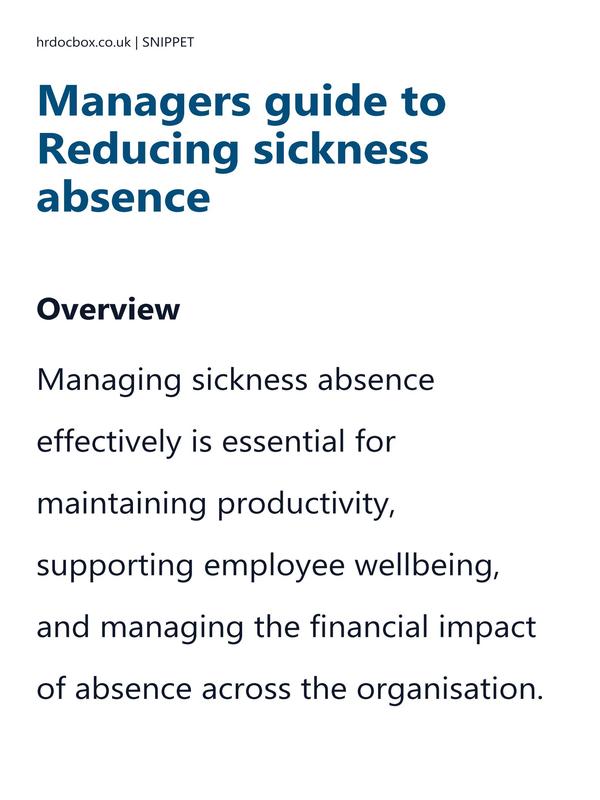
Overview
Managing sickness absence effectively is essential for maintaining productivity, supporting employee wellbeing, and managing the financial impact of absence across the organisation.
From April 2026, statutory sick pay (SSP) is payable from the first day of sickness absence. This represents a significant change from the previous rules, where SSP was not payable for the first three waiting days. As a result, employers may see increased costs associated with short-term sickness absence.
This guide provides managers with practical steps to reduce avoidable absence while ensuring employees who are genuinely unwell are supported appropriately.
Consistency is Essential
The most effective way to manage absence is through consistent application of company policies and procedures.
You've seen 20% of how the Managers guide to Reducing sickness absence is structured. Get the complete editable template instantly and customise it for your organisation.
This Manager's Guide to Reducing Sickness Absence provides practical guidance for managers who are responsible for supporting attendance and managing sickness absence within their teams. It focuses on early intervention, consistent management and understanding the reasons behind absence rather than simply recording days lost.
It supports organisations preparing for the April 2026 change where Statutory Sick Pay becomes payable from the first day of absence, increasing the financial impact of short-term sickness.
Effective absence management starts with clear expectations around attendance, absence reporting and keeping in contact during sickness. Managers should monitor attendance appropriately and address emerging concerns rather than allowing repeated or prolonged absence to go unmanaged.
Absence can arise from a wide range of health, personal or workplace circumstances. Managers should use return-to-work discussions and appropriate questions to understand whether there are underlying issues, while avoiding assumptions about an employee's health or circumstances.
A supportive return-to-work discussion provides an opportunity to check how the employee is feeling, confirm the reason for absence, identify any support that may be needed and reinforce the organisation's attendance expectations. Where appropriate, managers may need to consider reasonable adjustments or occupational health advice.
Where an employee has repeated periods of sickness absence, managers should review the overall pattern rather than considering each absence in isolation. The organisation's absence policy should provide the framework for deciding when an absence review or formal stage may be appropriate.
Managers should involve HR where absence is becoming persistent, complex or potentially requires formal action. HR can help managers apply the organisation's procedure consistently, consider relevant employment law issues and identify when additional medical or occupational health information may be appropriate.
Use the following as a practical framework for assessing the situation, considering the available options and deciding on the appropriate course of action. Follow each step in sequence to support consistent, informed and appropriate decision-making.
Understand the common mistakes to avoid when using this HR template, helping you reduce risk, prevent unnecessary costs and ensure the process is handled correctly.
Managers can help reduce absence by setting clear attendance expectations, responding promptly to absence, holding effective return-to-work discussions, identifying emerging patterns and addressing underlying issues where appropriate. The aim should be to manage attendance consistently while supporting employees where support is needed.
Where the organisation's policy provides for return-to-work discussions, managers should apply the process consistently. A short discussion can help confirm the reason for absence, check the employee is fit to return and identify any support or recurring concerns.
Managers should involve HR where absence becomes persistent or recurring, where there may be an underlying health condition or disability, where reasonable adjustments may be required or where the organisation's formal absence procedure may need to be considered.
Potentially, but the employer should follow its absence management procedure and consider the individual circumstances first. This may include considering medical evidence, reasonable adjustments and whether the employee has been given a fair opportunity to improve attendance before formal action is taken.
It may require additional consideration. Where an employee has a disability, the employer should consider its obligations under the Equality Act 2010, including whether reasonable adjustments may be appropriate. Managers should seek HR advice where disability may be relevant to an absence case.
AI can produce generic absence management advice, but HRDocBox provides structured, UK-focused HR guidance designed around practical workplace processes. This guide gives managers a consistent framework for managing attendance while recognising the importance of employee support, reasonable adjustments and appropriate HR involvement.
How this content is developed and reviewed
The Managers guide to Reducing sickness absence is developed using a practical HR methodology that considers current UK employment legislation, ACAS guidance, CIPD good practice and the real-world HR process it supports. Templates and supporting information are regularly reviewed and updated, with additional reviews triggered by significant changes to legislation, guidance or established HR practice, helping ensure each document remains practical, relevant and suitable for UK employers.
Darryl Horn, Chartered HR Director
Darryl is a Chartered HR professional with over 25 years' experience in senior HR and employee relations roles.
He has extensive practical experience of managing sick management HR processes and founded hrdocbox to provide businesses with practical, professionally developed HR resources grounded in UK employment law and best practice.
HRDocBox has been creating practical UK HR documents since 2009.
"Darryl provides support and advice with excellent judgement, and has a strong understanding of people, policies and UK employment legislation."
"He is someone I trust; consistent, dependable, and committed to doing things properly."




















Whether you employ 5 people or 50, hrdocbox gives you the structure, documents and expertise needed to manage employees professionally and legally.
Professionally written and fully compliant with UK employment law
Access a free contract template instantly - or save 10% on any document today.
Use this code at checkout for 10% off anything!
Includes instant download, updates, and full access to your HR templates.