Libraries
780+ HR templates
Everything your business needs to stay compliant
Policies, contracts, letters, guidance and HR support tools for UK employers.
View full libraryPolicies, contracts, letters, guidance and HR support tools for UK employers.
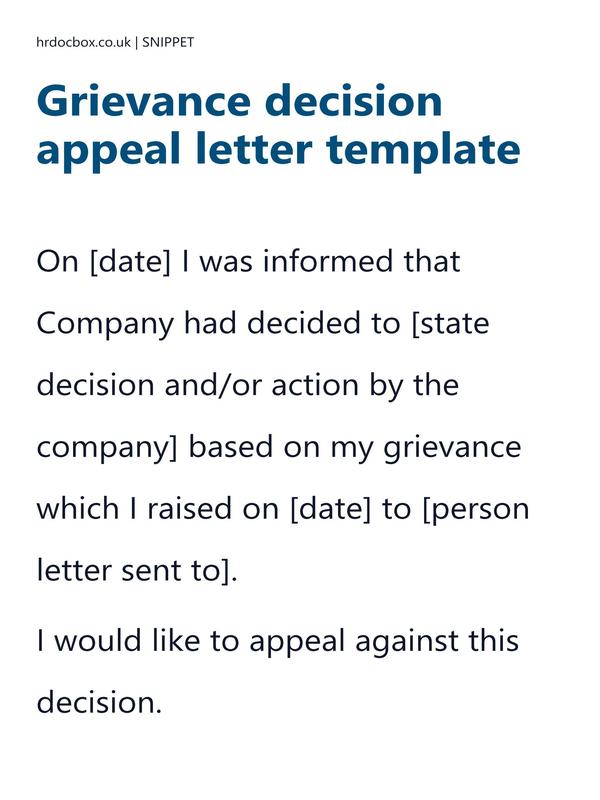
View full libraryUse this Grievance Decision Appeal Letter Template to challenge the outcome of a formal workplace grievance. It helps an employee explain why the original decision may be incorrect, unfair or procedurally flawed, identify any new evidence and request a fair review.
Use this template to:
<p>If you are managing an employee grievance, the toolkit brings together practical HR templates covering investigation, meetings, mediation, appeals and outcomes.</p>
[Sender name]
[Sender address]
[date]
[Recipient name]
[Recipient address]
Dear [Recipient first name],
Appeal Against Grievance Outcome
I am writing to formally appeal the outcome of my grievance, which was communicated to me in your letter dated [Date of Grievance Outcome]. I am submitting this appeal in accordance with the Company's grievance procedure.
Having considered the outcome, I believe that the decision should be reviewed for the reasons set out below.
Grounds for Appeal
My grounds for appeal are as follows:
[Ground 1 - For example, relevant evidence was overlooked]
I believe that [explain the finding or conclusion being challenged]. In particular, [identify the relevant evidence, information or circumstances] was not adequately considered in reaching the original decision. I believe this is relevant because [explain why it may affect the findings or outcome].
[Ground 2 - For example, the investigation was incomplete]
I am concerned that [explain the specific issue with the investigation or evidence considered]. In particular, [identify any relevant witness, document, event or line of enquiry]. I believe that this should be reviewed before a final decision is reached.
[Ground 3 - For example, the procedure was not followed fairly]
I believe that the process may not have been fair because [explain the specific procedural concern]. This affected my ability to have the grievance considered fully because [explain the impact].
[Additional Ground, if applicable]
[Set out any further reason why the original findings, conclusions or proposed action should be reconsidered.]
New Evidence or Further Information
Since the original grievance decision, I have identified the following additional evidence or information that I would like to be considered:
[Describe the evidence, explain its relevance and identify any supporting documents or witnesses. If there is no new evidence, remove this paragraph.]
Outcome Requested
I would like the appeal to be considered impartially, with the grounds set out above reviewed alongside the original grievance, the investigation findings and the evidence available.
In particular, I request that the Company [select and adapt the relevant outcome]:
I would welcome the opportunity to explain my grounds of appeal at an appeal hearing and to provide any further information that may assist the review. Please confirm the next steps, the proposed arrangements and the applicable timescales.
I understand that the appeal will be considered in accordance with the Company's grievance procedure and applicable guidance. I would also like to exercise my right to be accompanied at any formal appeal hearing, in accordance with the applicable rules.
Thank you for considering my appeal. I look forward to receiving confirmation of the arrangements and the outcome once the review has been completed.
Yours [faithfully | sincerely],
[Sender name]
[Sender job title]
[Sender telephone]
[Sender email]
[For, and on behalf of [Company name] ]

A grievance decision appeal letter gives an employee a formal way to challenge the outcome of a workplace grievance where they believe the decision was wrong, unfair or reached through an inadequate process. It helps the employee explain the reasons for the appeal clearly and constructively, allowing the employer to understand the issues that need to be reviewed.
An employee may wish to appeal if relevant evidence was overlooked, the investigation was incomplete, findings were inconsistent with the evidence, the grievance procedure was not followed fairly or the outcome did not adequately address the concerns raised. An appeal may also be appropriate where new evidence has become available or the employee believes the proposed action is insufficient to resolve the grievance.
A useful appeal letter identifies the original decision and explains precisely what is being challenged. Rather than simply repeating the original grievance, the employee should explain why the outcome may be incorrect or unfair, refer to relevant evidence and identify any procedural concerns. The letter should also state what the employee would like the employer to do next.
The employer should follow its grievance procedure and the ACAS Code of Practice. The appeal should be handled impartially and, wherever possible, by a manager who was not previously involved in the original decision. The appeal may involve a review of the original decision, a further investigation or a rehearing, depending on the grounds and the employer's procedure.
A written appeal provides a record of the issues being challenged and the resolution sought. Employees should retain copies of the original grievance, outcome letter, appeal and supporting evidence. Employers should handle the appeal promptly, keep appropriate records and communicate the final decision in writing.
Related HR resources and workflow
Explore the HR resources that may be relevant before and / or after using the Grievance decision appeal letter, helping you understand the wider process, maintain appropriate documentation and follow a consistent approach.

Use this Grievance Hearing Outcome Confirmation Letter to formally communicate the outcome of an employee's grievance following a hearing.
Grievance appeal letter template to help employees formally challenge a grievance outcome.
Use these best practice actions, recommended timescales and process stages to understand when and how the Grievance decision appeal letter should be used, helping ensure each step is handled consistently and appropriately documented.
Understand the common mistakes to avoid when using this HR template, helping you reduce risk, prevent unnecessary costs and ensure the process is handled correctly.
An employee may appeal if they believe the outcome was wrong or unfair, relevant evidence was overlooked, the investigation was inadequate or the procedure was not followed fairly. The employee should check the employer's grievance policy and submit the appeal within the applicable deadline.
The deadline should be set out in the employer's grievance procedure. ACAS recommends five working days from receiving the outcome as an appropriate period for raising an appeal. If more time is needed, the employee should request an extension promptly and explain the reasons.
The letter should identify the original grievance decision, explain the grounds for appeal, identify any relevant evidence or procedural concerns and state the outcome being requested. It should be factual, professional and sufficiently specific to allow the employer to understand the issues.
Wherever possible, the appeal should be considered by a manager who was not previously involved in the original grievance decision. The person handling the appeal should act impartially, have appropriate authority and consider whether further investigation or a rehearing is necessary.
Workers have a statutory right to be accompanied at a grievance appeal hearing by a qualifying companion, such as a fellow worker or an eligible trade union representative. The employee should check the hearing arrangements and tell the employer who will accompany them. Reasonable adjustments may be required in appropriate circumstances.
HRDocBox provides practical, editable HR templates designed for UK employers and workplace situations. Its resources offer a structured starting point for preparing clear, consistent documentation, which can be adapted to the facts and the organisation's procedures.
HRDocBox provides purpose-built HR documentation structured around practical workplace processes and UK employment considerations. A dedicated template helps users organise the relevant information consistently, while AI can assist with tailoring the wording. Important legal and procedural requirements should still be checked against current official guidance.
How this content is developed and reviewed
The Grievance decision appeal letter template is developed using a practical HR methodology that considers current UK employment legislation, ACAS guidance, CIPD good practice and the real-world HR process it supports. Templates and supporting information are regularly reviewed and updated, with additional reviews triggered by significant changes to legislation, guidance or established HR practice, helping ensure each document remains practical, relevant and suitable for UK employers.
Darryl Horn, Chartered HR Director
Darryl is a Chartered HR professional with over 25 years' experience in senior HR and employee relations roles.
He has extensive practical experience of managing grievance HR processes and founded hrdocbox to provide businesses with practical, professionally developed HR resources grounded in UK employment law and best practice.
HRDocBox has been creating practical UK HR documents since 2009.
"Darryl provides support and advice with excellent judgement, and has a strong understanding of people, policies and UK employment legislation."
"He is someone I trust; consistent, dependable, and committed to doing things properly."




















Whether you employ 5 people or 50, hrdocbox gives you the structure, documents and expertise needed to manage employees professionally and legally.
Professionally written and fully compliant with UK employment law
Access a free contract template instantly - or save 10% on any document today.
Use this code at checkout for 10% off anything!
Includes instant download, updates, and full access to your HR templates.