Libraries
780+ HR templates
Everything your business needs to stay compliant
Policies, contracts, letters, guidance and HR support tools for UK employers.
View full libraryPolicies, contracts, letters, guidance and HR support tools for UK employers.
View full libraryThis Managers' Guide to the 9 Box Grid explains how to use the performance and potential matrix as part of a structured talent review. It helps managers and leadership teams assess current performance, consider future potential, calibrate their views and agree practical development, succession and performance actions.
Use this guide to:
If you are introducing or reviewing your appraisal process, the toolkit brings together 11 connected HR templates covering preparation, reviews, feedback, objectives and follow-up.
This guide brings together the key information, considerations and practical guidance you need to understand the subject, make informed decisions and take an appropriate and consistent approach.
Purpose
The 9 Box Grid is a talent management tool used to help leadership and management assess employees across two dimensions:
The purpose of the grid is to support structured management discussions about talent, development, succession, retention and performance.
Important: this is a management assessment
The 9 Box Grid is not normally completed by employees themselves.
Employees should have appropriate opportunities to discuss their performance, achievements, career aspirations, development needs and support requirements through normal management processes. However, the assessment of where an employee sits on the grid is a management and leadership decision.
A line manager may prepare an initial assessment of their direct reports, but the assessment should normally be reviewed through a wider leadership or management talent review. This provides an opportunity to challenge assumptions, compare standards and agree a more consistent organisational view.
How the grid works
| Potential / Performance | Low Performance | Medium Performance | High Performance |
| High Potential | High potential Low current performance |
High potential Medium current performance |
High potential High current performance |
| Medium Potential | Medium potential Low current performance |
Medium potential Medium current performance |
Medium potential High current performance |
| Low Potential | Low potential Low current performance |
Low potential Medium current performance |
Low potential High current performance |
Understanding performance
Performance should consider how effectively the employee is delivering in their current role. Managers should consider evidence such as:
High performance
The employee consistently performs at or above the required standard and delivers strong results in their current role.
Medium performance
The employee generally meets expectations but may have areas where performance, consistency, capability or experience could be further developed.
Low performance
The employee is not consistently meeting the requirements of their current role or agreed objectives. Managers should establish why performance is below expectation before deciding what action is appropriate.
Understanding potential
Potential is about future capability. It should not simply mean that a manager likes the employee, that they are ambitious or that they are good at their current job.
Managers should consider evidence such as:
Potential should not be confused with immediate readiness for promotion. Someone may have strong potential but require further experience and development before they are ready for a more senior role.
The nine boxes
Box 1 – Low Performance / Low Potential
What it means: The employee is currently performing below the required standard and there is currently limited evidence of potential to move beyond their present level.
What managers should consider:
Typical next steps:
Important: Placement in this box should not automatically result in dismissal. Any formal performance action must follow the organisation's appropriate process.
Box 2 – Low Performance / Medium Potential
What it means: Current performance is below expectation, but there is evidence that the employee could develop and perform more effectively with appropriate support.
Typical next steps:
The key question is whether the employee can demonstrate sustained improvement when given appropriate support.
Box 3 – Low Performance / High Potential
What it means: The employee is not currently performing at the required level, but management sees evidence of significant capacity to develop.
This may occur where someone is new to a role, has recently taken on greater responsibility, has not received the right development or may be better suited to different work.
Typical next steps:
High potential should not be used as a reason to overlook current performance expectations.
Box 4 – Medium Performance / Low Potential
What it means: The employee is generally performing at the required level but there is currently limited evidence that they are likely to move into substantially more complex or senior responsibilities.
This is not necessarily a negative assessment. An employee may be highly effective and valuable in their current role without wanting or needing promotion.
Typical next steps:
Box 5 – Medium Performance / Medium Potential
What it means: The employee is a solid contributor with scope to improve current performance and develop further.
Typical next steps:
This is often an important development population because relatively small improvements in capability and performance may create significant future value.
Box 6 – Medium Performance / High Potential
What it means: The employee demonstrates strong future potential but is not yet consistently performing at the highest level in their current role.
Typical next steps:
Do not promote solely because an employee has been identified as high potential. Development and readiness should be assessed separately.
Box 7 – High Performance / Low Potential
What it means: The employee is performing strongly in their current role but there is currently limited evidence that they will move into substantially more complex responsibilities.
This is not a negative category. Many organisations depend on highly capable specialists and experienced employees who provide significant value without moving into management.
Typical next steps:
Box 8 – High Performance / Medium Potential
What it means: The employee is performing strongly and shows some capacity for broader responsibility, but further development or experience may be needed before they are ready for significantly more complex roles.
Typical next steps:
Box 9 – High Performance / High Potential
What it means: The employee is performing strongly in their current role and there is strong evidence that they could develop into more complex or senior responsibilities.
This group may form an important part of succession planning, but high potential should still be supported by evidence and should not automatically mean immediate promotion.
Typical next steps:
How the talent review should work
1. Managers prepare
Each manager reviews their direct reports and prepares an evidence-based view of performance and potential. Managers should avoid making assessments based purely on personality, personal preference or one recent event.
2. Leadership reviews and challenges
The management or leadership team reviews the proposed assessments together. Managers should be prepared to explain the evidence supporting their assessment.
3. Calibration takes place
The group considers whether similar standards are being applied across teams. Where one manager's definition of "high performance" or "high potential" appears materially different from another's, the group should discuss and calibrate the assessment.
4. Final placement is agreed
Once the evidence and context have been discussed, the leadership or management group agrees the appropriate current placement.
5. Actions are agreed
Every placement should result in an appropriate management action. The review should not finish with a completed grid and no plan.
Evidence managers should bring
What managers should not use as evidence
Do not confuse potential with ambition
An employee does not have to want promotion to be a high-value employee. Equally, wanting promotion does not by itself demonstrate high potential.
Managers should assess demonstrated capability and future capacity separately from an employee's personal career aspirations.
Do not confuse potential with promotion readiness
Potential asks whether an employee could develop into a more complex role. Readiness asks whether they are ready for a particular role now.
An employee may therefore be assessed as high potential while still requiring significant development before being ready for promotion.
The employee's role in the process
Employees should normally contribute to the wider performance and development process through:
However, the employee should not be asked to decide which 9 Box category they belong in. The grid is a management and leadership assessment designed to support organisational talent decisions.
What happens after the review
Once the grid has been agreed, managers should translate the assessment into practical action.
| Action area | Questions to consider |
| Development | What capability, knowledge or experience should the employee develop? |
| Performance | Is additional support, coaching or a formal performance process required? |
| Succession | Could the employee potentially succeed a key role in the future? |
| Retention | Is there a risk of losing important capability or knowledge? |
| Career development | What development opportunities align with the employee's interests and capability? |
| Role fit | Is the employee in the role where their skills and potential can be best used? |
| Review date | When will progress and the employee's position be reconsidered? |
Important principles for managers
Recommended review frequency
The organisation should determine how frequently the 9 Box Grid is reviewed. A formal talent review every 6–12 months is a practical starting point, with individual development and performance actions reviewed more frequently where appropriate.
An employee's position should be reconsidered when there is a significant change in role, performance, capability, development, business requirements or other relevant circumstances.
Confidentiality and records
9 Box assessments should be treated as confidential management information and only shared with people who have a legitimate need to access it.
Records should be accurate, securely stored and retained in accordance with the organisation's employment records and data protection arrangements.
Final reminder for managers
The value of the 9 Box Grid is not the box itself. The value comes from the quality of the discussion that puts the employee there and the action that follows.
A good 9 Box review should answer three questions:
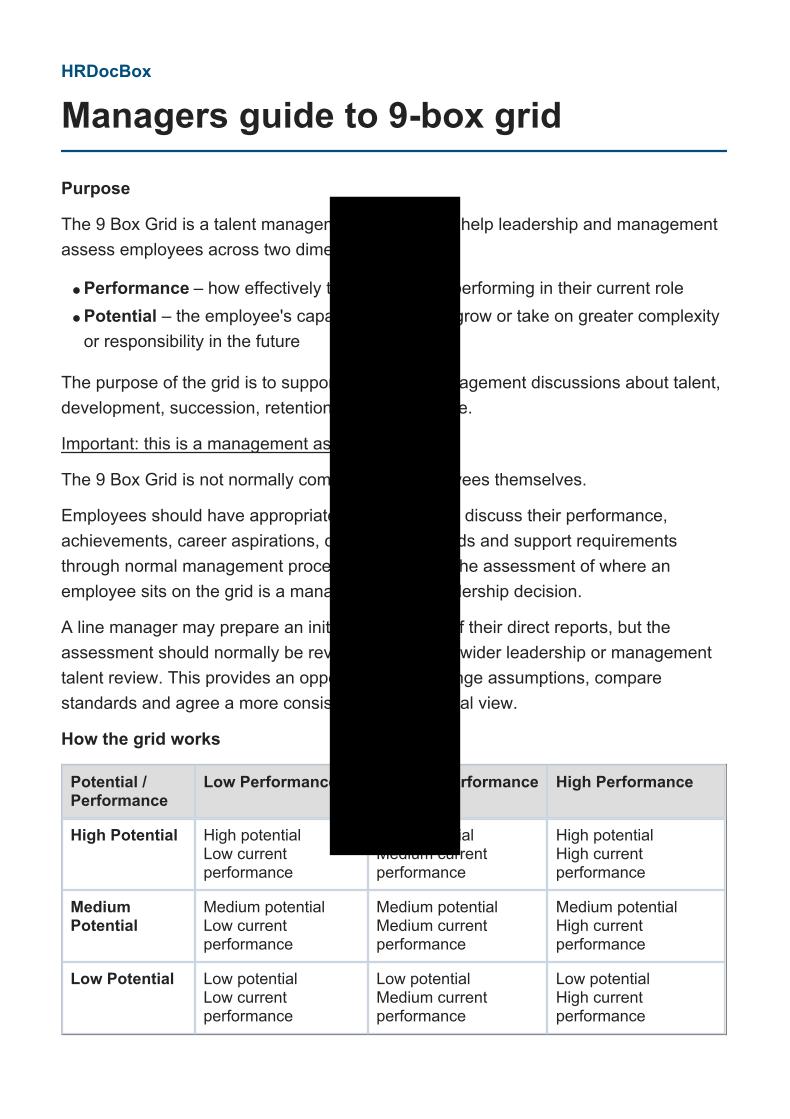
The 9 Box Grid is a talent management tool that places employees into one of nine categories by considering two separate factors: their current performance and their future potential. It is intended to help managers and leadership teams have more structured conversations about talent, development, succession and organisational capability.
Importantly, the 9 Box Grid is not normally completed by the employee themselves. The employee may contribute information about their achievements, career aspirations, development needs and experience, but the assessment and final placement are management decisions made through an agreed talent review process.
The horizontal axis normally represents current performance: how effectively the employee is performing in their current role against agreed objectives, responsibilities, behaviours and standards. The vertical axis represents potential: the employee's capacity to grow, develop or take on greater complexity or responsibility in the future.
A manager may prepare an initial view of their employees before the talent review, but the placement should be discussed and calibrated with other managers and leadership. This helps establish a common standard and challenges assumptions or overly subjective assessments.
Each box represents a combination of current performance and potential. A high performer is not automatically high potential, and an employee with high potential is not necessarily ready for promotion. Each combination requires a different management response.
The purpose of the exercise is not to create labels. The value comes from deciding what should happen next, such as development, coaching, stretch assignments, succession planning, retention activity, role clarification or performance support. The grid should therefore lead to specific actions with clear ownership and review dates.
9 Box placement should be treated as a current assessment rather than a permanent label. Performance and potential can change as employees develop, move roles, gain experience or receive additional support. Talent reviews should therefore be repeated at appropriate intervals.
Use the following as a practical framework for assessing the situation, considering the available options and deciding on the appropriate course of action. Follow each step in sequence to support consistent, informed and appropriate decision-making.
Understand the common mistakes to avoid when using this HR template, helping you reduce risk, prevent unnecessary costs and ensure the process is handled correctly.
The 9 Box Grid is normally completed by managers and leadership as part of a talent review. A line manager will usually prepare an initial assessment of their direct reports, but the final placement should ideally be discussed and calibrated with other relevant managers and leaders. Employees can contribute through normal performance and development discussions, but they do not normally decide which box they occupy.
This depends on the organisation's approach. If the organisation chooses to share the assessment, managers should explain it carefully and focus on the evidence, development opportunities and actions arising from it. Organisations should not use secret labels in a way that undermines trust or creates inappropriate management decisions.
No. Performance measures how well someone is performing in their current role. Potential considers their capacity to develop into more complex roles or responsibilities. Someone can be an excellent performer in their current role without wanting, or being suited to, a larger role.
No. Potential is not the same as immediate readiness for promotion. An employee may have strong potential but require further experience, development or exposure before being ready for a different role.
Yes. The grid should be treated as a snapshot rather than a permanent label. Performance and potential can change as an employee gains experience, receives development, changes roles or responds to support. Placements should therefore be reviewed periodically.
HRDocBox provides a structured UK HR document designed around the practical management process, including the purpose of the 9 Box Grid, leadership calibration, all nine categories and the actions that should follow each assessment. AI can generate descriptions, but it may not consistently distinguish between performance and potential or provide a complete, practical management framework.
How this content is developed and reviewed
The Managers guide to 9-box grid is developed using a practical HR methodology that considers current UK employment legislation, ACAS guidance, CIPD good practice and the real-world HR process it supports. Templates and supporting information are regularly reviewed and updated, with additional reviews triggered by significant changes to legislation, guidance or established HR practice, helping ensure each document remains practical, relevant and suitable for UK employers.
Darryl Horn, Chartered HR Director
Darryl is a Chartered HR professional with over 25 years' experience in senior HR and employee relations roles.
He has extensive practical experience of managing performance appraisal HR processes and founded hrdocbox to provide businesses with practical, professionally developed HR resources grounded in UK employment law and best practice.
HRDocBox has been creating practical UK HR documents since 2009.
"Darryl provides support and advice with excellent judgement, and has a strong understanding of people, policies and UK employment legislation."
"He is someone I trust; consistent, dependable, and committed to doing things properly."




















Whether you employ 5 people or 50, hrdocbox gives you the structure, documents and expertise needed to manage employees professionally and legally.
Professionally written and fully compliant with UK employment law
Access a free contract template instantly - or save 10% on any document today.
Use this code at checkout for 10% off anything!
Includes instant download, updates, and full access to your HR templates.