Libraries
780+ HR templates
Everything your business needs to stay compliant
Policies, contracts, letters, guidance and HR support tools for UK employers.
View full libraryPolicies, contracts, letters, guidance and HR support tools for UK employers.
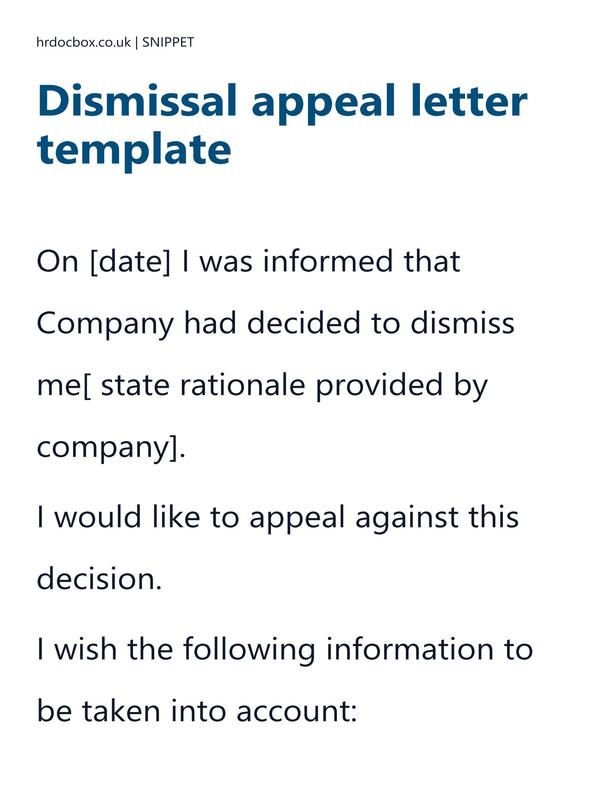
View full libraryChallenge a dismissal decision formally with a structured appeal letter that explains the grounds for appeal, identifies relevant evidence and requests a review of the employer's decision.
Use this template to:
<p>If you are managing employee dismissal, the toolkit brings together practical HR templates covering investigations, hearings, decisions, outcome letters and appeals.</p>
This template brings together the key information, sections and considerations you need to create a clear, comprehensive and professional HR document.
[Sender name]
[Sender address]
[date]
[Recipient name]
[Recipient address]
Dear [Recipient first name],
Formal Appeal Against Dismissal
Private and Confidential
I am writing to formally appeal against the decision to dismiss me from my position as [Job Title], as confirmed in the letter dated [Dismissal Letter Date]. I am submitting this appeal in accordance with the company's disciplinary and appeal procedure.
I do not believe the dismissal decision should stand for the reasons set out below. I ask that the decision is reviewed impartially, taking into account the grounds of appeal and the supporting information identified in this letter.
1. Grounds of appeal
Ground 1: [Brief description of the issue]
I believe the decision was incorrect or unfair because [explain the specific concern, including relevant events, dates or findings].
The information supporting this ground is [identify relevant documents, evidence, witness information or other details]. I believe this is relevant because [explain how it affects the findings or dismissal decision].
Ground 2: [Procedural concern, if applicable]
I believe there were concerns with the process followed because [explain the issue, such as an incomplete investigation, insufficient opportunity to respond, failure to consider relevant information or another procedural concern].
The impact of this issue was [explain how it may have affected the fairness or outcome of the decision].
Ground 3: [Evidence, mitigating circumstances or other concern, if applicable]
I would also ask the appeal manager to consider [describe any relevant mitigating circumstances, inconsistent treatment, new evidence or other matters]. This was not adequately considered in the original decision because [explain the reason, where applicable].
2. New or additional evidence
I would like the following additional information to be considered as part of my appeal:
[If applicable: This information was not provided or considered during the original process because [explain why]. I believe it is relevant to the appeal because [explain its significance].]
3. Concerns about the dismissal decision
Having considered the dismissal decision and the reasons provided, I believe the outcome should be reviewed because [summarise the principal reasons why the dismissal is being challenged].
I ask that the appeal manager considers whether the evidence supports the findings made, whether the procedure was followed appropriately, whether relevant circumstances were taken into account and whether dismissal was a reasonable outcome in the circumstances.
4. Outcome sought
I would like the employer to reconsider the dismissal decision and take account of the grounds and evidence set out in this letter.
My preferred outcome is [for example, that the dismissal is overturned and I am reinstated / that the decision is reconsidered following further investigation / that a different and appropriate outcome is considered].
5. Appeal hearing
Please confirm the arrangements for my appeal hearing, including the date, time, location and any documents that will be considered. I would like the opportunity to explain my grounds of appeal, respond to the matters raised and provide any relevant supporting information.
[If applicable: I intend to be accompanied at the appeal hearing by [Name], who is my [fellow worker / eligible trade union representative / trade union official].]
Please also let me know if any further information is required from me in advance of the hearing.
6. Closing
I ask that my appeal is considered fairly and impartially, in accordance with the company's procedure, and that I am informed of the outcome in writing.
Thank you for considering my appeal.
Yours [faithfully | sincerely],
[Sender name]
[Sender job title]
[Sender telephone]
[Sender email]
[For, and on behalf of [Company name] ]

A dismissal appeal letter allows an employee to formally challenge their employer's decision to terminate their employment. It should explain why the employee believes the decision should be reviewed and provide clear grounds supported by relevant facts, documents or other evidence. A well-structured appeal helps the employer understand the issues being raised and assess whether the original decision should be reconsidered.
Use this letter when an employee wishes to challenge a dismissal under the employer's disciplinary, capability or other applicable procedure. The grounds will depend on the circumstances and may include an inadequate investigation, an incorrect interpretation of evidence, an unreasonable decision, procedural errors, insufficient consideration of mitigating circumstances or relevant new evidence. Check the dismissal letter and company policy for the appeal deadline and submission arrangements.
Each ground should be clearly identified and supported by specific examples wherever possible. Rather than simply stating that the dismissal was unfair, explain what the employee believes was wrong, why it matters and what information supports the challenge. Where new evidence is available, identify it and explain why it was not provided or considered earlier, if relevant.
The letter should request an appeal hearing or review in accordance with the employer's procedure. Where possible, the appeal should be handled by a manager who has not previously been involved in the case. The employee should have an opportunity to explain their grounds and respond to relevant matters. They should also check the applicable arrangements for accompaniment at the appeal hearing.
The employee should explain what they are asking the employer to do, such as overturn the dismissal, reinstate them, substitute a different outcome or reconsider the decision after further investigation. The appropriate request will depend on the circumstances. The appeal should remain factual and professional, even where the employee strongly disagrees with the decision.
This template provides a starting point for a clear, focused appeal. It should be tailored to the actual dismissal, the evidence available and the employer's procedure. Where legal deadlines, discrimination, whistleblowing, automatically unfair dismissal or other complex issues may be involved, the employee may wish to seek independent advice promptly.
Related HR resources and workflow
Explore the HR resources that may be relevant before and / or after using the Dismissal appeal letter, helping you understand the wider process, maintain appropriate documentation and follow a consistent approach.

This Less Than Two Years' Service Dismissal Confirmation Letter provides a formal written record of an employer's decision to terminate employment where the employee has less than two years' continuous service.
If an ex-employee has appealed against their dismissal, issue this model letter template as invitation to an appeal hearing.
Use these best practice actions, recommended timescales and process stages to understand when and how the Dismissal appeal letter should be used, helping ensure each step is handled consistently and appropriately documented.
Understand the common mistakes to avoid when using this HR template, helping you reduce risk, prevent unnecessary costs and ensure the process is handled correctly.
Check your dismissal letter and employer's disciplinary procedure for the deadline. Submit the appeal as soon as possible and within the specified timeframe. If no deadline is stated, seek clarification promptly rather than assuming there is no time limit.
Possible grounds include an inadequate investigation, incorrect findings, procedural errors, an unreasonable outcome, inconsistent treatment, failure to consider mitigating circumstances or relevant new evidence. The grounds should reflect the actual circumstances of your case.
Yes. Employees have a statutory right to be accompanied at a disciplinary appeal hearing by a fellow worker, an eligible trade union representative or an official employed by a trade union. Check the employer's arrangements and notify them of your chosen companion.
If the appeal overturns the dismissal, you will usually be reinstated and treated as having remained continuously employed. The employer should confirm the practical arrangements, including any relevant pay and continuity-of-service matters.
An internal appeal does not necessarily pause or extend tribunal time limits. These depend on the claim and the relevant dates. Seek advice promptly if you may have a claim, and check the current ACAS Early Conciliation and tribunal requirements.
HRDocBox provides structured, customisable HR templates designed for UK workplace processes. AI can help organise your arguments, but the appeal must reflect the facts and evidence of your case. Consider independent employment advice where the dismissal has significant consequences or legal issues are involved.
How this content is developed and reviewed
The Dismissal appeal letter template is developed using a practical HR methodology that considers current UK employment legislation, ACAS guidance, CIPD good practice and the real-world HR process it supports. Templates and supporting information are regularly reviewed and updated, with additional reviews triggered by significant changes to legislation, guidance or established HR practice, helping ensure each document remains practical, relevant and suitable for UK employers.
Darryl Horn, Chartered HR Director
Darryl is a Chartered HR professional with over 25 years' experience in senior HR and employee relations roles.
He has extensive practical experience of managing dismissal HR processes and founded hrdocbox to provide businesses with practical, professionally developed HR resources grounded in UK employment law and best practice.
HRDocBox has been creating practical UK HR documents since 2009.
"Darryl provides support and advice with excellent judgement, and has a strong understanding of people, policies and UK employment legislation."
"He is someone I trust; consistent, dependable, and committed to doing things properly."




















Whether you employ 5 people or 50, hrdocbox gives you the structure, documents and expertise needed to manage employees professionally and legally.
Professionally written and fully compliant with UK employment law
Access a free contract template instantly - or save 10% on any document today.
Use this code at checkout for 10% off anything!
Includes instant download, updates, and full access to your HR templates.